 By admin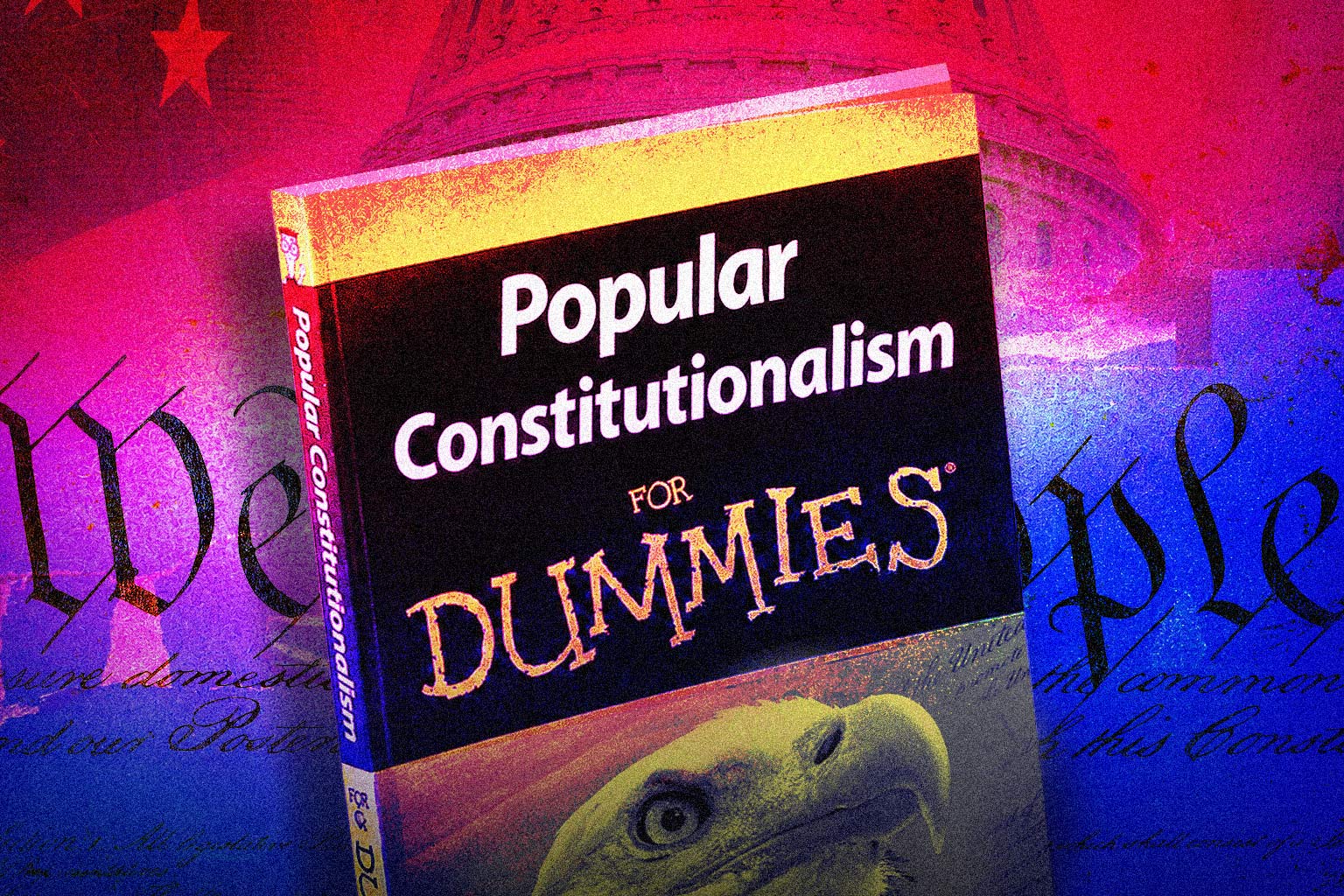
This is part of Amicus and Slate’s “By the People” series, which explores how the American people can reclaim the Constitution—and the law—from this monarchical Supreme Court.
Read more How the Supreme Court Swiped the Constitution From We the People
Supreme Court justices disagree about many things: whether the Constitution protects the right to abortion care, for example, or reifies your God-given right to carry a handgun, or empowers Donald Trump to commit crimes with impunity for so long as he remains president of the United States. Because the court is currently controlled by six Republican appointees, the answers to these questions have been (in order) no, of course, and almost certainly yes.
One thing about which the justices do not disagree, though, is that their institution alone holds the power to make these decisions in the first place. In its unanimous 1958 opinion in Cooper v. Aaron, the court described the federal judiciary’s “supreme” position “in the exposition of the law of the Constitution” as a “permanent and indispensable feature” of American governance. On its official website, the court advertises itself to visitors as the “final arbiter of the law,” and thus the Constitution’s “guardian and interpreter.”
This conception of the court’s role is both self-serving and an ambitious overstatement. By its terms, the Constitution is “ordained and established” by “the People,” who for most of this country’s history played a far more prominent role in the process of deciding what its promises mean. As the law professor Larry Kramer writes in his book The People Themselves: Popular Constitutionalism and Judicial Review, the Framers were not judicial supremacists; they were both familiar and comfortable with “improvising institutional and intellectual solutions to preserve popular control over the course of constitutional law,” irrespective of what nine life-tenured justices thought about the result.
Listen to the first episode of the Amicus podcast miniseries By the People here:
View Transcript
In Popular Constitutionalism, Kramer describes this tradition as one that “we seem to have lost, or surrendered, today.” The ascendance in the two decades since Popular Constitutionalism was published of a six-justice conservative supermajority whose members are intent on constitutionalizing a reactionary policy agenda is a pretty good reason for us—all 340-odd million of us—to do the work of reviving that lost inheritance.
A practical challenge presented by judicial supremacy, of course, is that the methods by which normal people can have a voice in the Constitution’s meaning are less obvious than the methods by which, say, Justice Brett Kavanaugh can do it. But they do exist, and none of them require you to spend a quarter-million dollars on a law school education first.
First, practice distinguishing between what the Constitution says and what judges and justices say about the Constitution, a document riddled with aspirational vagaries and flexible abstractions. Law professors and pundits often conflate these things, but they are not the same. Here, try it out with me: The prohibition on deprivations of “liberty” without “due process of law”? In the Constitution. The conclusion that this absolutely, positively does not cover the right to reproductive autonomy? Not in the Constitution! Just some stuff that Justice Samuel Alito thinks about it.
We can keep going. The existence of a “right” to “keep and bear Arms”? Also in the Constitution. Clarence Thomas’s conclusion that these words mean that modern gun safety laws must comport with America’s “historical tradition of firearm regulation,” as divined by judges whose knowledge of “history” boils down to what their clerks unearthed using ChatGPT? That is best understood as a suggestion, and you—an American who can lobby your representatives and campaign for sane gun regulations to try to keep your children safe in their schools—do not have to treat it as jurisprudential gospel just because a guy who wears pajamas to work said so.
Second, practice reading the words of the Constitution—the words actually in it, not the words Thomas and Alito wish were in it—and deciding what you think they mean. Your understanding of, for example, whether a law mandating the display of the Ten Commandments in every public school classroom in Texas is a “law respecting an establishment of religion” (a Constitutional no-no) is not less valid just because you are not a judge on the 5th Circuit. As President Franklin D. Roosevelt put it in a 1937 speech defending the New Deal against a hostile Supreme Court that had spent years hollowing it out, the Constitution is “a layman’s document, not a lawyer’s contract.”
Read more Does Trump Enjoy the Presidency?
Within a legal profession that venerates judges and worships the Supreme Court, this is borderline heresy. (Commoners having their own ideas? About constitutional law? Disgusting!) But the men (they were all men) who wrote the Constitution did not write for the appellate practice group leaders of D.C.’s most profitable law firms. They wrote For the People who consented to be governed by it, which includes you. Even if it were possible to divine exactly how the Framers would have wanted the establishment clause to apply to mandatory displays of the Ten Commandments, all of those people have been dead for centuries, and none of them were parents whose kids attended public schools in Texas. Public education as it exists today did not exist in 1791. For that matter, neither did Texas.
Third, whatever you decide about a given question, you need to talk about your answer with other people. Write a blog or a letter to the editor. Talk at a city council meeting. Picket an intersection and try to discern which honks express support for your position and which ones do not. If you want to bring back old-fashioned pamphleting, your nearest print shop will be delighted to help, just as soon as they get over their astonishment.
I understand that the Reconstruction Amendments might not feel like the most compelling discussion topic for happy hour. But slavery ended not because some brave judge declared it unconstitutional, but because the people’s representatives in Congress passed the 13th Amendment to make it so. As Kramer explains, the constitutionality of the Sedition Act of 1798, which criminalized many forms of criticism of the federal government, was “resolved” not by judges applying the First Amendment, but by a popular backlash to the Sedition Act that swept into office politicians who considered the law unconstitutional and allowed it to expire.
Right now, the legal marketplace of ideas is more or less the exclusive domain of judges, with occasional input from law professors who wish they were judges. Your participation in these conversations is the “popular” part of popular constitutionalism. (This is one of the rare circumstances in which posting online is actually praxis. Do not let it go to waste.)
To see what this might look like in the not-so-distant future: At the end of the court’s most recent term, four justices took the position that the Constitution does not protect birthright citizenship, and in a separate opinion, Justice Brett Kavanaugh suggested that (a Republican) Congress could abolish birthright citizenship by statute. If changes to the court’s personnel were to yield a five-justice majority willing to entertain Kavanaugh’s argument, a mass movement that rejects it will protect birthright citizenship much more effectively than a million op-eds by law professors explaining why he is wrong.
Finally, a court that has spent generations arrogating power to itself is not going to respond to a revival of popular constitutionalism with polite acquiescence. Returning the judiciary to its subordinate position will require Congress to act—to constrain the court’s jurisdiction, to add justices who understand their role, to impeach justices who stray outside of it, and so on. Politicians who promise meaningful change but do not support court reform are not repudiating judicial supremacy. They are proposing a slightly more palatable version of it.
Judicial supremacy reduces constitutional law to a spectator sport: Every season, nine justices play another round of games to decide who gets rights and who doesn’t. The premise of popular constitutionalism is that everyone else has a role to play in the process, too, that goes beyond white-knuckling it in the bleachers, waiting helplessly to see which team comes out on top. The Supreme Court can and does get the Constitution wrong, and We the People have the power to correct it. We just have to shake off a little rust first.
Read more It Could Always Be Worse—and That’s All Part of Trump’s Plan