 By admin
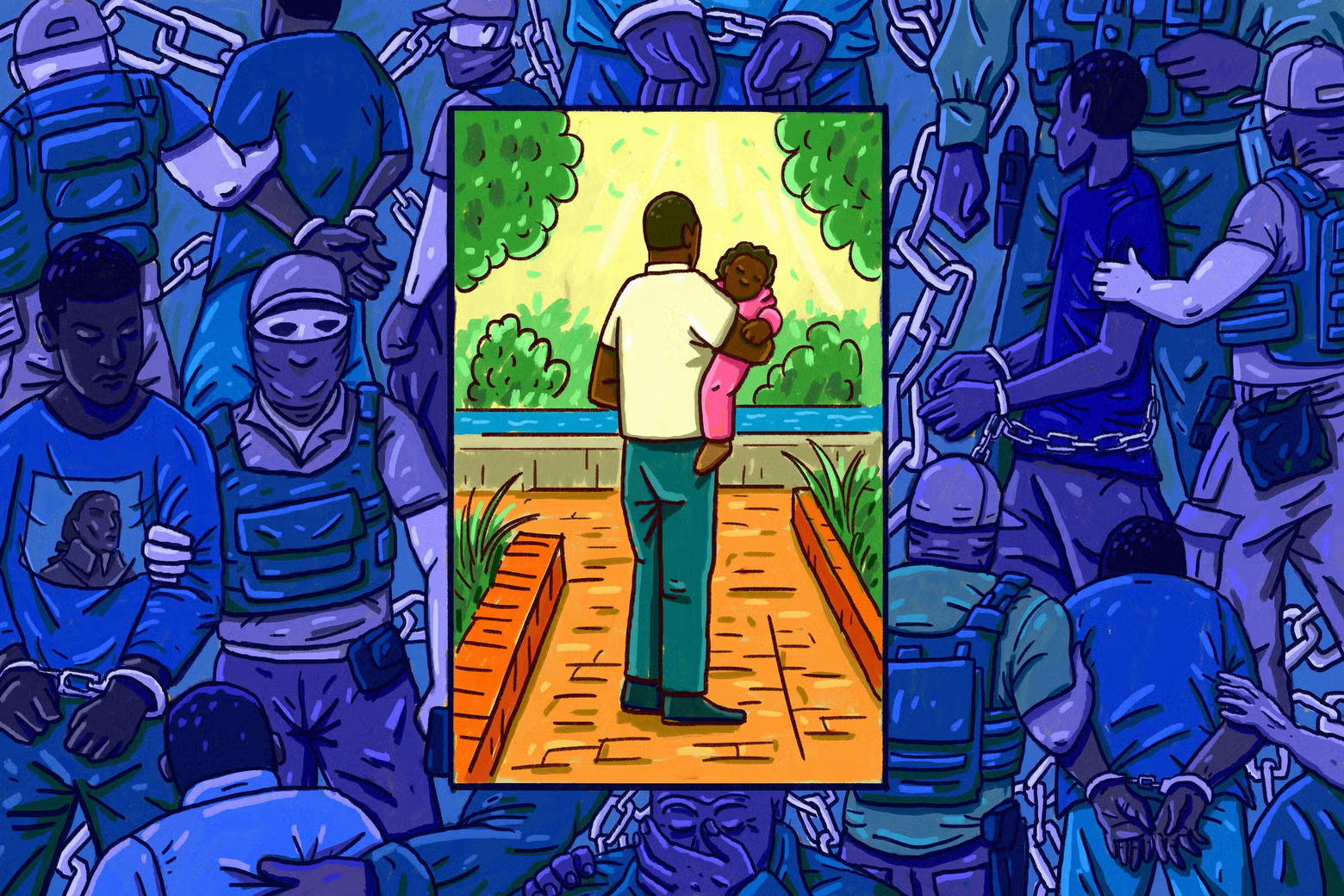
Part 1
The windows of the Haitian Support Center in Springfield, Ohio, were papered over from the inside, the blinds were drawn, the door locked, and the doorbell camera running. A volunteer guard stood watch from within, peering out into the parking lot, scanning for activity, opening the door just one body’s width to let people slide in, or out, as needed.
Read more Want to Help a Fascist? Start a Riot.
There were fewer people entering or leaving than there ever had been before. A lot fewer—at the HSC, at the St. Vincent de Paul on Raffensperger Avenue, everywhere. Some were trying not to be seen. Many were, in a word, disappearing.
Around a square formation of plastic folding tables sat about a dozen Haitian immigrants, still here, old women and men, young parents and children. Haitian Creole was spoken quietly, intermittently. In the corner of the room there were household items, food and water and diapers and paper towels.
Video from Slate
Nearly everyone sat in silence, looking down, eyes fixed on phones. Some were watching TikToks to pass the time. Others were scanning QR codes and filling out forms. “Now Hiring” flashed on one man’s screen as he scrolled. He stopped, and his finger hovered as he looked at the link. But on July 27, when the Department of Homeland Security revoked temporary protected status for the 300,000 Haitians living in the United States, it had canceled work permits, along with permission to live in the country legally. So he kept scrolling.
James Fleurijean, the center’s office assistant and interpreter, paced back and forth from the main room to his small side office, fielding questions. Fleurijean had initially come to Springfield enticed by a recruitment bonus from Amazon.
Almost nobody was allowed to work anymore, which meant they needed money for rent, food assistance, and more. Their driver’s licenses were no longer valid, so they needed transportation, and help getting kids to and from school. Basically everything. And even if they could work, or drive, or leave the house, there was fear of getting picked up by Immigration and Customs Enforcement, sent to detention centers, and deported to Haiti.
This afternoon was mostly about arranging rides, which departed Springfield every weekday morning. Some people had been summoned two hours away to ICE offices in Cincinnati, or Blue Ash, to submit to tracking devices. Some were summoned three hours away to court hearings in Cleveland, the date and time of which changed frequently. The penalty for missing a court date was automatic deportation, and there was always the risk that one might show up at an ICE facility and be arrested anyway, but still they showed up. Now letters had been arriving mandating children as young as 4 years old to report to ICE facilities to set up monitoring. “They don’t have a choice,” Fleurijean said. “They are compliant to the law.”
I sat in the plastic folding chair in the office, across from Fleurijean’s desk, where a few weeks prior, a 20-year-old named Pierre Damas Bel had sat, asking for help. Bel, who graduated from Springfield High in May, had been fitted with an ankle monitor just before his freshman year of college. Usually, those devices were saved for heads of households, and not appended to youths and minors. “He was very young to have it,” Fleurijean said. Bel had visited the ICE facility in Cincinnati multiple times, hoping to get it off, but had no luck.
Bel had agreed to talk to the New York Times about the situation, he told Fleurijean, which worried him. “He was so timid,” Fleurijean said. “We didn’t want to put a spotlight on him.”
Initially, Bel had planned to play soccer at nearby private Wittenberg University, but the ankle monitor had put a wrench in that, so he had swapped to public Wright State, with its ROTC program, where his immigration status had played at least some role in his being denied a uniform. He was despondent. “He told his father again and again that he was not coming back,” Fleurijean said. Did he mean to Haiti? Or school? Or Springfield?
And then Bel flung himself in front of a tractor trailer on Interstate 70, on Aug. 31, and died.
And so there was one extra thing to get straightened out this week: planning for his funeral, which was to be held the following weekend. “The whole community is devastated since then,” Fleurijean said.
As we spoke, another man in an ankle monitor came into the office. The monitors were becoming less common since Bel’s suicide, I was told. Now ICE had begun monitoring pregnant women via wrist monitors, and others via an app on the phone.
Where was everyone? All across Springfield, one of the largest Haitian populations in America, between 12,000 and 20,000 people, there were few signs of them. “It’s like the end of the world hits,” said Devon Hendricks, a content creator and videographer who has covered the Haitian population in Springfield for multiple years. “Like, where the fuck did all these people go?” It was not the first time Springfield had been depopulated: From the 1970s to the early 2010s, the city dwindled from over 80,000 to fewer than 60,000, a net loss of 20,000, owing to factory closures as the town deindustrialized. Now it was happening again.
One place they were: in jail. Haitian detentions in four Ohio jails had shot up more than 140 percent in the first five weeks since the end of their protected status, according to a report from the Ohio Immigrant Alliance. And so the nurses were absent from the area’s many nursing homes, and the third shifts at the auto parts manufacturing plants had basically gone dark.
All across town, they were behind drawn blinds and locked doors and padlocked gates. One auto repair shop, which its owner asked that I not identify, looked closed, though it was still open. They had pulled a truck around in front of the entrance, leaving just a few inches for the employees to slip in and out of the garage, invisible from the street.
“We have this truck blocking the entry—we’ve got to stay on our tippy-toes,” a mechanic named Denson, who started out at Amazon, told me. When the truck wasn’t there, they would draw the heavy metal gate closed and lock it, or else pay a scout to sit out front watching, relaying surveillance intel when needed.
Those changes were not precautionary. ICE agents had picked up a man leaving the shop a few weeks prior. “One of my customers,” Denson said. ICE had been patrolling the neighborhood, he told me, and when the man drove away from the shop with his vehicle fixed, there were five cars on him within a minute.
Read more What if Vivek Ramaswamy Ruins Everything—and I Mean Everything—for the GOP?
Hence the renovation. Not wanting to put their customers at risk, they’d begun towing people’s cars from their homes to the shop, and driving them back once the repairs were complete. “We’re doing it for free. I try to help,” Denson said.
But it was getting expensive. People were missing work, and had been delinquent on repairs, and late on bills, calling in favors everywhere, even for the essentials. There was no room to make up the towing costs with additional charges, because who had extra money to pay? Meanwhile, Denson told me, nearly everyone had converted all their money to cash, fearful that they could get locked up or deported at any moment, and lose access to checking accounts. “People don’t leave money in accounts anymore, which means that all the scheduled auto payments have ceased,” he said. “In six years in business, this has been the hardest for sure. The hole is getting deeper.
“We are waiting for the election,” Denson told me, though none of them could vote.
There were still flyers around the neighborhood celebrating the grand opening of the Lantern Bar, which had been scheduled for July 25. “Good Food. Good Drinks. Good Vibes,” they promised.
Two days later, the end of protected status for many Haitians became official.
“We opened on a Saturday,” said Keket, the Haitian woman who owned the bar, along with a restaurant nearby, and had spent nearly five years in a lengthy renovation. “And we had ICE on Monday.”
So they weren’t at the bar either. It had remained open, but there was little activity. That Friday night, only one patron came through, and so Keket closed early. There were not a lot of people coming, she said. “There are a lot of people leaving.”
Some went to Canada, though that was hard to pull off without immediate family already there. One went to Mexico. Those who had shown up to Springfield with money, or worked hard enough to buy into the town’s dilapidated housing stock, or founded their own businesses—those who had perhaps overinvested in their adopted community—were now tasked with the unenviable job of trying to sell. Maybe they were foolish for thinking that their protected status would last longer, even though immigrants from El Salvador have had TPS for 25 years thanks in part to an earthquake and gang violence, and Haiti had experienced worse versions of both of those, and more recently. In October, the Trump administration extended TPS for Sudanese and Ukrainian immigrants.
Some of the Haitians were already back on the island: some voluntarily, others deported. Part of the justification from the Trump administration for the withdrawal of TPS was that Haiti was safe enough to return to. But the Trump-run Federal Aviation Administration announced on Sept. 2, six weeks after ending protected status, that it was forbidding all American airlines from landing in Port-au-Prince for at least another six months, due to the risk of gang violence. Three separate commercial planes were shot trying to land in late 2024.
ICE deportation flights were being routed through the northern city of Cap-Haïtien, where planes could plausibly land without taking gunfire. Beyond that, there were no assurances. “I’ve heard stories that people are getting off the planes and literally sprinting down the runway for their lives,” said Carl Ruby, a pastor at the Central Christian Church of Springfield. Flight log data shows that ICE has now ramped up deportation flights to once a week: Every Thursday, a new planeful arrives.
“People are sleeping in the street,” said Fleurijean, of the Haitian Support Center. The gang violence was bad and everywhere, which meant that transportation between cities was dangerous, sometimes impossible. The Trump administration had publicized a pledge of $2,600 to anyone who voluntarily deports, which had turned into a bounty: Gangs expected recently returned Haitians to have thousands in cash on hand, minimum, and sought them out accordingly. At least 47 people were killed in one gang massacre in the town of Kenscoff in late August.
Fleurijean told me the people he’d spoken to had gotten the equivalent of only $65, and were now stuck in a city filling up with people after each flight. “They are living like hell down there.” Ruby had heard stories even worse. One of his parishioners recently told him that his brother had been burned alive by gangs.
Another place people weren’t: at the Southern Village Shopping Center. On Sunday nights, in the past, the mall could be rowdy. There was a Haitian barbershop, and a clothing store run by Haitians, a Christian church with French signage, a restaurant, and a car wash. All of them were closed but the restaurant and the clothing store, which now no one entered anyway. Cars rumbled into the parking lot, jostled by potholes, but nearly everyone went into the Dollar General. A small group gathered out front, smoking cigarettes in front of the Bureau of Motor Vehicles building, none of them Haitian. A purple news rack in front of the Dollar General advertised: Free Naloxone.
For a while, Keket Bongou restaurant, owned by the same Keket as the Lantern Bar, had been closed for ICE activity. But it couldn’t stay closed forever. It was dimly lit, and no one was dining inside. I sat out front through the whole dinner service. From 6:30 to 7:30, one man picked up a large to-go order; a woman came in for a small to-go order; a third man took an order to go. And that was it.
I went inside and spoke to a man named Lourdy, who was sitting in a booth. He wasn’t working per se, just helping out Keket, a friend. “Weekends used to be really good,” he said. “Now it’s dead.” For days, he said, he had seen ICE out in front of the restaurant, chasing people around the parking lot, though they weren’t here now. DHS Secretary Markwayne Mullin said that immigration authorities arrested 380 people in Springfield in raids beginning in mid-August. One employee of a nearby store, forbidden from speaking to the press by her employer, guessed she’d seen 30 people taken from the area around this shopping mall alone.
When would ICE come back? everyone wondered. When would the customers?
Haitian life was disappearing in Springfield.
“If I get that letter to go in for an ankle monitor, then they have you. I’ll just buy my ticket back to Haiti,” Lourdy told me, a place he hadn’t been since 2006. “I’m not scared.” Then he changed his mind. “Because of the gangs, I am scared. Because they can kill you anytime, anywhere, they control the government.”
Then, near 8 p.m., an older, white couple entered the restaurant. Lourdy got up and brought them menus.
Read more The DOJ Just Telegraphed Trump’s Biggest Election Target
Part II on Wednesday.