 By admin
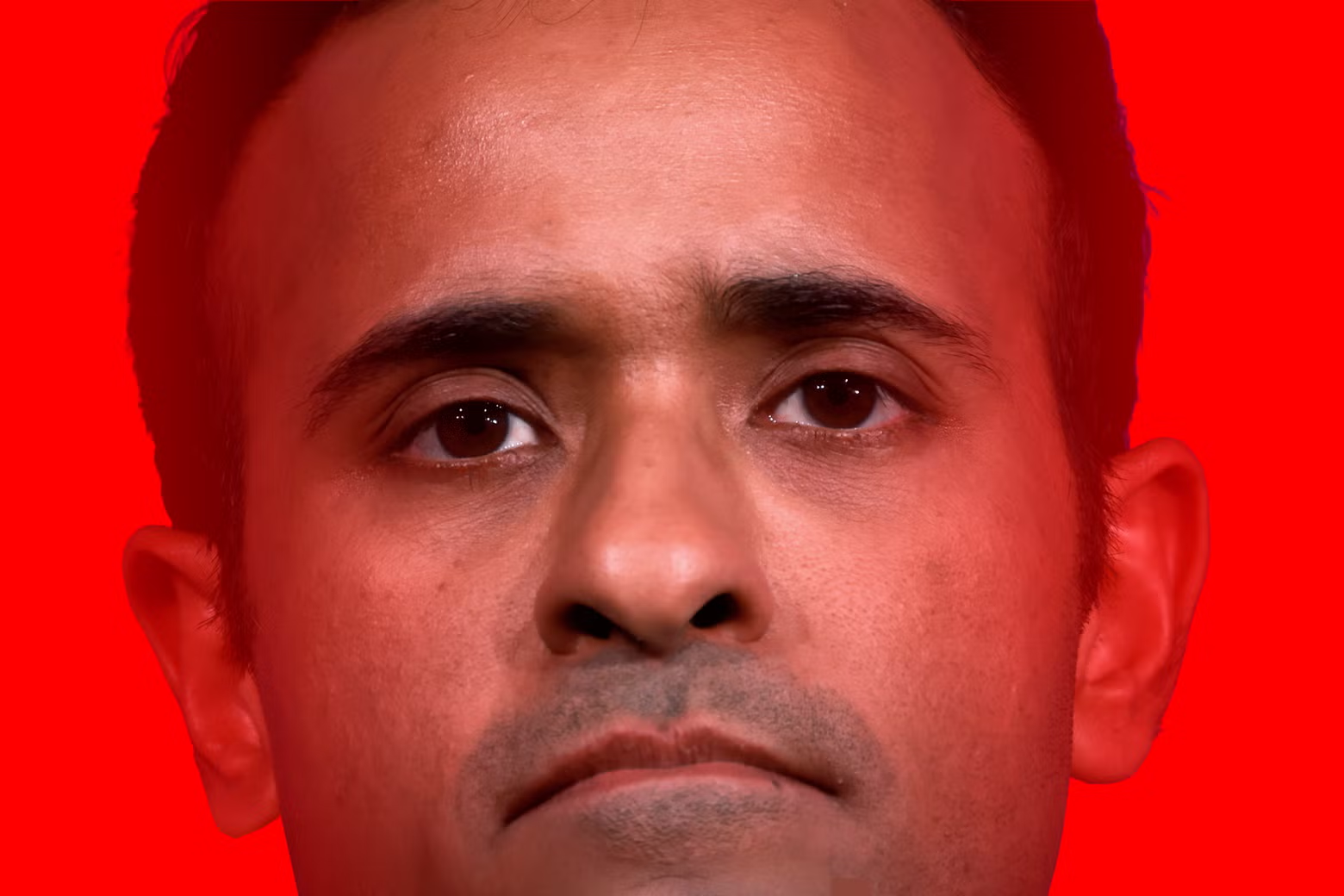
The mood at the Vivek Ramaswamy rally was upbeat—confident, even—but the cracks started to show before it began.
Read more These Two Supreme Court Justices Will Do Anything for Trump—We Just Got the Proof
The town hall in the small Cleveland suburb of Parma was entitled “Pierogis, Pabst, and Patriots,” and there were plenty of all three on hand at the Union House Bar and Restaurant. But we weren’t really supposed to be here. We were supposed to have convened at the Cleveland Harley-Davidson outpost for a “Christians, Bikers & Patriots” campaign event, before a sudden cancellation necessitated a shift to this woodsy sports joint. There was no word on what had gone wrong with the bikers.
Still, the energy was real in this crimson-tinged bar, bustling with elderly Ohioans in OSU jerseys and MAGA merch alongside watery tubs of PBR. (Among the T-shirts: a red-ink outline of Charlie Kirk raising his fist, and a Trump-Vance shirt where the year was crossed out and replaced, in Sharpie, with 2028.) Alfred, a 60-year-old Filipino immigrant who was raised in Shaker Heights and works in the Parma public school system, told me he didn’t think, whatever the national narrative, that too many of his fellow conservatives were disaffected with Donald Trump or the current Republican Party. He loved the way Immigration and Customs Enforcement was operating, and anyway, as devout Catholics, he and his wife would never vote for a pro-choice Democrat like Amy Acton—Ramaswamy’s opponent in the bitter race for the Ohio governor’s mansion. Others I spoke to were similarly unbothered. Mark, a retired Air Force technician sitting at the bar, was planning on attending church that very evening and claimed to be far more concerned about property taxes than Ramaswamy’s Hinduism, one of the many issues that may work against the candidate in this very Christian state. To him, Ramaswamy’s religious objectors were just “morons who say stupid shit.”
Video from Slate
Once the actual event kicked off, however, even the speakers couldn’t help but strike notes of concern. “If you choose not to decide in this election, you are supporting a cast of characters that wants to take our state in a fundamentally dangerous direction,” said Secretary of State Frank LaRosa, invoking Rush’s “Freewill” as he opened for the guest of honor and promoted his own campaign for state auditor. “The Democrats are feelin’ chippy,” he warned. “But there will be no blue wave. There will be a bright-red Ramaswamy tsunami!”
Ramaswamy finally took the stump to raucous applause and harped on his finely honed campaign planks—improving public schools, reducing property taxes and everyday costs, welcoming legal immigrants—while firing some culture-war drive-bys at the evils of “wokeism” and “transgenderism.” Former Ohio Treasurer Josh Mandel subsequently took the mic and felt the need to emphasize Ramaswamy’s devotion to God. “I’ve been with Vivek at churches all over the state. There’s this band of Christian warriors who are following and supporting Vivek because he supports them,” Mandel stressed.
The sentiment proved to be a bellwether for the audience Q&A. An answer Ramaswamy gave condemning sanctuary cities wasn’t enough for a hoarse-voiced attendee who repeatedly interrupted: “Damned immigrants are hurtin’ everybody! We gotta get all of ’em out of here!”
Ramaswamy stumbled for a moment, responding that legal immigrants were still cool, which failed to satisfy the heckler. “All of ’em!” the attendee yelled. “Send in the military!”
Not long after, a separate dissident followed up, skipping over the queue to ask, twice, “Do you believe Jesus is God?”
“Sir, we’re going to ask you to be respectful,” Ramaswamy replied.
“It’s a simple question!” the old man yelled back.
“We don’t reward those who are just screaming for attention,” Ramaswamy replied, turning away from the troublemaker. The supportive crowd handed another microphone to a Republican-voting teacher who’d earlier objected to one of Ramaswamy’s screeds about the current state of education in the state, and asked a question about his commitment to ensuring that all Ohio kids, including those with disabilities, learn to read. Here, despite the criticism, the candidate sounded a warmer note.
“We’ll be respectful to anyone who has a tough question,” Ramaswamy declared. “If I can’t stand up here and answer a tough question, then I have no business running the state.”
The problem for him is that there are nothing but tough questions, and he may not have good answers for many of them. If you believe the polls, it seems clear that Ramaswamy—a Cincinnati-born disciple of the MAGA political school, biotechentrepreneur, and one-time Republican presidential candidate—could be the first Ohio Republican to lose a gubernatorial bid in 20 years. The once swingy Buckeye State has only reddened further since Donald Trump flipped it in his first presidential bid, and the MAGA movement’s heir apparent, Vice President J.D. Vance, famously hails from here. Yet this could be the state where Ramaswamy, who once pitched himself as a younger and more capable Trump, ends up buckling to Acton, a doctor and first-time candidate who led Ohio’s Department of Health in the early days of its COVID response. There are a lot of reasons for this: He’s a pro–data center billionaire running for office at a moment when even Republican super PAC ads are pillorying billionaires and data centers. His Harvard-and-Yale pedigree and debate-me-bro verbosity make him come off more like a snob than a man of the people. He gets heckled a lot, even amid ostensibly friendly crowds. The social media posts where he does try to present himself as down-to-earth are frequently subjected to viral mockery. He doesn’t seem to be able to activate Republicans in a year when Buckeye Dems are actually motivated to hit the polls. The messages from his campaign, and from his well-funded supporters, have taken some incredibly vicious tacks—including, most recently and notoriously, an ad featuring the support of Acton’s estranged mother, who stayed married to a man whom the Democrat accused of sexually abusing her as a child.
And then, most obviously of all: Ramaswamy is a dark-skinned Hindu with a lengthy (and self-admittedly “funny-sounding”) last name who’s vying to be the standard-bearer of a party whose members increasingly present themselves as anti-Indian, anti-Hindu warriors for the Christian white identity project.
In Ohio, I was trying to surmise just how much Ramaswamy’s ethnicity and religion were helping usher in his political demise in this GOP. What I saw surprised me. There were scenes like the one at the rally, where some Republicans’ anti-immigrant, pro–Christian America rhetoric played out more familiarly. But among Ramaswamy’s fellow South Asians, a demographic that votes broadly Democratic but has drifted a touch rightward in recent cycles, there is also widespread doubt and suspicion—inconvenient for a campaign that needs every vote it can find. The community ties and social connections that Ramaswamy and his family have established across Cincinnati and Columbus could be helpful, in theory. But for many of his would-be constituents, the question is what those connections mean when the candidate has embraced a movement that sees them as the enemy. If you want to understand why Ramaswamy seems on course for a historic crashout in Ohio, those voters are a good place to start.
In 2024, Amjad Baig, a real estate agent based in the Columbus suburbs, joined an unusual coalition of Americans in making a counterintuitive choice: He voted for Donald Trump.
Baig, who supported Hillary Clinton in 2016 and organized a Pakistanis for Biden group in 2020, considers himself a fervent patriot. After emigrating from Lahore to the United States in the early 2000s and settling in the Ohio town of Dublin, the 54-year-old father of four got involved with its burgeoning South Asian blocs, eventually becoming president of the local Community Association of Pakistani Americans, and partnering frequently with the Ohio branch of the Federation of Indian Associations. I met him in September for dinner at Neehee’s, a regional Indian chain, where he recounted his Trump-era political journey.
“Joe Biden should have resigned earlier. Six months before the election, they decided Kamala Harris would run as a candidate. There was no primary,” he said. “We could have had a better candidate. So I encouraged people in my network to vote against Harris.” They weren’t hard to persuade, Baig added: Many South Asian Ohioans were already angered by the Biden administration’s indifference toward the atrocities in Gaza, and partial to Trump’s publicly professed skepticism of Middle Eastern wars.
That’s not quite how things have turned out two years later. Israel is still bombing Gaza, despite the ostensible ceasefire with Hamas; the war in Iran and its price shocks continue, hitting everything from fuel to food; Trump 2.0 is persecuting immigrants far more thoroughly, and aggressively, than even in his first term. The normally independent-minded South Asians across Ohio’s cities, Baig told me, are so furious that they’re again ready to vote against an Indian American candidate, just to hold Trump to account, even though many of them liked Ramaswamy when he first emerged on the scene.
This western stretch of the Columbus metropolitan area, the fastest-growing and most economically vibrant region in the Buckeye State, is not coincidentally home to its largest South Asian populations. Twenty years ago, as Baig related to me, the Noor Islamic Cultural Center had opened its doors in Dublin, welcoming the burgeoning South Asian American groups who had settled in and around the state’s capital. About a 15-minute drive away stands Ohio’s oldest Hindu temple, founded by white Hare Krishna disciples, now home to hundreds of worshippers of Indian origin. The Noor’s opening similarly attracted an influx of Ohioans with family roots in Pakistan, Bangladesh, and Afghanistan. It’s a collective of freethinking, independent, educated constituents who, across their respective backgrounds and countries of origin, have a lot of thoughts about the fact that one of their own is running to become governor of their state.
As Ohio State University professor Pranav Jani has written, Ramaswamy may be “skinfolk, but so not our kinfolk.” Unfortunately for the campaign, there are many others who feel this way.
“This is a country I need to protect, which is harder to do these days,” Baig told me. He was distressed about quite a few matters: the economic burdens facing Ohio’s small-business owners, national and local restrictions on the voting process, state-level efforts undermining the local hemp industry. Yet one matter was paramount: the attacks on first-generation immigrants like himself.
“We’re scared,” he added. “Just being an immigrant, you’re a target, thanks to ICE and all these bigots who’ve been given permission by Donald Trump. Vivek is going to follow what the Republicans say, and they’re so anti-immigrant now that that’s where he’ll land.”
Shabana Siddiqi, a conservative-leaning but, she said, nonpartisan retired physician who’d appreciated Ramaswamy’s presidential campaign for foregrounding his family background and opposing transgender education in schools, sounded nothing less than contemptuous of him now. “Racism is so common here, especially for Pakistanis and Indians. Vivek is brown, and we are all citizens with the same rights, but he doesn’t care about that,” she said. “I’ve met with Amy. She listens to us. She feels our pain. And I don’t think these Republicans understand, they’re losing a large chunk of votes the way they’re going.”
Read more There’s a 100 Percent Chance These Polls Are Fake
Aziz Taqdeer, an Afghan immigrant and social worker who’s lived in the United States since 2015, told me he’s hitting the polls for the first time ever because of his concerns around the Trump administration’s immigration crackdowns. “Over the past three years, it’s become impossible to get by. I’ve never been more worried,” Taqdeer said. “I know people who’ve been detained by ICE, and it does something horrible to your mental health, to know these agents can come for you at any time.” Also weighing on Taqdeer’s mind: inflation, his children, the driver who yelled at him the other day to “go back to your country,” and the ongoing betrayal of the many Afghans he knew who assisted U.S. forces against the Taliban.
Across differences in politics and identity, South Asians I spoke with around Columbus also shared the same affordability concerns acutely felt by Americans everywhere. As Baig reminded me, “Many of us are small-business owners, independent workers, homeowners, so we’re even more greatly squeezed by all these rising bills.”
Kashif Mehmood, a fossil-fuel engineer who voted for incumbent Republican Gov. Mike DeWine in 2022, said he will now be voting Democratic across the ballot in large part because of inflation. “I’m right in the center, not on the extreme left or right—I vote for whoever is good for the country,” Mehmood said. “Right now, the war and the economy are in such a horrible place. It’s making things harder for all us.”
Rajnikanth Katte, a Hindu Indian immigrant who serves as chairman of the Federation of Indian Associations in Ohio, agreed with this diagnosis and suspected that Democrats would win, even as he proudly displayed to me a photo of himself standing with LaRose, the secretary of state, at a recent federation event. “So many people are struggling and hurting right now,” Katte said. “I’m always in favor of whoever can help us make incremental improvements—whoever it is, whether that’s a Democrat or a Republican, I’ll support them.”
This will be the first election in Ohio’s history in which neither of the major-party gubernatorial candidates is Christian. (If she wins, Acton will be the first Jewish governor.) The large majority of Ohioans are Christian, and a quarter of them identify squarely as evangelical. Hindu, Jewish, and Muslim Buckeyes each make up 1 percent of the population, while nearly 30 percent of the state professes no religious affiliation, according to the Pew Research Center. White evangelicals still retain influence in Ohio, and they’ve made clear they do not love either of the choices they have in this race.
Throughout the year, Ramaswamy has been dogged by a resurfaced clip from his presidential run in which he tells an Iowa voter that Jesus is a son of God, not the son. That comment earned an early-year denunciation from Cincinnati pastor Michael Clary, who scoffed at the idea that “Vishnu worshipers could hold public office” and tweeted that he’d vote for Ramaswamy’s main opponent in the Republican gubernatorial primary: Casey Putsch, a car mechanic who also attacked Ramaswamy over his Hindu faith and invited the candidate to play “Cowboys and Indians” in a campaign ad where he fired off his rifle. After Putsch lost, Christian nationalist preacher Joel Webbon begged on his podcast for Republicans to stay home and send a message to the GOP that its base doesn’t want “polytheistic, demon-worshiping, cow-worshiping, bare-feet, scamming anchor baby Indians” in office.
Many Christian Ohioans don’t believe that Ramaswamy’s Hinduism is disqualifying—though that’s not to say they think anyone of any other faith should hold office, whatever the Constitution may say about religious freedom. Philip Coon, a retired industrial salesman who lives west of Dayton, is a MAGA Christian who thinks “Trump’s going to hell” and needs to “shut his mouth,” though that doesn’t depress his political support. “I’m hiring Trump to run the country, not to be my pastor,” Coon told me. “It’s the same thing with Vivek: I’m hiring him to run the state. I wish he was Christian, but he’s not.” Still, that openness does have a limit. “At my steel company, I dealt with Muslims, I dealt with Indians, and I got along with all of them. I hope they were legal, because I loved them,” he told me. “But I’m anti-Islam as far as this: I don’t think Muslims should get in our government because that’s bad news. I do believe the Antichrist is going to be Muslim.”
Others have been even more direct. A Chester-based preacher named John Young has repeatedly posted his “Ohio Must Stand on Godly Principles” essay below multiple Ramaswamy campaign Facebook posts, writing that he cannot support either contender because “our allegiance belongs first to Jesus Christ, not to a political party.” (Others tend to parrot that sentiment on Instagram whenever Ramaswamy shares a photo from a religious function.) When Baptist preacher and state Rep. Gary Click invited Ramaswamy to his church for a town hall, he ended up engaging in petty social media battles with followers who claimed they “never thought I would ever see a Baptist minister support a Hindu for Governor.” Younger Republicans deeply attached to the idea of America as a Christian nation appear little interested in seeking kinship with a millennial who doesn’t share their particular bent, no matter how MAGA he may otherwise be.
“I had students who went to a Turning Point rally in April, out of interest, and the report I heard was that there were very few other young folks at the event,” Benjamin McKean, an associate professor of political theory at Ohio State University, told me. “I have students who are excited about Vivek and Trump. But they’re cognizant of the fact that most students do not share their enthusiasm. It’s hard to compete with a frat party or whatever if the alternative is to go hear Vivek talk about why he still supports Israel.”
The one promising sign for Ramaswamy this election is that the older, whiter retirees of faith who showed up with such enthusiasm in Parma tend to be the most reliable voters around. And there are religious leaders loudly making it known they’ll vote for him, if reluctantly. “I would prefer to have a Christian on the ballot for governor in Ohio this year,” wrote Crossroads Baptist Church pastor Neal Daryan in a letter to the Columbus Dispatch. “Vivek Ramaswamy holds my Christian values, and I’m voting for him.”
Still, for anyone remaining on the fence, it might not help that some of the pastors who’ve put their support behind Ramaswamy are steeped in controversy. Jeff Tauring, a preacher who helped host the Parma event I attended, is notorious for leading a congregation that once protested outside a Jewish Democratic lawmaker’s house in 2022 with a banner commanding the legislator to “kneel before the cross.” In August, just before Ramaswamy spoke at a Middletown church, its pastor dismissed the possibility of hosting a similar event with Amy Acton, because “you wouldn’t ask a Muslim church to host a pork festival, would you?”
Acton is most likely to gain the support of religious minorities, along with more-liberal Christians and unaffiliated voters, if they’re fired up to vote against Ramaswamy. (So far, early voting numbers suggest they are.) That, of course, includes the very Hindus whose beliefs Ramaswamy so frequently invokes. Meanwhile, the Republicans of faith who voted for Putsch’s bigoted campaign could follow his lead in refusing to endorse the man who beat him. The depressed MAGA turnout is what’s most worrying Ramaswamy’s running mate, state Senate President Rob McColley. “We have three opponents right now in this race: We have Amy Acton, we have the national political environment, and then we have complacency,” McColley told a group of Republicans in the spring. “I would argue the third opponent is the most dangerous opponent we possibly have.”
One thing that Amjad Baig, the 2024 Trump voter and community organizer, kept making clear to me is that in everyday life, he’s not a partisan, and he prefers it that way. He owns multiple Teslas, and neither Elon Musk’s white supremacist turn nor his massive donations on behalf of Ramaswamy’s campaign will get Baig to join liberals’ Tesla boycotts. (His Dublin neighborhood is, incidentally, located next to a Tesla collision center.) He counts a few local GOP operatives, including volunteers for the Ramaswamy campaign, among his personal friends. He even found Ramaswamy to be an interesting guy, back when he was making waves in the 2023 GOP field.
But Baig also does like Amy Acton, whom he’s met multiple times. He’s likewise realistic about what he’ll be voting for when he votes for her. “Acton is very genuine and very liberal,” he said. “But the only reason she will win is because people don’t want Vivek.”
That can go multiple ways. People don’t want Vivek, meaning onetime GOP voters are fed up and sticking it to the party. People don’t want Vivek, meaning strict Christians don’t want a Hindu in office. People don’t want Vivek, meaning they think immigrants and their citizen-by-birth children are ruining America. In Ohio, I saw all versions in action. (His campaign did not respond to my requests for comment for this piece, and members of the press were not allowed to ask any questions of the candidate at the Parma town hall.)
This week, the outcry over the campaign ad with Acton’s mother has especially intensified, reminding the wider country of its aversion to Ramaswamy. (The already-unpopular president, who has defended the ad and reportedly told the candidate to “say thank you, God” for the get, might not be helping.) I’ve been thinking about what Shabana Siddiqi, the retired physician, told me in Dublin: that Acton “listens” and “feels our pain” when it comes to the horrors that immigrants and South Asians have faced during Trump’s second term. There was nothing like that forward-facing sense of understanding or empathy when she first encountered Ramaswamy during his presidential run. And from the viewpoint of her community, Acton was hardly the person all those Ramaswamy campaign ads alleged her to be: a drug and alcohol addict who championed such far-reaching stay-at-home pandemic orders during her Health Department tenure that she left countless Ohioans scarred.
“This negative campaigning is so ugly,” Siddiqi said. “All these ads are just against the other person. You don’t know who they are, or what they believe.” At least, until she met Acton for herself and made her own judgment.
So, yes, Ramaswamy’s Hindu faith may not be welcomed by many of Ohio’s Christians. But even among Ohio’s South Asians, of all beliefs, Ramaswamy’s entreaties to that dogma simply do not jibe with his actual conduct as a candidate, from his alignment with an intolerant political movement to his willingness to indulge in constant, personal attacks on his opponent.
Sudarshan Pyakurel, a Columbus resident and Hindu Bhutanese refugee, wrote a column for the Columbus Dispatch back in January where he called out Ramaswamy over that. “Many Hindu families in Ohio live with fear—fear of ICE raids, profiling based on accent or appearance and the constant anxiety of family separation,” Pyakurel wrote. “In such a moment, a public figure who claims Hindu values but offers only rhetoric and silence does not represent us.”
A lot of people don’t want Vivek. That may include a lot of intolerant Ohioans—but it will also, pointedly, include his own skinfolk.
Read more The Amy Acton Ad Came From One of the Darkest Corners of Today’s GOP