 By admin
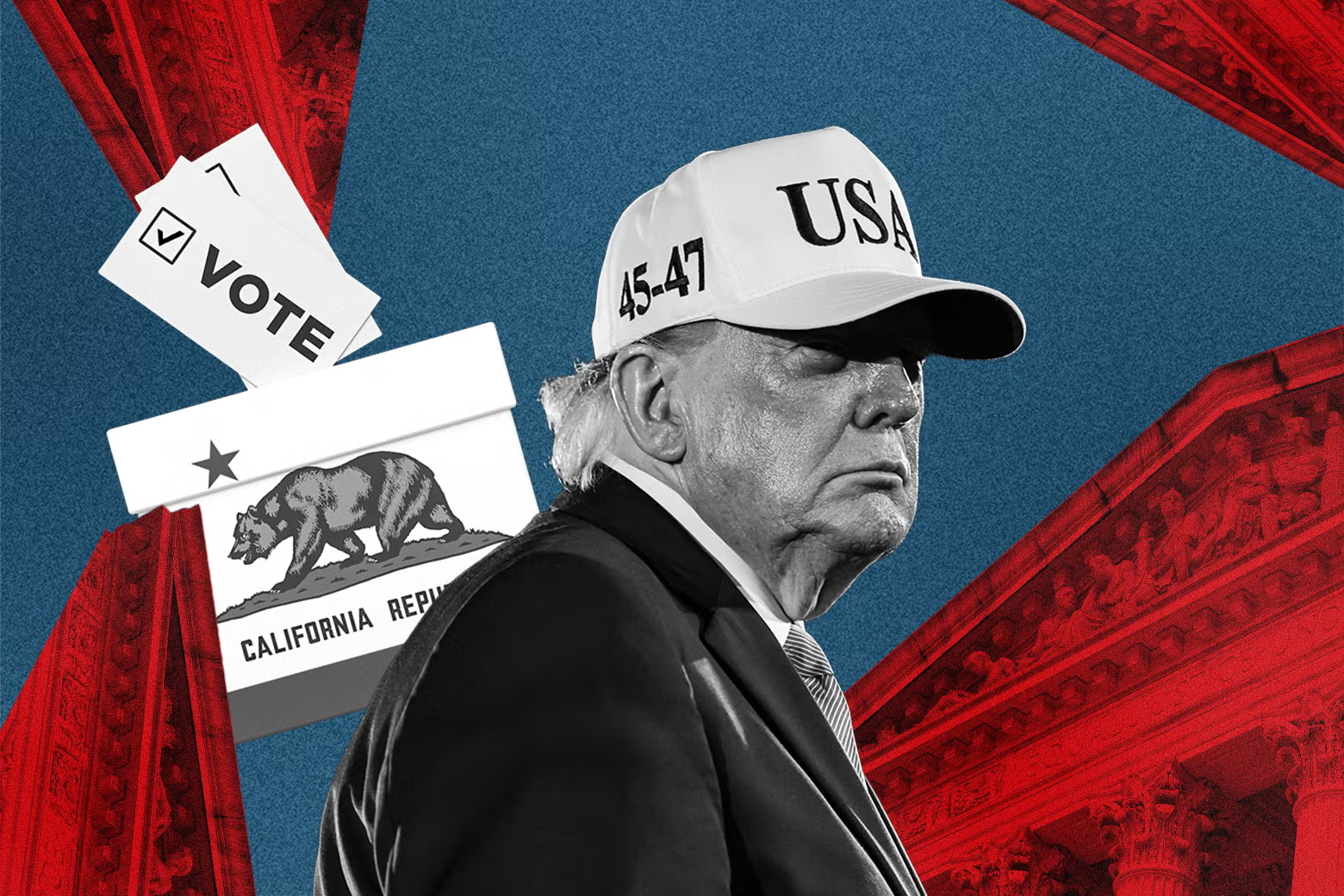
This is Executive Dysfunction, a newsletter that highlights one under-the-radar story about how Trump is changing the law—or how the law is pushing back—and keeps you posted on the latest from Slate’s Jurisprudence team. Click here to receive it in your inbox each week.
Read more The Trump Administration Is Promoting the “Good Guy With a Gun” Lie at Just the Right Time
With the midterm elections now just days away, it’s becoming clearer how the Trump administration plans to handle a potential blue wave that could destroy the president’s control of Congress for the remainder of his term. A key plank in this emerging strategy involves the most populous Democratic state in the country: California. The Department of Justice unveiled not one but two federal lawsuits over the past week that target the state’s elections, seeking the removal of countless voters from the rolls despite long-standing federal law that bans states from removing any voter within 90 days of a federal election. The trumped-up lawsuits make a showy attempt to go after a minuscule number of voters out of California’s whopping 23 million registered voters, but more importantly, the lawsuits conveniently lay the groundwork for a post-election legal fight—if things don’t go the president’s way.
Video from Slate
California being the Trump administration’s target should come as no surprise. Outgoing Gov. Gavin Newsom has been a constant critic of President Donald Trump. California is also the only Democrat-controlled state that successfully countered Trump’s mid-decade redistricting push, with voters there overwhelmingly passing a proposition to adopt new voting maps that could net up to five new Democrat-leaning House seats. The Trump administration unsuccessfully tried to convince the Supreme Court to ban California from using its new maps because they were “tainted by an unconstitutional racial gerrymander.” Clearly still salty about that matter, among others, the administration seems to have been cooking up a new way to attack California.
Over the summer, Homeland Security sent California’s Secretary of State Shirley Weber a letter alleging that nearly 200,000 registered voters in California might be noncitizens (numerous secretaries of state received similar letters). But the letters included allegations alone, no evidence or data verifying DHS’s claims, which Weber said she flagged and asked to see, to no avail. Fast-forward to Oct. 13, when Weber, along with Los Angeles County Registrar-Recorder and County Clerk Dean Logan received another letter, this time from the DOJ—three weeks before Election Day—asking them to review a list of over 20,000 individuals suspected of being noncitizens who were sent a vote-by-mail ballot for the November election.
DOJ wanted both Weber and Logan to direct election officials across the state to “segregate” submitted ballots from voters whose citizenship could not “immediately be verified,” refrain from sending ballots to any more people on its list of 20,000 suspected noncitizens “until we confirm their citizenship status,” and “if a ballot for any individual on the list has been returned, instruct the appropriate elections official to not verify the signature and/or tabulate the ballot until citizenship can be determined.”
Weber and Logan were given approximately 48 hours to respond to the DOJ’s letter. And like clockwork, on Oct. 15 the DOJ filed a lawsuit asking a judge to issue a restraining order to prevent California election officials from processing ballots for any individual on its list of purported noncitizen voters. Never mind the fact that asking California to remove even a single name from its voter rolls at this point is a direct violation of the National Voter Registration Act, which established a 90-day “quiet period” before an election. This provision is meant to prevent states from doing exactly what the Trump administration is asking for: mass removals of voters too close to a federal election, which can cause confusion and prevent voters from fixing any registration issues with enough time left to cast their ballots.
Weber called this out in responding to the DOJ’s Oct. 13 letter. She cited the NVRA and the unlawful ask being put on her and election officials across California. “With less than three weeks before the election, you are demanding unprecedented measures that threaten thousands of Californians’ right to vote, based on unverifiable information or methodology that you still fail to explain or provide,” . Weber also went after DOJ’s list of 20,000 purported noncitizens registered to vote in California, reiterating that she requested the underlying data and methodology months ago in order to attempt to verify the federal government’s claims. As it stands, the DOJ’s list effectively failed to “be of any investigative use.”
On Tuesday, a Los Angeles County election official responded in court to the DOJ’s lawsuit. She called the DOJ’s demands potentially “catastrophic” and said they could end up halting all ballot counting, in person or by mail. She also revealed that election officials looked at a sample of 200 people on the federal government’s list and found that about 43 percent of them had a voter registration canceled, 71 percent had never actually cast a ballot, and nearly 40 percent indicated they were in fact U.S. citizens.
This would not be the first time the Trump administration’s alleged noncitizen voting lists were found to be inaccurate. Last month, the Trump administration admitted that a list of nearly 16,000 purported noncitizen voters it flagged for Nevada election officials was wholly inaccurate. After Nevada Deputy Attorney General Greg D. Ott attempted to verify DHS’s claims, he found that every single person on DHS’s list was actually a lawful U.S. citizen. And since Trump retook the presidency, his DOJ has sued 30 states and D.C. to get access to their unredacted voter rolls. Twenty-six of those lawsuits were dismissed by federal judges, half of whom were appointed by Republican presidents, including by Trump himself.
None of this matters to the Trump administration because its goal isn’t actually to weed out voter fraud, but to accomplish two things. First, these efforts seed doubt in America’s electoral process that could convince some voters to distrust the system to the point where they won’t bother casting a ballot. Second, these sham lawsuits give the administration a foothold in the courtroom in the event that a state’s election results are not satisfactory to Trump. Now, the DOJ and losing Republican candidates have a legal record to pull on to claim fraud and challenge state election results.
Rick Hasen, law professor at UCLA and director of the Safeguarding Democracy Project, described this approach in a recent post on his Election Law Blog. Though Hasen expects the DOJ’s lawsuit against California “to go nowhere” in a court of law, he believes “this is a political document, potentially laying the groundwork for Trump to claim that the election results are illegitimate because California has not done enough to deal with noncitizen voting.”
To put a finer point on this, the DOJ this week announced a second lawsuit against 28 Californians for election crimes. They’re each being accused of making false statements in their naturalization applications—those applications ask whether applicants previously registered to vote or claimed U.S. citizenship. A number of these folks, though, do not appear to have actually voted, and some registered to vote more than 20 years ago, likely by accident. “Twenty-eight out of 23 million registered voters in California is just … a drop in the bucket numerically,” California Attorney General Rob Bonta said. “It’s 0.0001 percent of all the registered voters, and it makes the point that there is no widespread voter fraud.”
Read more The Midterms Are in 13 Days, So of Course Trump Is Picking a Fight With His Own Party
Research backs this up, with one study finding that when noncitizen voting and registration does happen, it’s usually due to bureaucratic error and not intentional. For instance, just this year New Jersey revealed that its Motor Vehicle Commission improperly registered about 6,600 noncitizens to vote back in 2023, but fewer than 400 of them actually cast ballots between 2023 and 2024.
The Supreme Court has a hand in all of this, after it effectively emboldened the administration to pursue these types of lawsuits through an opinion issued just a month ago in DHS v. League of Women Voters. In a 6–3 decision, the justices have allowed the federal government to use an expanded federal database, known as the Systematic Alien Verification for Entitlements, to identify noncitizen voting in states’ voter rolls.
What can be done now? Well, Americans are the only ones who carry the power of the vote, and right now they can control when they cast their ballots. As Joyce Vance, former U.S. attorney for the Northern District of Alabama, emphasized, “this is the time to vote early.” It will be far more difficult for the Trump administration to challenge election results with ballots submitted weeks ahead of Election Day, especially when races have a large margin of victory. And that’s only possible with strong voter turnout.
We hope you learned a thing or two from this edition of Executive Dysfunction, and if you enjoyed reading it, please consider supporting our legal journalism by becoming a Slate Plus member!
Elsewhere in Jurisprudence
-
In this week’s episode of Amicus, Dahlia Lithwick talks about the raid of Minnesota Rep. Ilhan Omar’s D.C. home with Andrew Weissmann, former chief of the Fraud Section at the Department of Justice. The Justice Department is attempting to build a denaturalization case against Omar, a particularly cruel new low for the president.
-
Catch up on Slate’s “By the People” finale, in which Dahlia was joined by Stacey Abrams, Ilyse Hogue, and Daphna Renan for a live conversation about popular constitutionalism. They offered clear and concrete steps for reclaiming the U.S. Constitution, while also answering questions about court expansion and term limits.
-
Slate is hosting another live event: Will the Midterms Be a Trick or a Treat? On Thursday, Oct. 29, our politics team will weigh whether a “blue tsunami” is actually coming, and whether it will have consequences for Trump, or whether all this talk is simply a phantom apparition. Register for this conversation to save your spot!
-
Friend of Slate Madiba K. Dennie explains Salazar v. Paramount, an online privacy case the Supreme Court heard oral arguments for last week. It revolves around the Video Privacy Protection Act, and the court’s Republican-nominated justices seemed to suggest corporations should be insulated from legal liability when they intrude on consumers’ privacy for profit.
-
The Supreme Court is considering how judges around the country handle criminal sentencing, and there is one justice who is particularly well equipped to hear this case: Justice Ketanji Brown Jackson. As Alexis Romero explains in Slate, she was previously the vice chair of the U.S. Sentencing Commission, but during oral arguments her fellow Republican-appointed justices seemed to disagree with her takes at every turn.
-
The fourth installment of Frank Bowman’s “Try, Try Again?” series in Slate argues that President Trump can be impeached for authorizing the lethal boat strikes last year in the Caribbean and Eastern Pacific. U.S. experts have since concluded that the strikes were unlawful, while the United Nations also found the strikes to be illegal and that they could constitute “crimes against humanity.”
Thank you for reading Executive Dysfunction! We’re thrilled to be in your feeds and will be back with more dysfunction analysis next week.
Read more The Supreme Court Is Poised to Undo a Basic Trans Right That Has Been in Place for Three Decades

Get the best of news and politics
Sign up for Slate’s evening newsletter.