 By admin
With less than two weeks to go before the midterms, the tale is the same as it has been all fall: It’s hard to find anything going Republicans’ way. Look around. While the GOP’s super PACs continue flooding Senate races in red states like Texas, Ohio, Kansas, and Iowa with ads, Senate Democrats’ super PAC is investing in Mississippi. In the House, Republican election groups are retreating from lost causes to defend core seats.
Read more Trump Is Making One More Play to Screw With the Midterms
But as Democrats put away House districts and Senate races in states like Georgia and North Carolina, one race is swimming curiously against the tide.
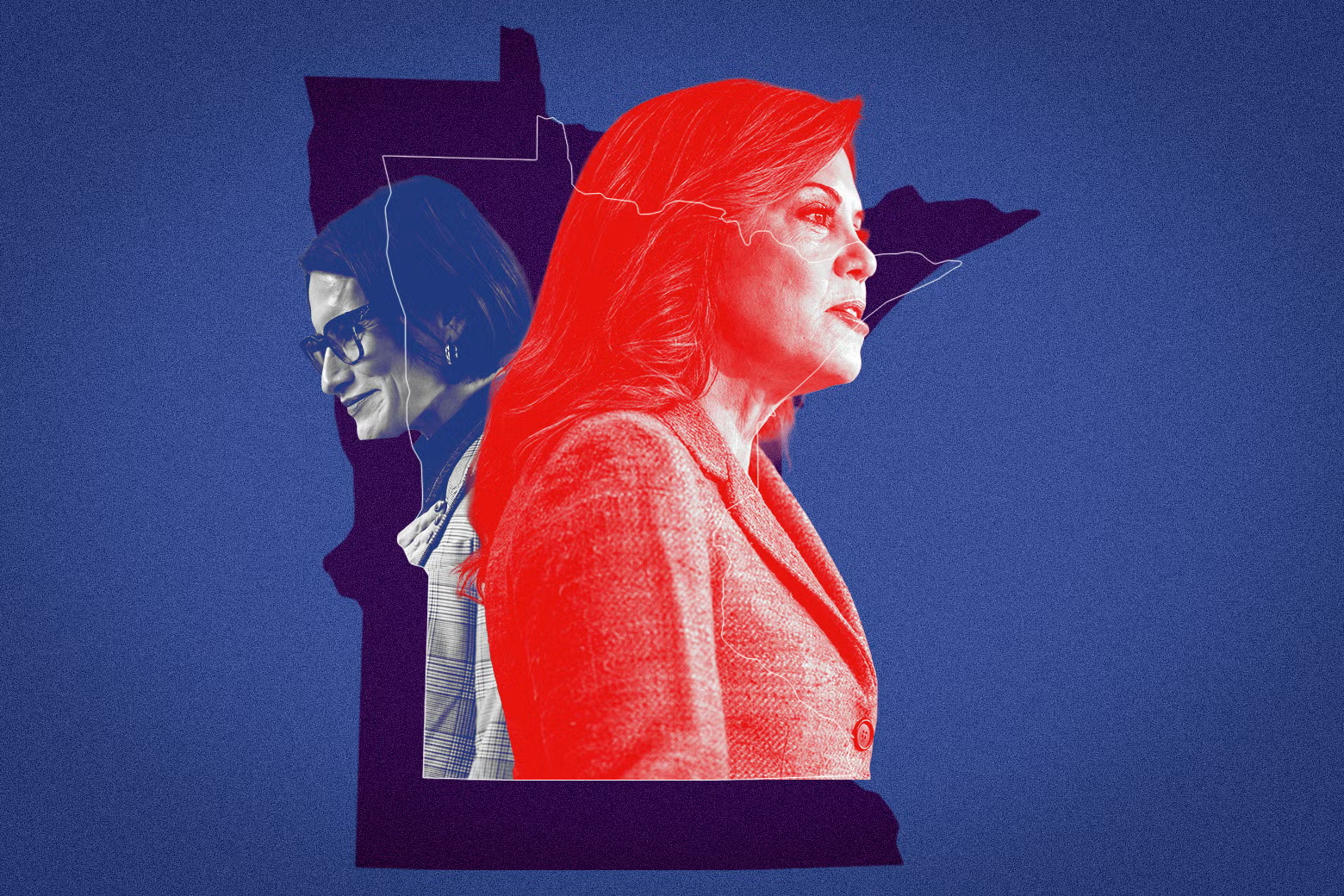
On the same day that the election handicappers at the Cook Political Report shifted their rating of the Mississippi and South Carolina Senate races in Democrats’ favor, and fellow forecasters at Sabato’s Crystal Ball moved dozens of House races Democrats’ way, Cook made another change. It moved the Minnesota Senate race, a contest between Democratic Lt. Gov. Peggy Flanagan and Republican former sports reporter Michele Tafoya, from “Likely Democrat” to “Lean Democrat.” Crystal Ball had made a similar decision the previous week. In other words, forecasters believe Flanagan is still the favorite, but not by much.
Video from Slate
What’s going on here? Why, in a great environment for Democrats, and in a consistently blue state like Minnesota, is this race looking like a squeaker?
It’s not the same as New Hampshire, Democrats’ other misbehaving light-blue state that should be a shoo-in this year but somehow isn’t. In the Granite State, Republicans are running a former senator from the state’s Republican royal family, and Republican outside groups invested substantially, and early, in that race. Senate Republicans’ main super PAC, meanwhile, hasn’t put any money behind Tafoya’s bid; each candidate’s campaign has spent a civilized couple-million dollars each. And it’s not that Minnesota is a runaway train trending redder demographically. It’s dominated by the Twin Cities, and has a high percentage of adults with college degrees, the dividing line on which so much of Trump-era political realignment hinges.
Instead, Democrats’ inability to pull away in this race is a matter of candidate quality, and seismic news stories from Minnesota that garnered immense national attention.
It’s not that Flanagan, an energetic progressive who harnessed anti-D.C. energy to win her primary over the more moderate Rep. Angie Craig, is a dunderhead. But Flanagan—like other progressive-wing nominees such as Abdul El-Sayed in Michigan and Troy Jackson in Maine—is clawing tooth and nail to get over the finish line even in this ideal Democratic environment while more moderate candidates like Roy Cooper in North Carolina and Jon Ossoff in Georgia have effectively put their races away. If the energy brought by progressive candidates is outweighing the softness they might have with the median voter, that’s not being picked up in polling.
Tafoya, meanwhile, was mocked by many upon her entry to the race, as former Sunday Night Football sideline reporters don’t have substantial governing backgrounds. What former Sunday Night Football sideline reporters do have, though, is vast name recognition and an ability to speak well on TV. A lack of a substantial governing background has its advantages, too, as it allows her to draw up positions from scratch. She’s described herself as a “pro-choice Republican” (a posture that abortion rights advocates argue is not entirely on the level), has not had to take any votes on the Iran war, and has pledged to “stand up” to Trump when he’s wrong.
What sets the race apart, aside from positions here or there, though, is that Tafoya, more than the average 2026 Republican in Trump’s America, has a lot of offensive material to work with. Flanagan is lieutenant to Gov. Tim Walz, who presided over a state welfare fraud scandal of such magnitude that it ended his bid for a third term. Tafoya has made this her central line of attack, arguing that Flanagan should be held accountable for the failures of the administration.
“My opponent has been second in command in this state for eight years, drawing a taxpayer-funded paycheck,” Tafoya, in one of her many hits on Flanagan over the issue, said in a recent debate. “And what do we have to show for that? We have massive fraud, historic fraud. We have test scores down. We have crime spiking. We have a massive surplus turned into a deficit.”
Read more The Trump Administration Is Promoting the “Good Guy With a Gun” Lie at Just the Right Time
Flanagan’s defense, meanwhile, is that the social services agencies responsible for being defrauded were outside her portfolio, and that the blame rests with Walz. “The governor’s been very clear that the buck stops with him,” Flanagan said during the debate, positioning the governor under the bus. “He was the one who had oversight here.”
Were that scandal to have been the last substantial national news story to explode out of Minnesota over the last year, Flanagan could be in even worse trouble. But it was the uncovering of those fraud scandals, along with its concentration of perpetrators within Minnesota’s Somali community, that egged the Trump administration into launching Operation Metro Surge, an assault on the Twin Cities from immigration enforcement authorities. That operation led to the deaths of two protesters under Immigration and Customs Enforcement agents’ heavy-handed tactics and turned the tide in both Minnesota and the nation against the administration’s mass deportation agenda.
It’s the legacy of Operation Metro Surge that will make it so challenging for Tafoya to turn the race into a true toss-up before Election Day. Trump’s heavy-handedness is not just an abstraction for Minnesota Democrats. They’ve battled it in their streets. If Tafoya’s task of hammering the welfare scandal is simple, Flanagan’s task—bringing up Trump, and the need to stop him—is simpler.
Earlier in the year, after she announced her candidacy, Tafoya said that she would be “honored” to have Trump’s endorsement, that she would “happily take” it. Trump has since become historically unpopular, and for a long time, she kept her distance. Just last week, though, Trump finally endorsed her, telling a crowd in Youngstown, Ohio (?), that “you have to vote for Michele Tafoya, who is a very respected person.” Trump said this with the briefest of pauses between “Michele” and “Tafoya,” as if he remembered in the moment that it might not be helpful to endorse her.
“I should say it,” he concluded anyway.
Tafoya’s reaction to the endorsement was telling. “I heard about that,” she said when asked about it. “Look, this campaign is about bringing all Minnesotans together, whether they voted for President Trump or whether they voted for Kamala Harris.” She was similarly evasive when asked during the debate about whether she would appear with Trump should he campaign in Minnesota—something he has threatened to do—twice giving responses that weren’t even in the ballpark of answering the question.
The RealClearPolitics polling average has Flanagan up 2 points over Tafoya at the moment, while an internal poll released by Senate Democrats’ super PAC, the Senate Majority PAC, at the beginning of the month showed her up by 8 points. Whatever it is, the same forecasters who are moving the race in Republicans’ direction “still believe the national environment will lift Flanagan to victory,” as the Cook Political Report’s Jessica Taylor put it.
It’s possible that the polls are way off, that Minnesota will fall in line with a result closer to what you’d expect, and that Flanagan wins in a walk. It’s just strange that we don’t know, particularly when, in much swingier states, Democrats have already seemingly clinched victory.
If the race is that tight, though, it’s a reminder that no “wave” election is ever uniform. Candidates matter, and state-specific issues matter. Weird things happen. In 2014, in an environment where Republicans won their largest House majority since the 1920s while picking up governor’s races in Maryland, Illinois, and Massachusetts, Democrats knocked off the incumbent GOP governor of Pennsylvania by 10 points. In 2018, when Democrats picked up 40 seats in the House, they lost a Florida Senate seat (and governor’s race) before the state had fully calcified into its present redness. There’s a not-unrealistic scenario in which Democrats win the Texas and Minnesota Senate seats by the same margin—or, if the polls are underestimating Republicans, lose them by the same margin.
Read more The Midterms Are in 13 Days, So of Course Trump Is Picking a Fight With His Own Party

Get the best of news and politics
Sign up for Slate’s evening newsletter.