 By admin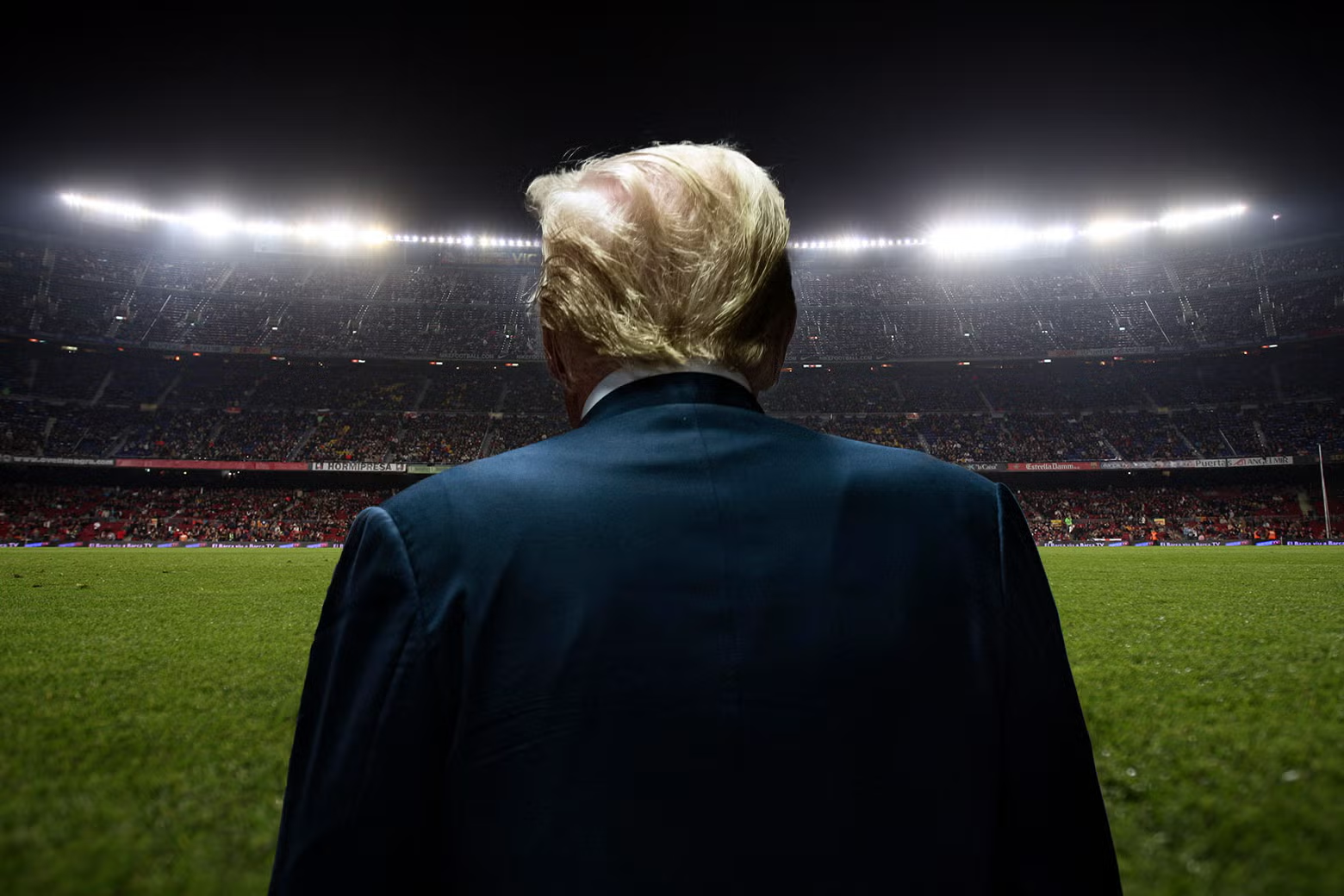
The best games of my life had no crowd.
A field in Chile, the dirt gone to red mud in the rain. A pitch in Cambodia where the turf was just the part of the ground with the least gravel. Voices in four languages that weren’t needed, because the language we spoke was the game: the give-and-go, the look that means I’m here, I’ve got you. A few families in the stands, if there were bleachers at all. No cameras, no money. We kept our own scoreboard. I have played far from any crowd, for nothing, since I was small, and I have never felt more alive, more part of something, than in those games the world never saw and only we remember.
Read more What’s Going On in Donald Trump’s Brain as He’s Turning 80? He’s Given Us Some Clues.
I think about that whenever a strongman tries to own what we had on those fields.
There is a moment in soccer that must be felt. The ball is moving and you are moving and three teammates are moving, and the pass arrives in the only patch of grass where it could land, and you are already there because you knew—because 11 bodies have briefly become one nervous system, one act of collective faith. You cannot command that moment into being. You cannot buy it. You cannot fake it for the cameras. It emerges from trust: the willingness to run into empty space believing someone will find you there. The beauty arrives not when someone imposes his will but when many minds converge on the same possibility. It is, at heart, a cooperative act—a republic the size of a field.
The autocrat is drawn to the power of the game, and misses where it comes from.
Strongmen have coveted this game for nearly as long as the World Cup has existed, attempting to bend a sport that belongs to everyone into the glorification of one man. The spectacle, they could stage. The belonging, none of them could ever seize. This summer, Trump waits in Row 1.
In 1934, Benito Mussolini hosted the second World Cup and invented what we now call sportswashing. He had pressured FIFA to bring the tournament to fascist Italy, then set about making sure it ended the way he needed. The night before a brutal semifinal, Mussolini reportedly dined with the Swedish referee—who went on to officiate the final too. And when the Italian Azzurri lifted the trophy in Rome, a second trophy waited for them: the Coppa del Duce, commissioned by Mussolini, six times the size of the real one.
A dictator who built himself a trophy six times bigger than the actual prize.
Mussolini was hardly alone. Argentina’s military junta hosted the 1978 World Cup while political prisoners were tortured within a mile of the stadium where the final was played, the cheering audible through the walls of the cells. Qatar spent a reported $200 billion turning the 2022 tournament into a monument to itself, built by migrant workers, hundreds of whom died. FIFA’s own secretary general once said so outright: “Less democracy is sometimes better for organizing a World Cup.” The names change. The impulse remains.
We tell ourselves sportswashing fails. Often enough, it works. Mussolini got his images of triumphant fascism. The junta got its month of flag-draped distraction. Qatar got the most-watched tournament in history, despite years of scrutiny over the workers who built it. The spectacle delivers. It buys prestige, photographs, the roar that drowns out everything the host would rather you not hear.
Read more Trump Brain
What it cannot buy is the thing it is reaching for: genuine belonging—millions choosing to gather around something larger than themselves. That is the real prize, and it evaporates the instant one man tries to seize it all.
Now the tournament comes home to America. Like Mussolini, Donald Trump wants what no rally can give him: the look of a whole world freely gathered—around him. It is one thing he cannot command, and he tries anyway. In December, FIFA awarded him its first-ever Peace Prize. The photograph shows him in the Oval Office, holding a giant replica of a World Cup final ticket—Row 1, Seat 1—Gianni Infantino beaming at his elbow. The Coppa del Duce, more than 90 years on, comes shaped like a golden ticket.
That is the contest. It’s not between nations, but between two ideas of what a crowd is for. To the autocrat, the crowd is a backdrop for his own face, applause engineered to flatter him. To everyone else, the crowd is the point: the immigrant kid, the muddy field, the strangers who become one thing for 90 minutes. Soccer has always belonged to the second kind of crowd. It is the most popular game on earth because it asks for nothing but a ball and other people, and rewards what the strongman cannot abide: cooperation, trust, the surrender of the self.
The autocrat will take his seat in Row 1. He will hold up his golden ticket and believe, as Mussolini believed, that the spectacle belongs to him.
It never has. The game belongs to the ones playing in the rain, for nothing—running into open space, trusting they’ll be found.
Read more All That Glitters