 By admin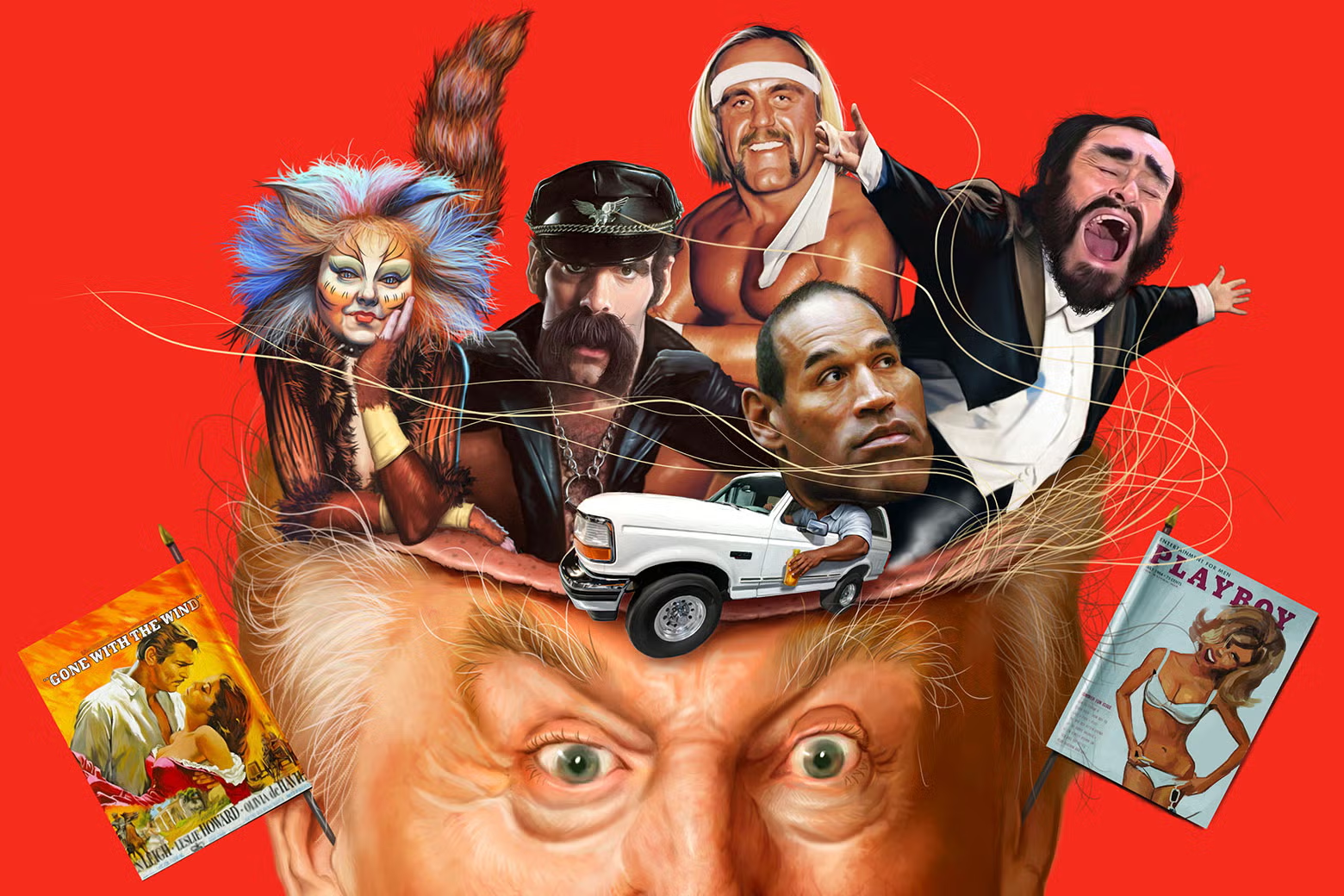
This is the year the first baby boomers—those born in 1946—turn 80, and that cohort includes Donald Trump. (His big day is June 14.) We have all recently lived through what it means to have an 80-year-old commander in chief, but at a political moment that’s simultaneously more horrific, erratic, and just plain befuddling than anything this country has seen in ages, we wanted to understand the brain of this 80-year-old president. Plenty of people are trying to discern whether his recent rants and raves are due to a more serious cognitive decline—we understand the instinct; we’ve done it too—but we went a different (if related) route. We’ve cataloged the cultural artifacts of the past that Donald Trump can’t stop bringing up at the strangest moments. You know—Rosie O’Donnell. Gone With the Wind. Hannibal Lecter. The song “Y.M.C.A.”
Read more All That Glitters
The more we dug into Trump’s many fixations, the more we realized that this man still thinks he lives in the 1980s. We also discovered—without too much surprise—that he often seems to fundamentally misunderstand the works he treasures most deeply. These items might not replace a brain map, but they do create a certain holistic view of what animates and splinters Trump’s mind. Sometimes, they just help explain his worldview. Other times, they seem to have had real influence on policy and the America that Trump is trying to create. Welcome to Trump Brain, the 25 things that define who the president is—and what he wants.
A.I. SLop videos
What era this is from: Current
The generation that will relate to it the most: … Boomers?
How well Trump understands the thing he is obsessed with: 10/10
When millions of people took to the streets in October to protest Trump’s authoritarianism, the president responded by dunking on his critics online. Specifically, he posted an A.I.-generated video of a fighter jet, piloted by himself in a literal crown, dropping human excrement onto the crowds.
It was perhaps Trump’s most juvenile use of A.I. slop yet—the kind of low-quality, feverish content made possible by artificial intelligence. (Think of posts of elderly identical twins asking Facebook users for birthday wishes, for example, or videos of women smashing glass bridges with rocks.) But it wasn’t his first. Trump undoubtedly is the perfect president for the A.I. slop era. In some ways, this is because he’s the ideal audience for it: Like many older internet users delighted by the technology, Trump seems to enjoy mindless, cartoonish, childish content. One of the videos he shared depicted him playing soccer with Cristiano Ronaldo in the Oval Office.
There’s a whole spectrum of Trump A.I. posts: There are harmless ones (long-haired Trump shredding the guitar in front of a stadium crowd). There are crass ones (fat jokes about certain politicians’ weights), petulant ones (Trump tossing Stephen Colbert into a dumpster), and gloating ones (Russ Vought as the Grim Reaper). There are the concerningly antidemocratic ones, like those of his critics and Democratic politicians being arrested. And there are the breathtakingly callous ones, such as a montage of glitzy, gilded scenes from a futuristic “Trump Gaza.”
As in everything, Trump does not treat the issue of A.I. with the seriousness it warrants. He does not seem to think about the jobs it will destroy, the way it is poisoning creativity or education, the way it warps our shared sense of reality. In fact, he has expressed active opposition to A.I. regulation. But while Trump certainly delights in using A.I. for propaganda, he doesn’t deploy it strategically. He mocks his opponents with the sophistication of an eighth-grade bully, fitting for a president who has managed to desensitize the public to his most dangerous moves by articulating them in the language of trolling. But that might be its genius: Everything feels less frightening when it presents as unbelievably stupid. —Molly Olmstead
Attitude-Era WWF
What era this is from: The late 1990s and early 2000s
The generation that will relate to it the most: Gen X and millennials
How well Trump understands the thing he is obsessed with: 8/10
In the mid-1990s, after a period of dwindling ratings and deteriorating cultural relevance, the WWF embarked on a radical brand pivot. A new vanguard—led by the beer-swilling redneck Stone Cold Steve Austin—would bring the art form into the modern age by embracing bad taste. They called it the “Attitude Era,” and in retrospect it represented the absolute apotheosis of pre-millennium x-treme marketing. WWE, the name the company adopted in 2002 after pressure from the World Wildlife Fund to swap the F, hosted Jerry Springer, Limp Bizkit, and scantily clad pillow fights. One particularly controversial angle had wrestler Triple H engaging in necrophilia with the supposed corpse of a woman who died in a car accident. The whole affair was tawdry, shabby, and cheap—designed to pander to downwardly mobile young men who felt angry at the world. In that sense, it was only a matter of time before Donald Trump got involved.
2007’s WrestleMania came billed as “The Battle of the Billionaires.” The central gimmick here was that Trump and his frequently scandal-embroiled peer, WWE chairman Vince McMahon, were locked in a blood feud. Both of them named wrestlers to represent them in battle. McMahon picked the Samoan heavyweight Umaga; Trump chose the jacked Bobby Lashley. The bout was hair vs. hair; whichever billionaire lost would be stripped of their mane in the ring. And so, the defining image of the event is Donald Trump—razor in hand and a weird little grin on his face—shaving McMahon bald.
It brings me no pleasure to report that Trump possessed the perfect mien for the performance of wrestling. The man is rhapsodically shameless—oafishly charismatic, memorably strange-looking—a cynic at heart, and a carny in spirit. The WWE provided space for Trump to gratuitously overstate his personal wealth, a favorite pastime of his. In his first campaign, Trump spoke as if he were cutting a wrestling promo: “Build The Wall,” “Lock Her Up.”
More to the point, Trump brought his natural understanding of WWE’s business with him into American politics. Pro wrestling is a realm where a man named John Cena plays a character named John Cena; the match outcomes are predetermined, but the personal stakes are huge. Trump spurred on the development of a political ecosystem that itself is steeped in its own form of unreality—a land of tweets, podcasts, and unresolvable debates about who is joking about what, and when. Dave Portnoy plays Dave Portnoy. Nancy Mace plays Nancy Mace. And Donald Trump, of course, plays Donald Trump.
“When I think of how politics and pop culture are often compared to wrestling, this is the element that seems most transferable: not the outlandish characters or the jumbo-size threats, but the insistence on telling a great story with no regard for the facts,” Jeremy Gordon wrote in a remarkably prescient spring 2016 piece titled “Is Everything Wrestling?” “If a story is told well, if its history seems consistent, then the machinations putting it into place can be temporarily overlooked or turned into a fun story of their own,” Gordon said. Nearly a decade later, there is no doubt that Trump has tilted the gravity of our consciousness. We remain trapped in Wrestling World, and we all know who holds the championship belt. —Luke Winkie
BLOODSPORT
What era this is from: 1980s
The generation that will relate to it the most: Boomers
How well Trump understands the thing he is obsessed with: 8/10
According to a 1997 New Yorker profile, Trump savors the crude, low-budget, only-somewhat-bloody action sequences in Bloodsport, which he called “an incredible, fantastic movie”(although, contrary to popular belief, he has never deemed it his favorite film). Viewed in 2026, the racist stereotypes, sexist typecasting, choreographed violence, exaggerated roars, and America–vs.–the world ethos of this martial arts flick feel like Trump’s memories of the ’80s exhibited in their tackiest possible concentration. Doubtless he’ll have thoughts on A24’s upcoming remake, which will be helmed by Michaela Coel and one of Elon Musk’s lawyers. —Nitish Pahwa
CATS/PHANTOM/EVITA
What era this is from: 1980s (and the most 1980s part of the 1980s)
The generation that will relate to it the most: Anyone who can hum “Castle on a Cloud” from memory
How well Trump understands the thing he is obsessed with: 2/10
The first two months of Donald Trump’s second presidency were a period of unprecedented upheaval, with tens of thousands of federal employees abruptly shown the door. But in the midst of all that carnage, Trump had a more anodyne idea: Someone should really revive Cats.
Trump’s suggestion was part of a broader vision to reorient the Kennedy Center around more conservative, backward-looking programming. (The Tony-winningcurrent revival of Cats set in the queer ballroom scene is presumably not what he has in mind.) But his wish list of non-woke repertory, which also included Les Misérables and The Phantom of the Opera, draws on an attachment that predates his entry into national politics: Broadway musicals. Trump’s first business venture was his 1970 investment in a Broadway comedy called Paris Is Out, and though that attempt to distinguish himself outside of his father’s real estate business went bust after only 11 weeks, he became a fixture at Broadway openings, reportedly seeing Evita as many as six times.
The theater community has not returned the affection: Shortly after Trump’s first election, Mike Pence was booed at a performance of Hamilton, and Patti LuPone said that if the president attended one of her shows, she would refuse to perform, “because I hate the motherfucker.” The sentiment is shared by her fellow Eva Perón Rachel Zegler, whose lauded London revival of Evita will transfer to Broadway next year. When the administration moved in 2020 to eliminate healthcare protections for LGBTQ+ people, she responded, simply, “Fuck Donald Trump.” The wholesale rejection hasn’t stopped Trump from blasting the music of Phantom and Les Miz, either at his campaign rallies or in private—apparently a show tune is sometimes the only thing that can head off a presidential tantrum. And whose spirits aren’t raised by hearing Betty Buckley (a Broadway legend who has a bone to pick with MAGA) belt out “Memory”? (One presumes he is not bumping the new version from Cats: The Jellicle Ball, which is sung by a Black trans woman.)
It’s revealing, though, that Trump’s taste in musicals, like so much of his worldview, seems to be stuck in the 1980s, a time when the ultrarich could survey the trash-strewn streets of Times Square from the windows of their limousines on their way to the latest Andrew Lloyd Webber smash. It’s often said that child stars are frozen at the age where they become famous, and although Trump was well into his 30s by the time he became a national figure, he still talks about American cities as if they’re crime-ridden cesspools rather than gussied-up tourist playgrounds. Perhaps he prefers to inhabit a time when there was still a possibility that the community he once tried to be a part of might still embrace him. Perhaps it’s simply the last time he set foot on the sidewalk. Or maybe the rousing stories of ordinary people rising up against injustice stir something within him, something so deep that it allows him to forget which side of that conflict he’s on. —Sam Adams
CARY GRANT
The era when he was most prominent: The GreatDepression through the early 1960s
The generation that he resonates with the most: The Silent Generation, baby boomers
How well Trump understands him: 7/10
On March 9, 2024, President Trump, campaigning in Georgia, made a speech that included an incredible passage, a tangent built on the idea that Joe Biden was going to the beach too much and abdicating his responsibilities as president:
Somebody said he looks great in a bathing suit, right? And when he was in the sand and he was having a hard time lifting his feet through the sand, because you know sand is heavy. They figured 3 solid ounces per foot, but sand is a little heavy, and he’s sitting in a bathing suit. Look, at 81, do you remember Cary Grant? How good was Cary Grant, right? I don’t think Cary Grant—he was good. I don’t know what happened to movie stars today. We used to have Cary Grant and Clark Gable and all these people. … This guy, he’s 81, going on a hundred. Cary Grant wouldn’t look too good in a bathing suit, either. And he was pretty good-looking, right?
There’s a lot in there—Trump’s body envy for Biden, his reflexive tendency to mourn the supposedly superior masculinity of past eras, the possible weight of sand. But this actor is a longtime fixation for Trump. As far back as 2005, Trump was a known Grant fan, telling a reporter he would have wanted Cary to play him in a TV movie about him that was then in production, calling Grant “the ultimate” and saying that no contemporary actor could compare. While trying to pick a vice-presidential candidate in 2024, Trump reportedly often mused: “Where is my Cary Grant?”
Of course, Grant is impressive—he collaborated with Alfred Hitchcock, appearing in Notorious, North by Northwest, Suspicion, and To Catch a Thief. But I bet anything Trump idolizes Grant more for his charisma, presence, and comic timing in comedies like Bringing Up Baby, His Girl Friday, and The Philadelphia Story. Nobody was better at playing a very handsome guy, the center of attention, who was also nonthreatening, not above a bit of slapstick, a little silly—above all, likable.
Cary Grant died at 82, in 1986. Trump had to settle for Canadian actor Louis Ferreira (then credited under the name Justin Louis) in the film Trump Unauthorized, and, much later, Sebastian Stan in last year’s The Apprentice—a film Trump called “a hatchet job.” And for his vice president, he had to settle for J.D. Vance—which is maybe for the best. We all know how much Trump hates being outshone, as perfectly demonstrated by his monologue on Biden in a bathing suit. —Rebecca Onion
CITIZEN KANE
What era this is from: The movie premiered in May 1941, when World War II had started but the United States had yet to join.
The generation that will relate to it the most: Every American will relate, until such time as we abolish the egregious accumulation of wealth. (Citizen Kane is immortal.)
How well Trump understands the thing he is obsessed with: 1/10
In 2002, Errol Morris interviewed Donald Trump about Citizen Kane—he was making a documentary about the movie, one he didn’t ultimately finish. But that clip did eventually come out, in late 2016, after Trump had already won that year’s election, and the depth of Trump’s misunderstanding of the film was striking.
“I think he learned in Kane that maybe wealth isn’t everything, because he had the wealth, but he didn’t have the happiness,” Trump muses, on tape, about Orson Welles’ 1941 masterpiece about an ambitious and miserable mogul. “In real life I believe that wealth does in fact isolate you from other people. … You have your guard up much more so than you would if you didn’t have wealth.” He focuses on the unhappy marriage between Kane and his first wife, and at the end, after Morris asks him if he has any advice for Charles Foster Kane, the future president sassily looks at the camera and delivers a banger: “Get yourself a different woman!”
Morris gave an interview to LitHub in late 2016 after this clip hit the internet. “The problem that Charles Foster Kane is having is not because of a bad marriage choice,” Morris said. “The problem is he’s an empty, hollow man, a simulacrum of a human being, a nothing, nowhere man who destroys the people around him, who’s incapable of love, incapable of compassion, incapable of self-reflection, incapable of awareness of the world around him save that which suits his own slimy purposes of gathering wealth and power.”
Trump sees the wealthy man at the center of the film as isolated and victimized because of others’ reactions to his money—not because of his own choices. The rich, in the Trump era, have found a champion who believes that they deserve not only to keep their money, but also to remain isolated from any negative emotional reactions the rest of us might have to their increasing dominance. At least we can take comfort in the way the film went right over his head. —R.O.
dIddy
The era when he was most prominent: The mid-1990s to mid-2000s
The generation that will relate to him the most: Gen X, though the influence Combs had on millennials can’t be ignored
How well Trump understands him: 5/10
Trump and Sean “Diddy” Combs have been known acquaintances for years—or whatever it’s called when two rich and famous dudes in entertainment are often invited to the same charity events, galas, and afterparties. A Getty Images search for the two men shows they were often found in the same rooms going as far back as 1997. Trump even referred to Combs as “the legendary Puff Daddy” in a video invitation to Combs’ 29th birthday party in 1998.
All of this seemed to change when Trump’s political career—fueled by anti-Black actions and rhetoric—began to take off. Combs—an entertainer who came to symbolize the ideal pinnacle of Black achievement before a snowball of revelations about his history of domestic abuse came to light in 2024—became a vocal Trump critic, voicing his support for Biden in 2020 and saying in a videotaped interview that “white men like Trump need to be banished.” (Trump’s track record of promoting racial equity back when the two were getting papped together was also shaky at best.)
But Combs’ ill will toward Trump seemed to vanish after Combs was charged in a high-profile federal sex-trafficking case. Though Combs was found not guilty of the more severe charges, he was convicted of two counts of transportation for the purposes of prostitution and sentenced to four years in federal prison. At the time, Trump stated that Combs was one of “a lot of people” who had asked him for a pardon. Were Trump to have granted Combs clemency, the hip-hop mogul would’ve been in company with the likes of Devon Archer, a businessman who cheated an Indigenous tribe out of $60 million; Rudy Giuliani; Steve Bannon; over a thousand defendants of the Jan. 6 riot; and many more. In the end, it seems that Trump has decided against orderinga commutation or pardon for Combs. I guess being buddies at swanky Hamptons parties in the ’90s only goes so far. —Nadira Goffe
DIET COKE
What era this is from: Created in the 1980s, but it’s timeless
The generation that will relate to them the most: Transcends generations
How well Trump understands the thing he is obsessed with: 6/10. He has no idea what aspartame is, technically speaking, but he gets the gist.
On his first day back in the White House for his second term, Donald Trump made his priorities clear: He issued a flurry of truly horrifying executive orders. And he brought his so-called Diet Coke button back to the Oval Office. Previously in use during his first stint in the building, it’s a red button that sits on the Resolute Desk, and the president reportedly uses it to summon his favorite beverage via a “Diet Coke valet.” There’s been some confusion about whether his predecessor removed the button or simply used it to communicate with his staff in a more conventional way. But even if no technical reinstallation was required, the Diet Coke button as a concept had returned, and with it a leader who almost certainly cares more about his access to soda than any of the executive orders he signed that day.
Trump’s Diet Coke habit is legendary—the New York Times once reported that he drinks a dozen of them a day. He doesn’t partake in alcohol, coffee, or cigarettes, so it’s not like he has something else to provide a pick-me-up. Trump and Diet Coke also share certain biographical details: Both are phenomena of the consumerist culture of the ’80s and throwbacks to that era of yuppie excess.
Newer diet drinks call themselves “sugar-free,” but Diet Coke doesn’t attempt to repackage its superficial concerns as health-consciousness, and neither does Trump. In one of his most famous Twitter episodes, in 2012, after spending days questioning whether Diet Coke “works” to help people lose weight (“I have never seen a thin person drinking Diet Coke”), he concluded that he would nonetheless “still keep drinking that garbage.”
It wouldn’t be the only time Trump would spit at the fountain that quenches him. The Coca-Cola Company and Trump’s toxic relationship likely hit rock bottom when he called for Americans to boycott Coke products in 2021. Four years and an election win later, Coke nevertheless saw fit to suck up to him, changing its traditional presidential inauguration gift of a commemorative Coke bottle into a commemorative Diet Coke bottle especially for the soda-guzzler in chief.
All this does at least help us answer the question of what’s going through Trump ‘s head when he gets us into a war or expresses indifference over the death toll that follows. There’s a very good chance that it’s nothing more or less than I want another Diet Coke. —Heather Schwedel
ESCAPE FROM ALCATRAZ
What era this is from: 1970s
The generation that will relate to it the most: Boomers
How well Trump understands the thing he is obsessed with: 0/10
Last year, Trump announced that he wanted to reopen the notorious Alcatraz prison; in the days prior, the 1979 historical drama had aired twice on his local PBS station in Florida. While the White House wouldn’t confirm whether a rerun had, in fact, shaped Trump’s decision, it seems likely the film made an impression on him in some form, in light of the “Alligator Alcatraz” appellation and his recent request for Congress to appropriate $152 million for a reopening of the actual Alcatraz.
Trump adores longtime Hollywood conservative Clint Eastwood, who anchors the film, and Escape From Alcatraz just so happens to be the last cinematic collaboration between the star and director Don Siegel, both of Dirty Harry fame. Eastwood plays the spoon-wielding lead in this thrilling jailbreak saga based on the infamous real-life escape from the Alcatraz Federal Penitentiary in 1962. Just a year later, the notorious prison closed, seemingly for good, but perhaps just for now. —N.P.
The Godfather, Goodfellas, and the Mob
What era this is from: The 1970s, 1980s, and 1990s
The generation that will relate to it the most: Boomers, Gen Xers, and older millennials
How well Trump understands the thing he is obsessed with: 7/10
Gangster flicks are perhaps among the most misunderstood movies out there. Many fans savor and remember only the lavish dinners, familial camaraderie, cigar-chomping dealmakers, and heart-pounding schemes that bring in the loot—and don’t pay much attention to the hard fall the characters typically take in the end.
At first, Donald Trump might seem to be one of those fans, given his tributes to the first two Godfather movies (“The family aspect intrigued me, as did their business and history”) and to Goodfellas (“The ‘business’ and how it was handled was impressive”). But his cinematic admiration perhaps stems less from aesthetic appreciation than firsthand knowledge. Trump doesn’t just admire mobsters, fictional or real; he’s dealt with them directly in New York real estate and adopted their vocabulary in everyday governance, as even Goodfellas co-writer Nicholas Pileggi has noted. Vito Corleone comparisons have followed Trump from The Apprentice to the White House, his shakedown tactics manifesting in interactions with everyone from game-show contestants to Volodymyr Zelensky to America’s public universities.
As for the endings? Maybe he doesn’t have to pay attention. Trump knows he won’t end up a schmuck like Goodfellas’ Henry Hill, relegated to witness protection and dull domesticity. Nope—he’ll carry on the distinguished Corleone parallels for as long as he can, doling out Tommy DeVito–style malevolence from the White House itself. —N.P.
GONE WITH THE WIND
What era this is from: The movie premiered in 1939
The generation that will relate to it the most: Boomers and Gen X were probably the last Americans to be introduced to this film cold, on TCM or VHS, without an overlay of critical analysis. Now most younger people, centrists to leftists, see it as an artifact with questionable politics. (The film is also an unfashionable 3 hours and 56 minutes long.)
How well Trump understands the thing he is obsessed with: 10/10
In February 2020, Parasite, directed by Korean filmmaker Bong Joon Ho, won the Best Picture Oscar. The film had subtitles and a complicated “eat the rich” subtext. Donald Trump did not like a non-American movie winning the top prize, and said so in a campaign rally in Colorado. “What the hell was that all about? We’ve got enough problems with South Korea with trade,” he complained to his supporters. “On top of that, they give them the best movie of the year. Was it good? I don’t know.” And he added, in a plea to Make the Movies Great Again: “Can we get, like, Gone With the Wind back, please?”
Has Donald Trump seen Gone With the Wind? At the time, at least one writer doubted it. But another noted that might not matter—he’d cite Gone With the Wind just because it’s an old movie, and one that liberals don’t like.
The Confederacy aside, GWTW is also a movie that is grand in scope, was a huge production, is very long, and triggers Technicolor memories of Scarlett O’Hara in her dress made of curtains. It got a ton of Oscar nominations, and many wins, and over its lifespan, it has made a lot of money. Gone With the Wind is a true achievement of 20th-century capitalism, born of great ambition, carried out on a grand scale, and built on American nostalgia for a racist past. As a referent for Trump’s general idea of an “American movie,” it’s perfect. —R.O.
HANNIBAL LECTER
What era this is from: 1980s, 1990s, 2000s
The generation that will relate to it the most: Every single one!
How well Trump understands the thing he is obsessed with: 0/10
There was plenty of confusion around Trump’s repeated campaign-trail invocations of Hannibal Lecter, but they make more sense when you realize that he confused asylum-seekers (whom he’s been trying to kick out) with institutionalized patients, fueling his incoherent roars about “in-SANE a-SY-lums” and recalling his main reference point for such asylums: The Silence of the Lambs.
“They’re coming from all over the world, from prisons and jails, and mental institutions and insane asylums,” Trump told his fans in Charlotte, North Carolina, in July 2024. “You know, they go crazy when I say, ‘The late, great Hannibal Lecter,’ OK? They say, ‘Why would he mention Hannibal Lecter? He must be cognitively in trouble.’ No, no, no, these are real stories. Hannibal Lecter from Silence of the Lambs. He’s a lovely man. He’d love to have you for dinner.” It did not assure anyone that Trump is not “cognitively in trouble,” and it still hasn’t. —N.P.
HULK HOGAN
What era this is from: The white-hot apex of the 1980s
The generation that will relate to it the most: Elder Gen Xers
How well Trump understands the thing he is obsessed with: 10/10
Last summer, about a year before his death, Hulk Hogan appeared onstage at the Republican National Convention. After a short speech, he ripped off his T-shirt—in the same way he used to before doing battle with Macho Man Randy Savage or the Ultimate Warrior—to reveal a tank top emblazoned with a Trump/Vance 2024 insignia. It was a shrewd pivot for the retired wrestler; Hogan had become unmoored throughout the 2010s due to the vile things he uttered about his daughter’s Black boyfriend, which surfaced during his sex-tape fracas. The Trump train had provided safe cover for innumerable creeps and bigots in the past, and Hogan was no different; he hopped on board just as he was in the process of launching an alcohol brand, Real American Beer. The MAGA faithful, as they tend to be, were easy marks.
When you survey the results of Trump’s 11 years at the center of American life, what bubbles to the surface is a metric ton of graft. Hawking a vaguely pro-MAGA tinted light beer is not, on the face of it, all that dissimilar from launching a Melania Trump–themed meme coin, or slapping one’s name on the Kennedy Center. It’s all chintzy and campy, the plundering of low-hanging fruit. Pro wrestling is an art form about revving up petty hatreds and cheap biases for a quick paycheck—Hogan, in red, white, and blue, tearing up an Iraqi flag at WrestleMania VII. In that sense, you could say that Trump learned from the best.
You can find a few old photos, from the late 1980s, of Trump and Hogan posing together, when the future president played host to a couple of major WWE events. My favorite one features Trump backstage, flanked by both Hogan and Andre the Giant, holding aloft the Winged Eagle belt, still one of the most iconic titles in the American pro-wrestling hierarchy. At the time, it seemed like this represented the absolute pinnacle someone like Trump could ever aspire toward—firmly ensconced in B-celebrity culture, never to be taken seriously. I suppose, then, it is a testament to the man’s ability to cheapen everything he touches: He managed to scale the White House and still make it look like a wrestling ring. —L.W.
“Is That All There Is?”
What era this is from: The late 1960s
The generation that will relate to it the most: Boomers
How well Trump understands the thing he is obsessed with: 9/10
In an interview with biographer Michael D’Antonio, Trump let slip that one of his favorite songs of all time was a schmaltzy piano ballad recorded by the late, great Peggy Lee. The song is an ode to life’s impressive lack of meaning. Lee recounts a rigmarole of joys and traumas—a trip to the circus, a bad breakup, a house fire—which all fail to leave much of an impression. The emotional intensity of the moment dissolves, the wounds heal, and time marches onward. Lee, then, is left wondering if this is the true nature of mortality: a long pattern of disappointments, up to and including the moment you gasp your final breath.
“It’s a great song because I’ve had these tremendous successes and then I’m off to the next one. Because, it’s like, ‘Oh, is that all there is?’ ” Trump told D’Antonio. “That’s a great song actually, that’s a very interesting song.”
I’ve always wondered why I’ve fixated on this detail of Trump’s personal canon. Some might find it humanizing—proof that below the bloviating gestalt, the president can become awed by existential futility. But that’s not quite right. For me, the sensation is closer to schadenfreude. Because it’s true, Trump has put together a miraculous career. He built a branding empire, a television empire, and a political empire so indomitable it realigned the American order. But it was always clear to any discerning viewer that these were the overcompensations of a man beset by eternal emptiness. His final masterstroke—bullying the world into saluting his greatness by executing an incredible comeback—will once again remind him that the maw at the center of his being remains unfilled. Joke’s on you, Donald Trump. That really is all there is. —L.W.
LATE NIGHT
What era this is from: Forever. Forever and always—unless Trump gets his way.
The generation that will relate to it the most: Millennials
How well Trump understands the thing he is obsessed with: −10,000/10
Read more Enter the Brain
Trump has cited a few different motivations for running for president in 2016, but I think I know the real one: Seth Meyers made fun of him a liiiittle too hard at the 2011 White House Correspondents’ Association dinner. Trump has always been thin-skinned, especially with late-night comedians who have been making fun of him for 45 years. What else could motivate him into action quite like some Lorne Michaels mentee?
Listen, it’s hard to be dunked on. I’d also feel temperamental if Saturday Night Live made a meal out of jokes about my turkey neck week after week. But it’s a long-held American tradition for late-night television to make fun of the president; alas, this particular one is absolutely watching, and appears to have time to bite back on X night after night after night.
This president seems to have nothing better to do at 11 p.m. or 1 a.m. than watch late-night television. He responds to particular jabs delivered by Jon Stewart or Jimmy Kimmel. He makes wild and often inaccurate assessments about the ratings for guys like Seth Meyers or Stephen Colbert (or he used to). SNL remains a consistent thorn in his side, especially when Alec Baldwin is playing him.
Trump’s obsession goes beyond mere personal fixation. During his first term, he threatened Saturday Night Live with a federal probe over their “one-sided coverage,” and then in his second term, the Federal Communications Commission claimed that the show had violated an equal-time rule by bringing Kamala Harris on. These days, network heads are increasingly willing to kiss his ring in order to preserve monopoly-creating deals, and so late-night jokes that displease our boy king now have real consequences. The on-paper reason for the cancellation of Colbert’s Late Show was profitability, but it’s hard to divorce those financial troubles from the $16 million CBS forked over to the president mere days prior. Kimmel was now-famously yanked off the air by ABC after comments he made about Charlie Kirk and Trump. In both cases, Trump celebrated the censorship impacting both shows and promised that the likes of Meyers would be next.
His obsession with late-night television is almost endearing, like a child who bursts into tears on their birthday because someone smooshed a cupcake into their cheek. He can’t handle the joke, while also desperately wanting to be the center of attention—don’t forget, he, too, once hosted SNL before he lobbied to get it canceled. More so than athletes or other politicians, Trump seems to view comedians as the cool guys; he just wishes they would laugh with him instead of at him. —Scaachi Koul
les mIS
What era this is from: 1980s NYC, when megamusicals reigned supreme
The generation that will relate to it the most: Anyone who has ever dreamed a dream
How well Trump understands the thing he is obsessed with: 4/10
Trump has long loved musical theater, and after his failed dalliance with producing, back in his 20s, he’s decided to use the presidency as a vehicle for soothing that wound as well. After installing himself as the chair of the Kennedy Center and promising to launch a “GOLDEN AGE of American Arts and Culture,” he started his run with one of his all-time favorites, Les Miserables, last year.
The sung-through show chronicles the unjust incarceration of its hero, Jean Valjean, and a youth-led revolution against tyranny, but what is fascinating is how Trump seems to relate to—and misunderstand—the story. Back in 2016, he used the show’s “Do You Hear the People Sing?” during campaign rallies, and even adapted the nickname “Les Deplorables” for his followers, after Hillary Clinton’s infamous remark.
I guess every powerful person has to imagine themselves as the underdog, but that doesn’t make it any less shocking that the man who threatened to halt all SNAP payments to Democratic states identifies so strongly with a protagonist who endured 19 years of prison labor for stealing a loaf of bread to feed a starving child. And then there’s Javert—an armed agent of the state whose monomaniacal focus on bringing Valjean to “justice” ultimately destroys his life. You have to wonder if Trump hasn’t actually seen what becomes of this supremely loyal henchman later on in the show. Even tweens performing Les Misérables School Edition understand that the villain’s narrow-minded obsession with “law and order” is the root of his downfall.
Meanwhile, Trump’s own maniacal focus on remaking the Kennedy Center in his own image has hit a wall: In late May, a federal judge in D.C. ordered that the additional letters adding Trump’s name (and implying that the current commander in chief is deceased) must come off of the shining theater on the Potomac. —Madeline Ducharme
O.J. SIMPSON
The era when he was most prominent: 1990s
The generation that he resonates with the most: Gen Xers and the eldest of elder millennials
How well Trump understands him: 5/10
You might think Trump was a businessman before he was president, but really, he was a socialite. Plenty of celebrities who now publicly criticize Trump and his policies used to rub elbows with him. And so if you think of Trump as a New York nepo baby—someone who wanted to be noticed and recognized, viewed as big-rich and untouchable—he always had more in common with the likes of Kim Kardashian than any garden-variety president.
It makes sense, then, that he spent much of his time in ’90s celebrity culture fixated on O.J. Simpson. After all, that’s how we got Kim in the first place.
Before Simpson was acquitted of murdering his ex-wife Nicole Brown Simpson and her friend Ron Goldman, he and Trump were old friends. In 1993, the two of them were photographed together at the opening of the Manhattan Harley Davidson Cafe, with Brown and a then-12-year-old Ivanka. (Also there? Jeffrey Epstein, obviously.) Later that year, Simpson attended Trump’s wedding to Marla Maples, mere months before he was charged with murdering Brown and Goldman.
Ever since then, Trump has had Simpson on the brain—but he can’t seem to make up his mind on what he thinks about him. A month after Simpson was acquitted, Trump went on The Howard Stern Show and said he was likely framed. In 2008, he spoke to Stern again about Simpson, saying he wanted to put him on The Apprentice. “I don’t like people that kill their wives. Does that make sense?” Trump said. “Does that make me a disloyal person?” (Meanwhile, some Trump supporters have been spotted wearing “I Wish Hillary Had Married OJ” T-shirts.) At the beginning of 2025, he posted a meme showing Barack Obama behind the wheel of Simpson’s Bronco, speeding away from cop cars on the freeway. Trailing behind him is Trump and, incredibly, that meme of J.D. Vance as a fat baby.
Trump’s feelings around Simpson seem to vacillate between thinking he got a raw deal and then looking at him as a symbol of obvious guilt. Maybe he looms large in Trump’s mind because he’s an example of how celebrity can take a turn: One day you’re on top of the world at the Harley Davidson Cafe; the next, you’re a throwaway gag in the Naked Gun remake. Simpson was acquitted, but he never regained the public’s affection or goodwill, and will forever be remembered as a pariah who perhaps got away with literal murder. Trump fears that same loss of worldwide affection. And frankly, the longer his second term goes, the more it seems that fear is coming true. —S.K.
PAGE SIX
What era this is from: 1977–present
The generation that will relate to it the most: Boomers, Gen Xers, and elder millennials
How well Trump understands the thing he is obsessed with: 10/10. They share an id.
What’s the most significant thing that happened to Donald Trump in 1977? That was the year he got married for the first time and became a father, but the answer still might be that the New York Post launched Page Six, its gloriously catty and all-knowing gossip section that would go on to shape his life in innumerable ways.
Page Six and other publications like it are quick to claim that they invented Trump, and they’re not totally wrong to do so. From the beginning, Trump loved seeing himself in the paper, and readers loved reading about his lavish life. As a result, Trump items were never in short supply, and Trump the character began to emerge. “We didn’t see it at the time, but item by inky item we were turning him into a New York icon,” wrote former Page Six reporter and editor Susan Mulcahy in a 2016 Politico piece.
Page Six and its ilk are where Trump learned to manipulate the media. It’s been widely reported that in the ’80s and ’90s, Trump sometimes pretended to be his own publicist, John Barron, when talking to reporters. But his involvement with tabloid stories could go even deeper than that. One Page Six reporter told Esquire in 2020 that Trump once served as a named source in a piece about his love life—and also as multiple anonymous sources quoted in the article. (A White House spokesperson denied this.)
Page Six is still around and frequently breaks news on Trump-adjacent topics like his son Barron’s dating life or Trump’s marriage to Melania, but its influence has diminished in a post-monocultural era. Trump doesn’t need to work the phones leaking tips to reporters when he has every reporter’s attention and social media feeds where he can rage in all caps. Not that we should put it past him—some suspected him of being an anonymous Page Six source as recently as 2018. —H.S.
Pavarotti and Bocelli
What era this is from: 1970s, 1980s, 1990s, 2000s
The generation that will relate to it the most: Boomers
How well Trump understands the thing he is obsessed with: 6/10
Trump seems to be very invested in letting people know he has the approval and respect of the opera world’s last global superstars, Italian tenors Luciano Pavarotti and Andrea Bocelli. “I have Pavarotti coming. Pavarotti doesn’t perform for anybody. He’s the highest-paid performer in the world,” he once told the New Yorker. “If I call him, he’ll do it—for a huge amount less. Why? Because they like me, they respect me.”
It seems the great performer did respect Trump enough to book a 2000 gig at his Atlantic City casino—and then, when he made one of his infamous last-minute withdrawals, made it up to Trump with an actual performance there the following year. “Luciano is a great friend. I don’t get angry at my friends,” the mogul subsequently informed the New York Times. Ten years later, seated in the Oval Office, he would tell Italy’s then prime minister that Pavarotti, who died in 2007, was a “friend of mine, great friend of mine.” It’s likely that claim is dubious: In 2016, as Trump blasted the “Nessun Dorma” aria at his campaign rallies, the tenor’s widow demanded that the candidate cease at once, framing Trump as someone opposed to her late husband’s values of “brotherhood and solidarity.” For years afterward, in spite of that rebuke, Trump would continue to perform Pavarotti impressions at rallies, call the man a “friend,” compare contemporary opera singers to the maestro, and play his recordings in the White House.
As for Andrea Bocelli, who’s very much still alive: The conservative vocalist had previously performed at Mar-a-Lago but turned down an invitation to perform at Trump’s first presidential inauguration, citing vehement social media outrage. Bocelli would return to Mar-a-Lago for an early-2024 “charity” event, however, and Trump would keep playing his operatic renditions at his campaign stops. The bestselling tenor also avoided the second inauguration but made a special Oval Office visit in October, when he serenaded the president. All this has not led to a boom for the now-struggling NYC opera scene, however: The Met Opera’s general manager said Trump has hurt ticket sales and foot traffic with his immigration crackdowns. —N.P.
PLAYBOY
Its era of greatest prominence: 1960s for quality, but 1990s for tacky (Trump)
The generation that will relate to it the most: Boomers and Gen X
How well Trump understands the thing he is obsessed with: 9/10
Trump’s tastes have always trended cliché. He is a billionaire who loves gold, an American who loves McDonald’s, a white guy who loves Creedence Clearwater Revival, a baby boomer who’s got beef with low-flow toilets. It stands to reason, then, that as a male chauvinist who came of age in the mid–20th century, he has harbored a longtime fascination with Playboy.
In 1990, he gave an extended interview to the magazine and was pictured in a suggestive tableau on the cover, which he kept framed in his Trump Tower office. He has been photographed with models at Playboy parties. He made cameo appearances in at least three Playboyvideos, including one that could be described as softcore porn. As host of The Apprentice, he once rewarded a winning team with a visit to the Playboy Mansion, where the mostly female contestants stood around and watched barely dressed women frolic in the pool. That was the night Trump met Karen McDougal, the Playmate who alleged the two had a nine-month affair. In 2016, the National Enquirer paid her $150,000 for the story just to ensure it would never get out—and there’s evidence to suggest that money came from Trump himself. (Trump has denied both having an affair with McDougal and making this payment.)
So much of Trump’s performance in office is foreshadowed here, in his pre-presidency history with Playboy: the obsession with image, the assumed dominion over women’s bodies, the humiliation of people incentivized to flatter him, the alleged indifference to the law. “Playboy” is no longer shorthand for something genuinely sexy; a passé magazine brand in an era of internet porn and OnlyFans, it’s been dethroned as a mainstay of mass-market erotic material. But its foothold in the past makes it a fitting touchstone for the Trump 2.0 era’s antique sexual politics, which combine the oppressive gender roles of the 1950s, the shameless sexual objectification of the 1990s, and the sex-crime apologia of the rest of human history.
Still, Trump’s love for Playboy stems from more than just his contempt for women. Until Hugh Hefner’s death, the Playboy Mansion appealed to Trump as a domain completely ruled by one man, creating an authoritarian fantasyland. Need a bedroom Jacuzzi that can fit a dozen people at once? You’ve got it. Want three live-in girlfriends who let you micromanage their beauty routines? Have at it. How about a private residential zoo? Whatever you say!
The mansion’s goings-on were evidence that Hefner had amassed enough money and prestige to get his way, even when his way defied social norms, public-health best practices, and the law. That kind of hegemony was Trump’s ultimate dream—and with the GOP and Supreme Court in his thrall, it’s practically come true. All of America is now Trump’s Playboy Mansion. The rest of us are just living in it. —Christina Cauterucci
ROSIE O’DONNELL
The era when she was most prominent: 1990s
The generation that she resonates with most: Late-boomer moms and elder millennials who watched her when they were home sick from school
How well Trump understands her: 2/10
If the world’s top psychologists engineered a persona to claim rent-free residence in Donald Trump’s skull, they couldn’t have done a better job than Rosie O’Donnell. A fat, aging, soft-butch lesbian, she embodies a whole menu of qualities Trump believes should disqualify women from public influence. But O’Donnell has refused to be cowed by the president’s bullying for nearly 20 years. And he can’t stop thinking about it.
Trump’s obsession with O’Donnell began in 2006, when she revealed that she had his number way before the rest of the country did. While millions of other Americans were chortling at Trump’s foibles on The Apprentice, O’Donnell was a host on The View, ridiculing the way he positioned himself as a moral authority after the winner of his Miss USA pageant tested positive for cocaine. Between his extramarital affairs, his bankruptcies, and his shady business dealings, he had no business acting like an arbiter of decency, O’Donnell said. He was “not a self-made man,” she added, but “one of those snake-oil salesmen,” concluding, “I don’t enjoy him.”
Trump responded with a scorched-earth media campaign, insulting O’Donnell on TV and telling press outlets that he was going to sue her. (He did not.) He called her ugly, and a “loser,” and, in a call to Larry King Live, threatened to get one of his friends to steal her partner.
In the years that followed, whenever she popped up in the news, Trump couldn’t stop himself from chiming in. When O’Donnell got engaged in 2011, he tweeted that he felt sorry for the fiancée and her parents. When she revealed that she’d had weight-loss surgery, he proclaimed that her comments were “not politically correct.” When she returned to The View in 2014, he posted that she was “crude, rude, obnoxious, and dumb.” And who could forget the 2016 presidential campaign, in which Trump mentioned O’Donnell at two different debates when asked to account for his general mistreatment of women. All the while, she has remained his vocal critic.
At first glance, it is baffling that Trump would waste his brain space on a detractor whose cultural relevance peaked in the ’90s, whose most recent claim to fame was a one-episode arc as a nun who lost her virginity to Miranda on And Just Like That. But Trump’s O’Donnell fixation is a clear window into his worldview. In his mind, she is a person of no consequence who lacks any clear purpose in public life: a woman who does not hew to traditional standards of feminine sex appeal, and who by her lesbianism has opted out of the competition for male approval. The fact that she nonetheless achieved television stardom and hung on to fame chafes against Trump’s sense of how the world should work. Yet he hasn’t been able to exert his dominance and crush her the way he has so many others because, while she says she’s been hurt by his protracted crusade against her, she is constitutionally incapable of shutting up.
That’s a familiar quality for the president. I suspect that the durability of his grudge stems in part from the fact that he sees himself in O’Donnell: loud-mouthed in a New York–y way, rich in charisma, unafraid to make crass proclamations that sound good on TV. This helps explain why he can’t disregard her criticism the way any normal person might shrug off slights from someone they don’t respect. It also makes O’Donnell a competent foil—and a satisfying target for Trump’s favorite pastime, revenge.
O’Donnell immigrated to Ireland in January, seeking safety for her nonbinary, autistic tween in the Trump 2.0 era. The president could have declared victory and tied a bow on this particular grievance. Instead, he called her a “Threat to Humanity” on Truth Social and suggested he would revoke her U.S. citizenship. (There is no mechanism by which he can do so.) His long-standing, wildly disproportional response to her mockery, his insistence that American identity distort for his pleasure, his wielding of presidential power to settle personal scores—is there any obsession that better illustrates the Trump way? —C.C.
Sunset Boulevard
What era this is from: 1950s
The generation that will relate to it the most: Boomers
How well Trump understands the thing he is obsessed with: 10/10
Citizen Kane isn’t the only black-and-white film classic about a faded cultural icon, bitter in old age and stuck within their past glories, that Trump has cited as a favorite. Billy Wilder’s Sunset Boulevard, the tale of silent film star Norma Desmond’s descent into murderous derangement as her Hollywood comeback stays out of frame, is the other. The president reportedly screened the flick for press secretary Stephanie Grisham during his first term, which led her to be “shocked at all of the similarities between President Trump and Norma Desmond”—portrayed in an Oscar-winning performance by ex–silent film star Gloria Swanson.
Many commentators were eager to seize on the parallel after Trump lost the 2020 election, cheered an insurrection, and appeared to be facing some post-presidency accountability. Yet, in light of his White House return, the most relevant scene from Sunset Boulevard may not be the infamous ending (an arrest staged on a faked movie set) but a different portion that Trump himself pointed out to reporter Timothy L. O’Brien on a plane ride in the early 2000s. As he watched Desmond berate her adversaries—“Haven’t they got any eyes? Have they forgotten what a star looks like? I’ll show them. I’ll be up there again, so help me”—Trump leaned over his shoulder and said, “Is this an incredible scene or what?” But as O’Brien noted, “Trump doesn’t want anyone questioning his star power or impeding his storylines. Like Norma Desmond, he plans to show any doubters what he’s made of.”
Norma Desmond may have never regained the real spotlight, but Trump appears to have learned from her rash errors, cultivated that sense of vengeance, and climbed his way back up. So help us all. —N.P.
VICTORY AT SEA
What era this is from: The 1950s
The generation that will relate to it the most: The Silent Generation and baby boomers
How well Trump understands the thing he is obsessed with: 5/10
On Sept. 30, 2025, in the middle of a rambling speech before several hundred generals and admirals at Quantico in Virginia, President Trump suddenly said, off-script, “We should maybe start thinking about battleships, by the way,” then veered into a stream of nostalgia about a World War II documentary from his childhood:
I used to watch Victory at Sea. I love Victory at Sea. Look at these admirals. It’s got to be one of your all-time—in black and white. And I look at those ships, they came with the destroyers alongside of them, and man. … They were 20 deep, and they were in a straight line, and there was nothing going to stop them.
He referred to the program again during a March speech in Florida, bringing up battleships, then musing, “Remember Victory at Sea? You see these ships going through those waves like the waves were nothing. … They’re pieces of art, beautiful, most beautiful, the big battleships of the 1940s, right? … Would we ever wanna bring ’em back?”
Many in the audience, including some of the admirals, must have wondered, What the hell is he talking about?
Victory at Sea was a big deal in its heyday. It was assembled by historians from 60 million feet of archival film shot by naval fleets worldwide, edited down to 60,000 feet, set to a majestic symphonic score composed by Richard Rodgers, and aired by NBC in 26 half-hour episodes, on Sunday afternoons, from October 1952 till May 1953.
It’s doubtful that little Donnie Trump, just 6 years old at the time, watched, or could possibly remember, any of these episodes. But he may have watched the much-truncated version, shown in a single 90-minute primetime slot in December 1960, when he was 14 and living at a military prep school his father had sent him to in hopes of repairing his unruly behavior.
The drama, the music, the pow-pow-pow of those 6-inch guns and those gallant—yes, “most beautiful”—ships rattling amid the waves. It must have made an impression on a teenage boy parading and drilling in a uniform on the outskirts of West Point.
In this sense, though, that teenage boy never grew up. Watch him describe a crew shooting down Iranian missiles: “It’s so incredible, these guys, these geniuses. … Ding, ding, ding, ding. Missile launch, then psshm, poom!” He has praised several of his favorite officials—Secretary of State Rex Tillerson in his first term, Gen. Dan Caine now—for looking their role, “straight out of Central Casting.” Life is a movie, an action movie, and war is the best action movie of all.
It’s too bad Donald was too young to see the entire 13-hour version of Victory at Sea. It might have taught him that war can be long and grueling. The 90-minute cut—or 78 minutes not counting commercials—reduced the excruciating War in the Pacific to rapid moments of triumph.
This is why he thought the war on Iran would be over in a few days. Send the mightiest American bombs and missiles to kill the top leaders and blow up thousands of their targets—of course the bad guys will cry uncle! He couldn’t imagine ragtag mullahs surviving, much less adapting with asymmetric strategies that our high-tech gear can’t deal with (even though his advisers warned that they might).
And now he’s stuck. The three major wars that he thought he could stop (or had stopped) through the power of his suasion and his bombs—in Ukraine, Israel’s occupied territories, and Iran—are in limbo. He drops bombs, claims victory—but the wars lumber on. Last week, Iran dropped out of peace talks, finding them useless; Trump shrugged that he was finding the talks “very boring” anyway. (They’d gone on for weeks.)This movie is off the rails. “Get me rewrite!” he seems to be moaning. “Call Central Casting!” —Fred Kaplan
“Y.M.C.A.”
What era this is from: The height of disco, also an important era of civil rights gains for the LGBTQ+ community
The generation that will relate to it the most: Gen X
How well Trump understands the thing he is obsessed with: 2/10
Over the past several years, the Village People’s hit 1978 song “Y.M.C.A.” has soundtracked many a Trump rally and public event. This wouldn’t be surprising, given the song’s status as a bona fide American classic, if it weren’t for the song’s historical significance to the LGBTQ+ community.
The American disco group the Village People originally got their start in (and their name from) New York City’s historically gay Greenwich Village neighborhood. Given the group’s commitment to costumed stage personas, the mixed sexuality of their members, and their name, theVillage People came to represent the confluence of masculinity and queerness. Thus, on the surface, the lyrics of “Y.M.C.A.” seem to promote the Young Men’s Christian Association and their new single-room occupancy units of the time. But depending on who you ask, the song was understood to be a gay anthem because of both the group’s identity and the reputation of YMCA buildings as frequent spots for cruising. Though Village People singer and songwriter Victor Willis has denied the queer interpretation of the song many times over, one of the people who hasn’t internalized that historical correction is Trump himself.
In 2022, Trump sat down with the Nelk Boys—Canadian-American YouTubers who rose to fame via prank videos, vlogs, and, now, right-wing and pro-manosphere content—and referred to the classic song as “the gay national anthem.” He continued by stating that he likes the track for public events because it “gets people up and it gets them moving.” There’s a painful irony here, given the president’s hefty record of homophobic policies and statements, from endorsing violent transphobia to appointing anti-LGBTQ+ Supreme Court justices to using the concept of religious freedom to dismantle LGBTQ+ rights.
In 2020, Willis told BBC News that the group had asked the Trump campaign to stop using their song at events, but to no avail—Trump was legally able to use the song because of a political licensing agreement. The song would only become even more synonymous with the president in 2022, when his hokey dance often done to the classic became so viral that athletes around the world began imitating it. In 2023, the Village People’s manager reportedly sent the campaign a cease-and-desist letter after a look-alike group was hired to perform the song “Macho Man” at Trump’s Mar-a-Lago estate. Yet, in 2025, Willis and the group changed their tune, accepting Trump’s invitation to perform during some of his inaugural events because, as the group stated in a January Facebook post, they “believe that music is to be performed without regard to politics.” A disappointing choice to say the least. Young man, sometimes there is a need to feel down. —N.G.
“YOU CAN’T ALWAYS GET WHAT YOU WANT”
What era this is from: The late 1960s
The generation that will relate to it the most: Boomers
How well Trump understands the thing he is obsessed with: −14/10 Mick Jaggers
Before “Y.M.C.A.,” there was “You Can’t Always Get What You Want.” The Rolling Stones classic was one of Trump’s favorite songs to play at his early rallies during the 2016 primaries and beyond—until, in June 2020, the Stones threatened to sue him. Rolling Stones frontman Mick Jagger expressed his surprise that Trump “used it on everything,” from “every rally through the election campaign.” Jagger believed it to be odd: “It’s a funny song for your play-out song. When he finished the speech, he played this out, this sort of doomy ballad about drugs in Chelsea.”
Outside of it being very typical of Trump to ignore the original context of a song (in this case, drug abuse), it’s even more typical of the president to embrace a song with lyrics that go against almost everything he actually stands for. Its most famous lyric is: “You can’t always get what you want, but if you try sometimes, you might find, you get what you need.” Pretty rich for a man who almost always gets what he wants and often refuses to take no for an answer. —N.G.
Read more The Trump DOJ’s Threat Against California’s Vote Is a Bluff