 By admin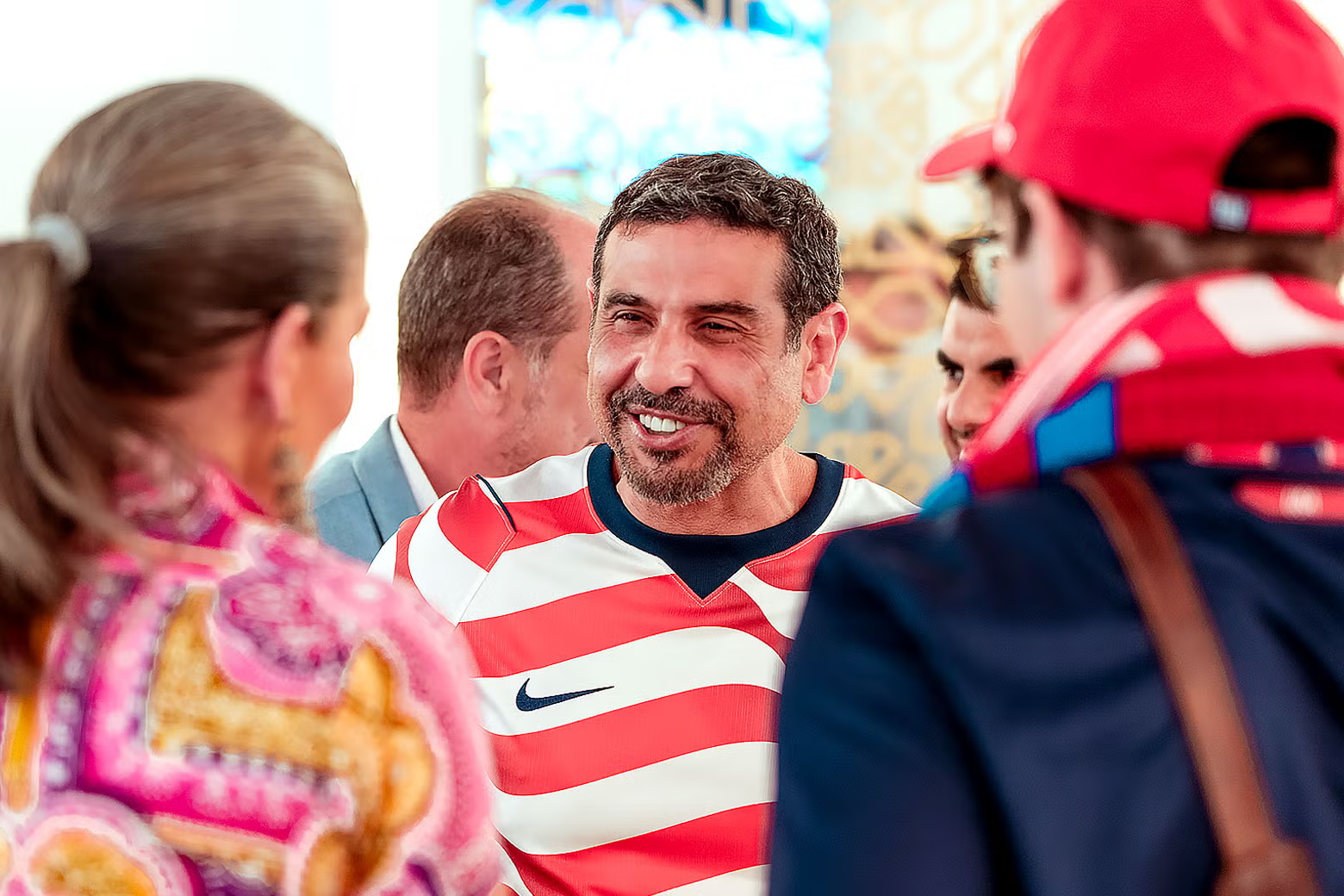
Adam Hamawy’s campaign headquarters is in a suburban New Jersey office center, down the hall from Princeton Plastic Surgeons, his practice that offers everything from eyelid surgery to Brazilian butt lifts. When I walked in, the only immediate clue that the doctor there had just won a much-contested congressional primary was a small cluster of campaign posters bearing his name behind the check-in desk.
Read more The Supreme Court Gave Trump a New Way to Break the Government
Hamawy led me through the polished medical half of the office to a room around the corner with a conference table and a messy whiteboard with leftover green-marker notes from the primary. He called it “the engine room.” “This place was packed with people pulling their hair, and potato chips and some old pizza,” he said. “It’s so quiet now.” The campaign is in recovery mode before the general election in November, which he is heavily favored to win.
Hamawy is a former Army combat surgeon who served in Iraq. There’s military memorabilia all around the office, including an aerial image of the air base at Balad where he worked. In the race he just won, he ran as a progressive on positions that play well in Jersey’s comfortably blue 12th Congressional District, like Medicare for all and abolishing Immigration and Customs Enforcement. But a few months ago, he was virtually unknown. In a diverse district with a slew of candidates, a Muslim plastic surgeon with no name recognition shouldn’t have won. But Hamawy did—and one issue seems to have made the difference.
For the past several years, the safest advice in Democratic politics has been to talk about anything other than Gaza. Talk about affordability. Talk about healthcare. Talk about housing. Talk about Donald Trump. Talk about human rights, sure, but if it came to Gaza and Israel, widen the frame to something universal and move on quickly. This position became so common that it even has a nickname: PEP, or “progressive except Palestine.”
I saw this phenomenon up close. At the Democratic National Convention in 2024, I watched national party leaders embody PEP to perfection. Even when uncommitted delegates arrived in Chicago representing hundreds of thousands of protest voters furious over the Biden administration’s support for Israel’s increasingly unpopular war in Gaza, Democrats didn’t budge. The uncommitted delegates asked for a Palestinian speaker and, at a minimum, to be treated as part of the coalition. By the end of the week, many of them felt they had been ignored.
The PEP posture made some political sense. To focus on Gaza risked alienating moderates and some reliably pro-Israel Democrats. Even as polling has started to show Democratic voters becoming sharply more critical of Israel and more sympathetic to Palestinians—as many as 8 in 10 now hold an unfavorable view of Israel—the party continued to stick to Biden’s firmly pro-Israel position as it headed into the presidential election. And then, after the excruciating loss, the Democratic National Committee’s “autopsy” of the 2024 election infamously didn’t mention the words Israel or Gaza at all. In her book published in late 2025, though, Kamala Harris called Biden’s lack of empathy for Palestinians “inadequate.”
The 2026 midterms might just be different. Recent Democratic primaries in New York anointed three Zohran Mamdani–backed leftist challengers for Congress, all of whom made the United States’ support of Israel’s military front-and-center issues. In New York’s 10th Congressional District, Brad Lander’s win over the otherwise politically similar Dan Goldman seemed centered almost entirely on the issue.
An even stronger case study exists one state over, where Hamawy, who not long ago returned from a medical mission to the Gaza Strip, managed to clear the field in his crowded Democratic primary in part by focusing directly on Gaza. He spent months going to Congress and sharing his firsthand accounts and photos of what he saw while working there, leaving rooms in tears. When he decided to run for Congress himself, he spoke in no uncertain terms about genocide and U.S. “bombs killing kids.” On the other side of his primary, it seems that Hamawy’s unapologetic stance on Gaza will in all likelihood send him to Congress.
Even so, as he described to me in his office, perils remain, especially for Muslim candidates. In Hamawy’s case, it led to suspicions about his past and true motives that was effective enough for his eventual primary win to be deemed “controversial.”
Born in Egypt, Hamawy, 56, grew up in Old Bridge, New Jersey, where he arrived as a baby. The state’s now-thriving Muslim community was still developing at the time. He told me that during his childhood, Eid prayers were sometimes held in hotel ballrooms because mosques were too few and too small.
To his mother’s delight, he decided he wanted to be a doctor at age 4, after envisioning the doctor who treated his broken arm in Jersey City Hospital as “an angel.” To his mother’s dismay, he joined the Army ROTC at Rutgers University in the ’80s after a recruiter invited him and other students to rappel off some local cliffs. He had been in Boy Scouts and had an appetite for adventure, but it was the prospect of having his college paid for that sealed the deal.
Over the next few years, he completed medical school and a seven-year general surgery residency while delaying his enrollment in the Army. By the time he got to the Basic Officer Leader Course in 2003, he arrived as a major, surrounded mostly by junior officers. A year later, after board certification, he was in Iraq, working in combat support hospitals in Balad, Baghdad, and Babylon ( “all the Bs,” as he put it). He couldn’t put a number to the amount of people he treated, which included U.S. soldiers, Iraqis, contractors, and journalists. “Hundreds,” he said. “The experience that I got there, you cannot get anywhere else. To this day, when people see me operate, they think I’m always calm, even though inside I might not be. There’s nothing that fazes me.” He even was part of the team that saved Illinois Sen. Tammy Duckworth, an anecdote that took off during his campaign.
His move into being a plastic and reconstructive surgeon came after he noticed how few of them there were in the Army. “It’s not just about saving their life,” he said. “It’s putting them back together.”
That’s partly what brought him to Gaza. As a medical student, Hamawy had gone to Bosnia, flying into Sarajevo on a white U.N. plane while the city was under siege. After Iraq, he kept volunteering in disaster zones and conflict zones—Haiti, Belize, Turkey, Lebanon, Jordan, the Syrian border, the West Bank. He felt freer to work when operating outside of the United States. “All the things that suck about medicine here, it’s eliminated,” he told me. “There’s no bureaucracy. I see you. You need this. Can I do it or not? I can, let’s take care of it. All the red tape is gone.”
For a while, that was his rhythm: Parachute into the most devastated places on Earth, save lives, return to his practice in New Jersey, repeat. But after one trip to Gaza, he said he was forever changed. It was carnage like he had never seen before—even with all of that experience.
“I saw children come in every day blown apart, missing limbs, orphaned. I saw families coming in huge numbers,” he said. “You see your children in those kids—when you’re taking care of a 12-year-old and you have a 12-year-old, or a little girl and you have a little girl. In medicine, you compartmentalize. But when you go to someplace like Gaza, you get overwhelmed. You can only compartmentalize so much.”
When he came back to his civilian practice in New Jersey, he said he could barely sleep. “There are very few people who have seen what I’ve seen, other than the doctors and nurses who went with me. Journalists from the outside world aren’t allowed in,” he said. “I was in hospitals being shaken by bombs falling around us—bombs that I am funding with my tax dollars.”
While Hamawy was in Gaza, Israel seized and closed the Rafah crossing. When his team tried to rotate out after its two-week mission, they were denied permission. For eight days, he and the other volunteer doctors were trapped at Gaza European Hospital near Khan Younis as bombs rained down around them. One of the people pushing for his release was Duckworth. When only the Americans were granted permission to evacuate, Hamawy refused to go. “Our team wanted to leave together, just like we came in together,” he said.
When Hamawy and his full team did make it home, he went to Washington to thank Duckworth and several other senators who helped them get out, including fellow Jerseyite Cory Booker. He wanted them to understand that the wounds he treated were not separate from congressional votes, weapons transfers, and the money the United States continued to send. He urged them to end the supply of weapons to Israel and to allow patients to come to the United States for treatment. But he quickly realized that he could only effect so much change. “I think we got a lot more support from the staffers than the members of Congress. But many of them were afraid to vote a certain way,” he said. “Many of them are getting obviously paid by AIPAC to think a certain way.”
He went back to Washington repeatedly—to the White House to brief the National Security Council, to testify at the United Nations and the State Department, taking as many meetings as possible, though not a single Republican would meet with him. He stopped bringing photographs because he felt the images could be overwhelming. The reaction was emotional, he recalls, but even among Democrats, he saw stark limits.
Read more Trump’s Latest Iran Escalation Comes With a Corrupt New Twist
That experience set him on the course that led him to his victory on New Jersey primary night in June. “It’s not only about advocating for people in Gaza. It’s about advocating for my neighbors, my patients, and everyone here at home,” he said. “We always have enough money for bombs. Here at home, our healthcare system is falling apart. Our education system is falling apart. Our infrastructure is falling apart. The economy is rigged for billionaires and corporations, and people are falling behind every day. Seeing those realities together pushed me to act.”
This story became central to his campaign, a staple of speeches, and in the end, a crucial linchpin for his financial support. He received $2 million in backing from a new pro-Palestinian super PAC designed to counter the American Israel Public Affairs Committee. It helped him take a lead over 12 other Democrats in a district with many different demographics, including a strong Jewish base. But with that momentum also came something else.
In what would likely be the first time many voters outside New Jersey heard his name, reports surfaced late in the campaign of Hamawy’s past association with Sheikh Omar Abdel-Rahman, the Egyptian cleric better known as “the Blind Sheikh.” Abdel-Rahman lived and preached in New Jersey before he was convicted in 1995 of seditious conspiracy in relation to the first bombing of the World Trade Center.
Hamawy had spent time around Abdel-Rahman in the early 1990s, during the gap between graduating from Rutgers and starting medical school. He traveled in a van with Abdel-Rahman and Emad Salem, the government informant who later became a key witness in the federal case against Abdel-Rahman. Hamawy had helped Abdel-Rahman translate a fax from Egypt and had been to the cleric’s apartment.
During Abdel-Rahman’s trial, Hamawy was called by defense lawyers to testify in his favor. He essentially did so, though on the stand, he also said, “Of course, that’s what he always talked about. He talked about jihad.” Abdel-Rahman was convicted and sentenced to life. He died in 2017. Hamawy was never accused of anything in connection to the case.
This issue became the principal argument against his candidacy as it became clear that Hamawy was going to likely clinch the nomination. Andrew McCarthy, the lead prosecutor in Abdel-Rahman’s trial, wrote that Hamawy had been a “sympathizer.” Michael Mukasey, the federal judge who oversaw the case and later became attorney general, described Hamawy as “more than a casual traveling companion.” Some of Hamawy’s Democratic opponents treated the association as a character question, arguing that voters had a right to ask whether this disqualified him from representing them in Congress.
When I asked Hamawy about the connection, he acknowledged it, but dismissed its relevance. He said that his role had been inflated into something it was not, and focused largely on the investigation, not on the relationship. “It was such a small part of my life. I played such a small role in that trial,” he said. “I was in the military during that time, before that time, and after that time. I did my civic duty in court. I was there for about 15 or 20 minutes.”
Hamawy has said he condemns Abdel-Rahman’s violent rhetoric and actions and that he had no contact with the cleric after his arrest. But the old association gave his critics a way to fold his past into his present—his criticism of Israel, his Muslim identity—and paint him as an extremist, a familiar dynamic in other 2026 races currently playing out.
Hamawy is now preparing for the general election, and by all accounts, it should be an easy win for him—the district votes reliably for Democrats by a margin of +13. He knows that he will have to deal with conversation around his relationship with Abdel-Rahman, but that is not actually the thing that concerns him the most. Instead, he’s worried about people only seeing the Gaza part of his message.
“They try to make the story like you’re a one-issue candidate,” he said. But he’s running for office with much greater ambitions. “My platform is that we should not be funding a genocide, but we should be spending on healthcare here at home.”
I understood his point. But I also saw what inspired his voters—and that was what he did with the brutality he witnessed in Gaza. This was most evident when I attended a watch party his campaign organized for the World Cup at a Yemeni coffee shop. The U.S. was playing Australia, and the room had the loose, multilingual feel of soccer in New Jersey. People drifted between tables with their hot drinks and plates of food. Fans wore the jerseys for their favorite teams: Morocco, France, Egypt. Hamawy wore the waving red-striped U.S. kit, a newly minted politician’s choice if I’ve ever seen one.
He did not work the room all that much. People stopped him for photos and pulled him into side conversations, but he mostly focused on the game.
Around the room, I asked his supporters what attracted them to Hamawy’s campaign, and what this early victory means to them. Jennifer Cohan, a Princeton voter, told me she first learned about Hamawy through an email from a friend. She had been undecided in the primary until she read about his background. “I was familiar with the surgeons that had gone to Gaza and had testified,” she said. “And then I put two and two together.”
Elijah Dixon had run in the same primary before dropping out and backing Hamawy. He first heard about him when potential supporters told him they were already preparing to support Hamawy, and he decided he should too. When Dixon knocked on doors and helped phone-bank, he told me the Blind Sheikh attacks did not come up, but Gaza did. “People are not supporting our tax dollars going over to fund the destruction of generations of families,” he said. Hamawy “did not shy away from that, and it resonated with the people.”
Omayma Mansour said she’s known Hamawy’s family for decades. Their mothers were friends. She called him “the guinea pig of our community,” because no one knew at the start whether a Muslim candidate could make it as far as he did, especially in a district of people with so many different backgrounds.
When Hamawy got stuck in Gaza, Mansour and other locals took it upon themselves to reach out to their elected officials. ”We just at that time kind of realized how dangerous that this moment was. I mean, he could have never come out. He has four children.” She laughed recalling how Hamawy returned to Gaza on another medical mission after all of her efforts to help get him out. It was when he came back again that he told his close friends and family that he’d decided to run.
Eman El-Badawi, a local elected official in Cranbury, had not known Hamawy before the campaign. She told me she had been living with the heaviness many Muslims and Arabs have felt since Gaza. She was less interested in Hamawy as a symbol than as a model for her children. She has six of them, ranging from young children to young adults, and wants them to witness a Muslim candidate take the attacks, refuse to retreat, and win. “I’m happy for us,” she said, “Not just us as Muslims. He is the right fit for New Jersey.”
By the time I left the watch party, the old Democratic advice felt even stranger than it ever had. For years, candidates were told to move away from Gaza as quickly as possible. Hamawy moved toward it. He insists Gaza may not be his whole platform, but it was the place where the rest of his platform— healthcare, ICE, the cost of living—became credible.
The harder question is what Hamawy will do with the win once he gets to Washington. He ran because he came to believe that witnessing was not enough, that telling powerful people what he had seen could move them without changing what they did. Congress will test whether holding power feels any different. And his victory leaves the national Democratic Party with a question of its own: whether it sees Hamawy as a lesson worth learning from, or an exception it can safely explain away.
Read more Lindsey Graham’s Greatest Delusion