 By admin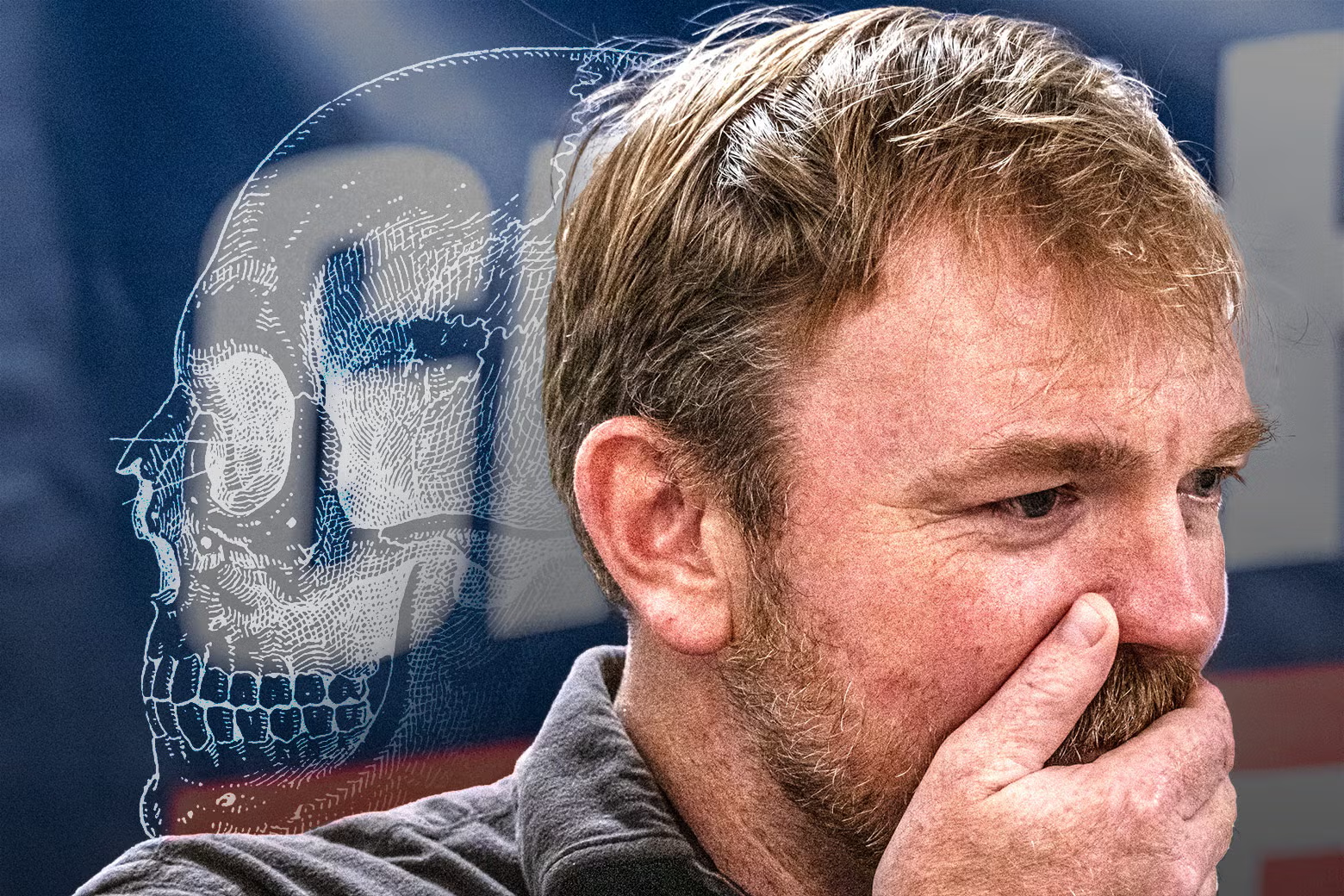
Graham Platner announced he will drop out of the race to be senator of Maine. Twin scandals, one alleging sexual assault and the other nonconsensual condom removal, arrived back-to-back this week, finally sinking a candidacy that had long been plagued by them. His party will now need to pick a new candidate to face off against Susan Collins this fall.
Read more Peace, Out.
Amid cries of duplicity and betrayal, Kat Rosenfield has the best take on exactly how this happened: Members of the party’s progressive wing wanted “to shed the unflattering image of themselves as the perpetually offended HR department of politics in favor of something rougher, tougher, and more relatable.” They made a horrible bet.
The whole train wreck has shone a spotlight on how humanity meshes with politics. If he wants to step off the shameless path tread by unrepentant villains like Donald Trump, Platner must now focus on redemption outside the spotlight. The rest of us can grapple with why these were the straws that finally broke the camel’s back—given that we already had heard about infidelity, abuse of exes, lying about his working-class roots, and, of course, his baffling decision to get a Nazi tattoo.
That tattoo was the warning the Democratic Party should have heeded, as it pointed to a very human and very common failing. As a fellow veteran, I’ve been thinking deeply about the tattoo specifically, and what it meant. After learning this week of these latest allegations, I’ve realized that this revealed something very specific about Platner that we should have realized when we learned of the tattoo.
In 2007, as a 23-year-old Marine in Croatia, Platner got drunk and got a tattoo on his chest—a Nazi Totenkopf, the death’s head popular with the Schutzstaffel, more commonly known as “the SS,” Hitler’s elite guard. Worse, the specific symbol Platner chose was preferred by the SS-Totenkopfverbände, whose main role was running the concentration camps responsible for exterminating at least 2.7 of the 6 million Jews murdered in the Holocaust.
Why the hell would he do something so unspeakably stupid? Well, Platner’s answer is that he never knew the origins of the skull tattoo he got—not when he got it, and not for years after. He says he was horrified to learn that it was Nazi-related when the news broke last fall, and he subsequently covered it up. This seems somewhat unbelievable (and has been contested by one of his ex-girlfriends), but let’s go with it for now. Platner’s battle-buddy Phil Proschko said they wandered drunk into a Croatian tattoo parlor, brutalized by intense combat in Iraq, and picked something out of one of the shop’s books that evoked an image of death to memorialize those comrades they’d lost down-range. This makes sense on its face. Croatia has a much more comfortable and permissive relationship with Nazism, and it’s not surprising that the Totenkopf is on the menu in a local shop over there. Maybe they genuinely didn’t realize what it was, and Platner never learned, as he claims.
In this scenario, the choice is not really remarkable. Death imagery as a bulwark against fear of death is so well known that it is covered under the psychological umbrella of Terror Management Theory as a coping mechanism. It makes sense: You wear the thing that frightens you to show yourself, and more importantly those who must rely on your willingness to go running into danger, that it does not have the power to immobilize you when you will need to act. Gallows humor, another military mainstay, plays a similar role, allowing service members to literally laugh at death. Even in my fire company, where we are dedicated to preventing loss of life, skulls are on practically every T-shirt, bumper sticker, and key chain. Popular around my firehouse is a line directly cribbed from its military origins: “Death smiles at everyone. Firefighters smile back.”
This theory is that Platner got his Totenkopf out of a desire to honor those he’d lost in the midst of his service, and out of a deep-seated, common, and totally understandable need to process the trauma of his experience. It was also likely a means to galvanize himself against how that experience alerted him to the omnipresent nearness of death. And despite his playing fast and loose with the truth in other places, Platner’s experience of combat is . He served in the brutal Ramadi theater in Iraq as a machine-gun-team leader. His receipt of the Combat Action Ribbon leaves no doubt of his sacrifice—they do not just hand those out.
But this makes sense only if he’s telling the truth that he thought the image was just a death’s head and not a Totenkopf, and it’s pretty clear that he is not. The likely more accurate rendering of Platner’s original defense, that he was young and stupid and didn’t know what he was doing, is that he was young and stupid and did know what he was doing. That doesn’t mean he’s a Nazi, even an ironic Nazi. (When he walked into that Croatian tattoo parlor back in 2007, it was years before the right-wing backlash to woke hall-monitor-style online progressivism gave us the ironic internet edgelord who might have consciously done such a thing.) What is much more likely is that his choice went beyond glorifying death imagery and passed into a warped kind of warrior worship.
Read more Todd Blanche Has Already Flunked His Confirmation Hearing
This kind of warrior worship is also incredibly common. When we tell ourselves stories about warrior elites—and invoke their iconography to inspire and galvanize—we often dismiss and ignore their victims as inconvenient or annoying footnotes. I know about this because I wrote a whole book about it. In The Bronze Lie: Shattering the Myth of Spartan Warrior Supremacy, I examined the obsession with the (almost entirely false) story of the fearless and undefeatable Spartan warrior.
One of the things I was struck by in that cult, resurgent once again on the political right, is the total lack of interest in Sparta’s many victims. The Spartan Krypteia, lionized for the mostly false story of their elite status, are celebrated without too much focus on the fact that they purportedly existed as a tool to terrorize and subjugate a caste of slaves kept in humiliating bondage for centuries. There also is the common obsession with the power and ferocity of the “warrior-monks” of the Crusading orders, which barely touches on the unspeakable horrors they visited on not just Muslims, but fellow Christians they viewed as apostates. (Unsurprisingly, this warrior worship has given us another unwise tattoo choice on a politician, Pete Hegseth’s famous Jerusalem cross.)
Warrior symbolism from truly horrific combatants is all around us. The gaming universe of Warhammer 40,000 is surging in popularity to the point where it’s attracted the devotion of celebrities like Henry Cavill. The universe has been criticized for fascist flirtations for years, and it’s warrior-worship vaunts characters, like “Commissar Yarrick,” who are clearly patterned off the Soviet commissars of the 1940s who gleefully shot the unwilling members of the famous penal battalions when they inevitably fled the battlefield. (Yarrick wears the same overcoat that got Greg Bovino in so much hot water.)
We may, as a society, still have a big red line around Nazism (well, the left does anyway—the right, as evidenced by the newfound relative mainstream acceptance of the likes of Nick Fuentes, has been flirting with erasing that line for some time). But military service necessarily puts members through experiences that erase all lines whatsoever. The brutality of warfare is of necessity a moral wasteland, and those who operate there must look for ways to make sense of what they have experienced, and these efforts can be shot through with misguided attempts at gallows humor, or worse, finding kinship with the fringes of human darkness in an effort to process what you have done.
The point is this—it is as common as the grass for those seeking warrior inspiration to turn to stories and icons with real historical impacts. And we like our stories simple and one-sided. It’s inconvenient to be reminded that for every victorious warrior, there’s the enemy he defeats. For every conqueror, there is the conquered. When we lift up the one, it’s troublesome to consider the other. In this, Graham Platner is yawn-inducingly common. He wasn’t a Nazi, or even an antisemite. He was just a young man looking at a symbol of power and not caring much about who that power was used to subjugate.
I don’t think Graham Platner ever hated Jews. But I do believe that, at least in his 20s, he didn’t notice them. He looked to what he saw as a virtue, and wasn’t terribly interested in what cultivating it cost. This was the blaring red alarm bell—an extremely common, extremely human failing. For Platner, people with inconvenient needs and agency simply dropped out of sight. He is not unusual in this, but he is responsible for it. It is telling of his character. If just a fraction of the allegations leveled against Platner are even partially true, it is clear that women, like Jews, vanished from his view, particularly when he wanted something badly enough. He wanted to run for senator, so even though he knew about the skeleton in his closet—that he had an ex who had accused him of sexual assault in Instagram DMs, even if he didn’t believe her—he let himself ignore it. He didn’t consider what her experience might prompt her to do, to his own eventual detriment.
The famous Buddhist Angulimala Sutta tells a story of a serial killer who is redeemed by the Buddha and becomes a righteous monk. Out asking for money to support the community, this redeemed man is discovered by the family members of those he murdered and is beaten nearly to death. The Buddha, seeing him bruised, bloody, and weeping, smiles and tells him he must bear it.
The lesson of the scripture is that everyone can be redeemed, can change, no matter what mistakes they have made. But while we can be redeemed, we must also accept the consequences of our actions and live in the new life born from them. For Platner, this is almost certainly a life of reflection and atonement outside the political arena. The measure of his serious intent to change will be measured in how he spends it—in seeking a return to public power, or in reckoning with the harm he inflicted.
Read more Months After Renee Good’s and Alex Pretti’s Deaths, ICE Is Ramping Up Again