 By admin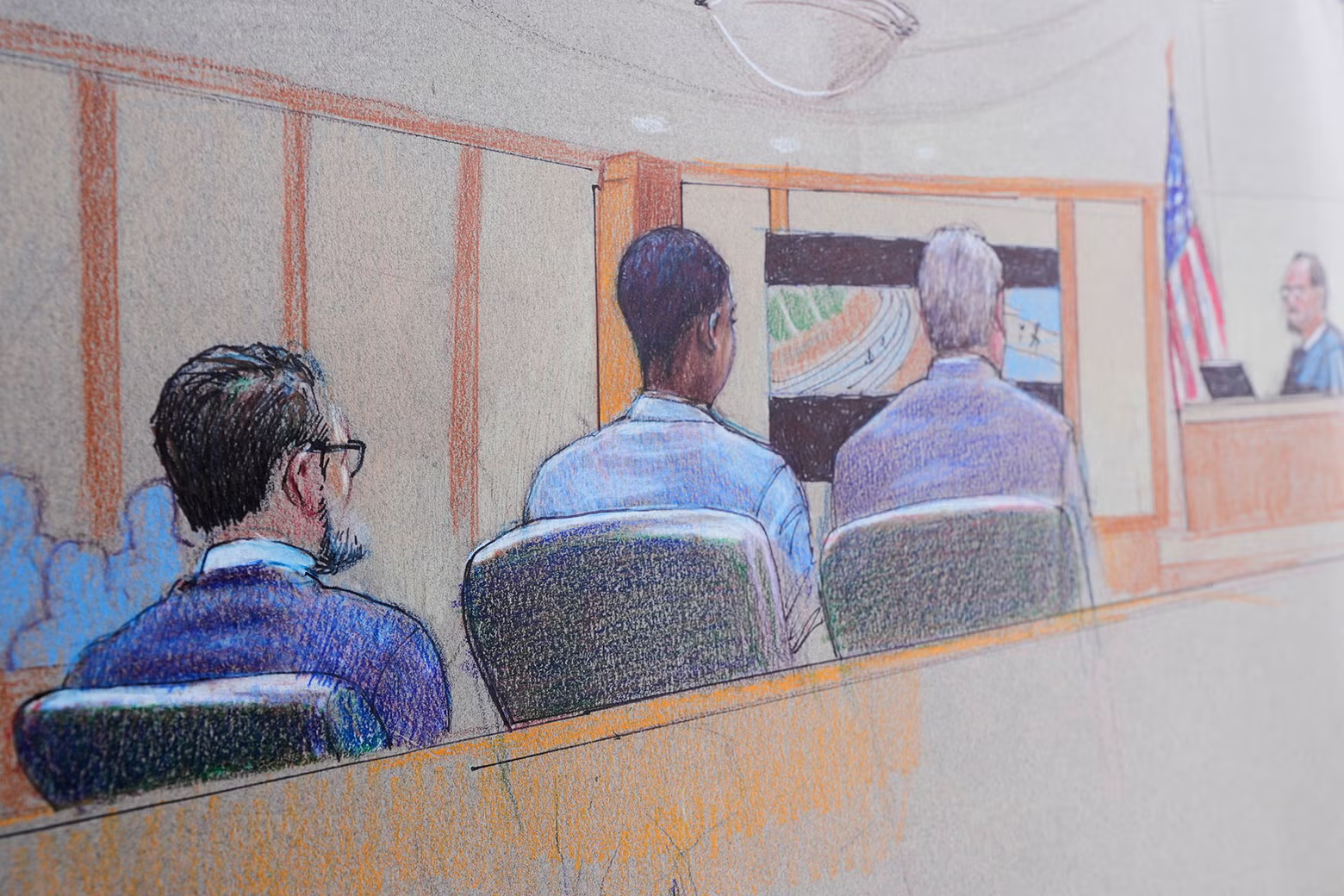
Long before the jury rendered its guilty verdict in the Karmelo Anthony case, there was reason to question whether the trial had already gone off the constitutional rails. The case, which concluded last week in a conviction for first-degree murder, has generated exactly the sort of fierce debate, outrage, celebration, and anguish that high-profile criminal trials often produce. Every significant criminal case eventually becomes a vessel into which the country pours its anxieties, fears, loyalties, and grievances. People see the same facts and emerge with entirely different stories. That is neither new nor surprising.
Read more Trump Gave His Fed Pick One Job. About That …
The details of this case and the central factual questions are not what’s remarkable: People may dispute whether the then-17-year-old Anthony acted in self-defense when he stabbed unarmed 17-year-old Austin Metcalf to death at a track meet. These sorts of legal skirmishes happen all the time in this country.
What is remarkable is that after nearly a century and a half of Supreme Court decisions condemning racial discrimination in jury selection, after generations of litigation, after Batson v. Kentucky, after countless judicial pronouncements declaring that race has no place in the selection of jurors, we are still arguing about whether Black citizens were excluded from a jury because they were Black. That is a scandal.
According to reports from the trial, defense counsel objected after prosecutors struck the final three remaining Black prospective jurors from the venire—ultimately, there was not a single Black juror. The state reportedly responded that the jurors were removed because they were educators. The trial court accepted this explanation.
The exchange, as reported, captures in miniature one of the oldest constitutional failures in American life. It reveals a wound so old that Americans have almost grown accustomed to it, a wound that has survived Reconstruction, Jim Crow, segregation, the Civil Rights Movement, and nearly four decades of Batson jurisprudence.
The history of excluding Black Americans from juries is often described as though it were merely a chapter in the chronicle of criminal law. That understates the matter dramatically. The struggle over jury service is a struggle over citizenship itself. The generations that systematically excluded Black Americans from jury boxes understood that a jury is one of the few institutions in American life through which ordinary citizens exercise direct governmental power. Jurors decide whether the state has met its burden. Jurors decide whether liberty will be taken. Jurors decide whether the immense machinery of prosecution and punishment will continue forward or come to a halt. The jury is where the people themselves enter the administration of justice.
That is precisely why Black Americans were excluded. That exclusion was not some unfortunate byproduct of a flawed system. It was deliberate because the architects of racial hierarchy understood exactly what jury service represented. A society cannot plausibly claim that a people are equal citizens while simultaneously denying them participation in one of the institutions through which law is administered. The jury box represented power, and power was precisely what Black Americans were not supposed to possess.
The Supreme Court recognized the constitutional obscenity of that arrangement as early as Strauder v. West Virginia in 1880. Again and again, over the course of nearly a century and a half, courts have acknowledged that discrimination in jury selection inflicts injuries that extend far beyond any individual defendant. Excluded jurors suffer an injury because they have been denied equal participation in one of the central obligations of citizenship. Civic communities suffer an injury because public confidence in the administration of justice is eroded. The courts themselves suffer an injury because a legal system that distributes participation according to race cannot credibly claim to embody equal justice under law.
The history of racial discrimination in jury selection is not the history of a problem that disappeared. It is the history of a problem that adapted. When explicit racial exclusions became unconstitutional, facially neutral explanations took their place. When courts began condemning discrimination, discrimination learned the language of compliance. That is the real and lamentable story of Batson. Batson is often taught as a triumph. In some ways it was. The Supreme Court finally acknowledged what lawyers, defendants, and communities had known for years. Yet the uncomfortable truth at the heart of modern Batson jurisprudence is that although it identified the disease, it has never found an effective cure.
Read more The Text of Trump’s Iran Deal Is Out. It’s Worse Than I Thought.
The reason is painfully obvious. The Constitution forbids racial discrimination in jury selection. A prosecutor who wished to discriminate against Black jurors after Batson would therefore have every incentive not to describe the strike in racial terms, a dynamic that may have been at work in the Anthony case. Following Batson, the discrimination necessarily speaks a different language. And so courts find themselves engaged in a peculiar exercise. A Black juror is struck. An objection is raised. A race-neutral explanation is offered. The explanation is evaluated. The trial proceeds. But the question is not whether an explanation can be offered. The question is whether it should be believed. The entire point of Batson is the recognition that discrimination frequently disguises itself.
To boot, the issue under Batson as properly understood is not whether a prosecutor is a racist. It is whether race played a role in the strike. Those are profoundly different inquiries. Yet courts frequently behave as though sustaining a Batson challenge requires a judicial declaration that an officer of the court harbors racial animus. Many judges recoil from that conclusion, and the constitutional inquiry becomes personal. Suddenly the focus is no longer on the excluded Black juror, the defendant’s right to a fair trial, or the public reputation of a legal system soured by this practice. Rather, the focus becomes whether a prosecutor should bear the stigma associated with a finding of discrimination. Batson was intended to expose constitutional violations. Too often, it has become a mechanism for avoiding the discomfort of acknowledging them.
That is why the explanation offered in the Karmelo Anthony case matters. Not because teachers cannot be struck from juries. Of course they can. Not because every strike against an educator is suspicious. Of course it is not. The concern arises because constitutional scrutiny is supposed to begin where the explanation begins, not end there.
If the final three remaining Black prospective jurors were removed because they were educators, it is reasonable for one to ask whether non-Black educators were treated similarly, whether the rationale was applied consistently, why only three Black prospective jurors remained at that stage of the process, and whether the explanation reflects genuine concern or convenient justification. Batson was never intended to allow courts to stop asking questions the moment an explanation appears.
North Carolina knows this story particularly well. In my home state, where I practice law, courts have confronted evidence of prosecutorial training materials designed to help lawyers articulate race-neutral justifications for juror strikes and survive Batson challenges. Those materials reveal a legal culture that has become so familiar with the mechanics of Batson that lawyers are taught how to navigate around it and have developed a way to evade judicial reprimand. A constitutional doctrine intended to prevent racial discrimination has indeed become predictable enough that people could develop strategies for surviving accusations of racial discrimination. Despite a long and deeply documented history of Black exclusion from jury service, findings of Batson violations in North Carolina have remained strikingly rare. The lesson many Black North Carolinians have drawn is that proving discrimination, even when the evidence flashes like a warning beacon, has become nearly impossible.
Some defenders of the process, as we’ve observed in the Anthony case, have questioned the concern about the exclusion of Black jurors because the jury was not all white and other minority citizens were seated. But that observation misses the point. The equal protection clause is not an exercise in demographic accounting. Constitutional rights are not vindicated through racial substitution. A Black juror is not interchangeable with a Latino juror. A Latino juror is not interchangeable with an Asian juror.
And perhaps that is why so many Black Americans view these controversies with a mixture of anger and exhaustion. There is a particular fatigue that comes from watching the same constitutional injury reappear generation after generation under different names and different explanations. There is a particular weariness that comes from hearing courts speak eloquently about equality while repeatedly encountering circumstances that seem to demand far more rigorous scrutiny than they receive. There is a particular exasperation that comes from being told, once again, that what appears obvious should not be questioned too closely.
Americans will never agree about what happened the day Austin Metcalf died. They may never agree about self-defense, culpability, or punishment. But a constitutional democracy cannot ask citizens to accept a verdict while ignoring a serious question about the legitimacy of the process that produced it. If Karmelo Anthony was denied the jury the Constitution promised him, then the shouting should stop, the verdict should fall, and the case should be tried again.
Read more The Dumbest Way Pete Hegseth Is Draining the Military