 By admin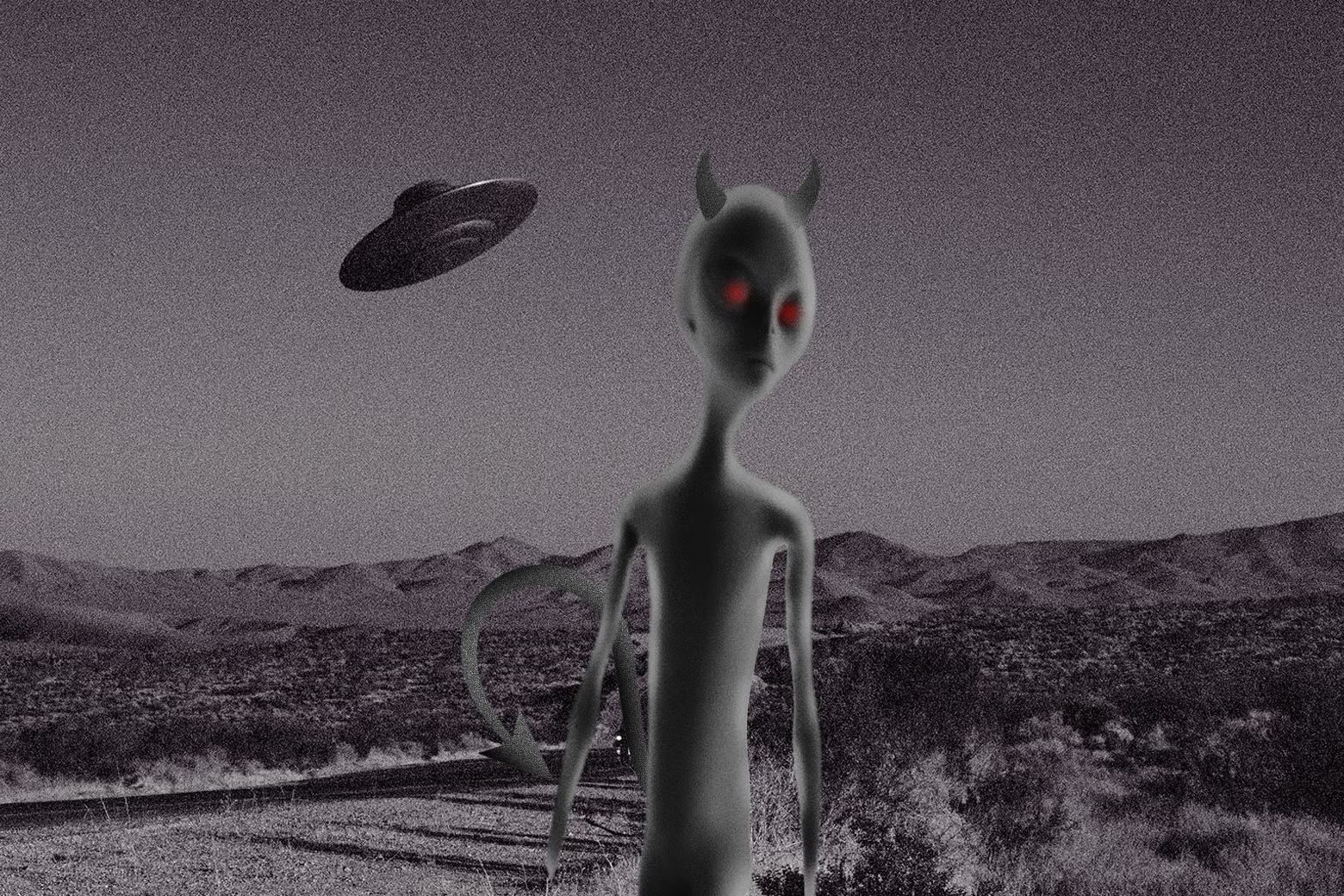
A Catholic priest got fired from his job as an exorcist last week because he claimed that UFOs are, in fact, demons.
Read more Will Graham Platner Make It to November?
That news reads like a bit of a genre-mashed Mad Libs, so we’ll slow down a bit: Monsignor Stephen Rossetti has been working in the Washington Archdiocese for the past 15 years as an exorcist. For those who know of exorcisms primarily from horror movies, the news of a professional exorcist in the nation’s capital causing drama may have been a bit confounding. But exorcists are an established part of Catholicism. While some more skeptically minded clergy do not enjoy discussing demonic possession, each diocese is supposed to have a designated exorcist.
It’s a real role in the church, and while it’s not exactly like Hollywood portrayals, it’s not entirely dissimilar from the movies either. If a person in the diocese comes to fear that they or their loved one has been bodily possessed by a demon, the diocese launches an investigation involving medical, psychological, and psychiatric testing. In the rare cases when the investigation concludes that the person is indeed afflicted by the devil, the designated priest or bishop who has received special training and apprenticeship steps in to perform the Rite of Major Exorcism. At the chapel or other discreet location for the exorcism, the priest sprinkles the possessed with holy water, lays their hands on them, breathes on their face, recites “exorcistic” prayers over them, holds the crucifix up to them, and makes the sign of the cross over them.
Rossetti, a licensed psychologist and unusually prolific exorcist, has “led hundreds of exorcism and deliverance sessions,” according to the website of his exorcism-focused nonprofit organization. He also trains other priests to be exorcists.
Recently, however, Rossetti’s remit had included statements on UFOs. “As an exorcist I wanted to raise that danger. And that is that demons like to hide,” Rossetti had said in a May 29 video posted on Facebook. “It’s my personal belief that probably many if not most of these UFO sightings are in fact demons.”
UFOs may seem to be squarely outside the lane of an exorcist, but they’re in the news of late, thanks to the government last month releasing, in ostentatious and Trumpian fashion, “UFO files.” And Rossetti isn’t alone in seeing a spiritual nexus of a topic that, at least in secular circles, is more commonly discussed in the context of aliens. In March, Vice President J.D. Vance said that he believed UFOs were demons.
But Rossetti’s comments ran afoul of his boss, the Catholic archbishop of Washington, D.C., who announced Wednesday he had “removed” Rossetti from his position as an exorcist. (Rossetti gets to keep his job as a priest.) In its statement, the archdiocese said Rossetti’s UFO takes “gravely undermine the Church’s very precise teaching on the devil, demons and exorcism.”
To the uninitiated, it’s a bit confusing that a religious official whose job description includes warding off demons could get in so much trouble for speculating that there could be a demonic link to what are, by definition, unexplained aerial phenomena. Is there some grand conspiracy here? Does Rossetti know too much?
Scandalous as that sounds, there’s actually something less supernatural and more terrestrial playing out here: a power struggle between the Catholic Church and influencer priests who’ve successfully harnessed the internet’s algorithms.
Because it wasn’t just his statements on UFOs that got Rossetti canned. It was, per the statement, his “recent use of social media” that also undermines the church’s teachings. And a look at Rossetti’s social media presence helps explain why. Rossetti isn’t just a priest; he’s also a content creator. Until his ouster Monday, he led a nonprofit in D.C. dedicated to helping the “spiritually suffering,” often through exorcisms. He appears to have dedicated much of his time there to putting out videos and written posts about demons and their trickery. He has 50,000 followers on both Facebook and TikTok and 149,000 followers on Instagram.
It’s clear Rossetti—or at least someone he’s associated with—attempts to present his content in a way that the algorithm will favor. His videos are bite-sized and have the professional look of being made in a podcast studio, and the other posts have simple graphics and text broken up for easily digestible carousels.
Read more What if the Entire Election Took a Month?
See, for example, his post from Wednesday titled “15 signs a house has demons.” Click through, and you’ll find a list of “some common signs of a demonic presence”: “temperature drops in areas of the house”; “doors and windows inexplicably closing and opening”; “people being inexplicably pushed or shoved, including on stairs”; and “messages to … ‘Get Out’ conveyed perhaps scrawled on a mirror.”
If this sounds more Hollywood than parish church to you, well, it appears that Cardinal Robert McElroy, the archbishop of Washington, agrees.
Rossetti isn’t alone in his sensational style. He’s part of a small group of exorcist influencers, Catholic priests who draw their own independent followings from the internet by promising to let the public in on the darkest workings of the devil. Almost all exorcists, at the urging of the Vatican, keep their identities secret, their role in battling the occult known only to the other priests in their diocese. But a tiny number have chosen the spotlight. Father Carlos Martins, for example, produces an Exorcist Files podcast with 40,000 followers on YouTube that promises to take viewers through his experiences “battling the ancient serpent in many forms.”
Because these celebrity exorcists are imbued with a kind of divine authority in their audiences’ minds by their proximity to supernatural matters, their social media followings can be unusually strong and loyal. And that backing can give them significantly more power and influence than a priest, typically a figure lower on the church’s organizational chart, would normally have. As a result, these influencers often clash with their local bishops, putting up resistance when told to rein in their posting. The bishops, often nervous about angering the public at a time when church attendance continues its steady decline, have to think carefully about whether to challenge these celebrity priests.
But there are sometimes stakes to those conflicts beyond Catholic theological matters: Many of these influencers are political. According to Andrew Chesnut, the chair of Catholic studies at Virginia Commonwealth University, “pretty much all the prominent American exorcists” tend to have right-wing politics and theology. This is largely because exorcism as a modern practice has been shaped by evangelical influences: The overwhelming majority of exorcisms today are done by Pentecostals. (These tend to be much more informal events than Catholic exorcisms.) The idea of being “beset by demons,” Chesnut said, is a conservative evangelical one, and it has shaped these exorcists’ views.
In 2020, a right-wing priest performed an exorcism at the site of a Black Lives Matter protest. The next year, a priest known as Father Z with a hugely popular blog performed regular exorcisms to purge the evils of election fraud in the presidential election. The Rev. Daniel Reehil, a pro-Trump exorcist, hosts a podcast in which he speaks of “spiritual warfare.” Another popular exorcist, Chad Ripperger, frequently ties politics he doesn’t like to demonic possession.
In this case, Rossetti is a less controversial figure; he posts mainly about demons, not politics. And he struck a humble tone in response to the news, writing in a statement Wednesday that “I ask forgiveness for any ways that I have not been faithful to the teachings of the Church’s Magisterium, particularly in the cited video on ‘aliens and the demonic.’ ” We don’t know exactly what happened behind the scenes before this ouster, and whether there are other, more mundane, factors involved.
But we do know that Rossetti’s firing shows just how challenging it is for a millennia-old institution to keep control of its message in the age of the influencer. Algorithms, after all, give these priests an incentive to be flashy and address controversies. Institutional rules and norms, on the other hand, give bishops incentives to be methodical and cautious. It only takes one attention-grabbing and theologically underdeveloped topic for these competing incentives to create drama.
It’s hard to imagine any topic more ideal for creating this kind conflict than UFOs. As Chesnut noted, UFOs-as-demons is actually an evangelical idea from the 1950s and ’60s, and not something the Catholic Church has ever meddled in. It’s the kind of idea that exorcists playing loose with theology might be attracted to, but not something the church itself seems inclined to back.
In fact, the church doesn’t seem to have anything to say at all about UFOs. In that vacuum, it makes sense that some Catholics have begun to invent their own beliefs. Rossetti’s firing may look like a strange case of heresies and extraterrestrial mysteries, but it’s really a case of the old-fashioned institutional powers coming up against a hard rule of the attention economy: You just have to keep saying stuff, no matter how flimsy the thought, to keep the algorithm happy. This rule, it turns out, applies to exorcists, too.
Read more What Do We Do With the Latest Revelations About Graham Platner?