 By admin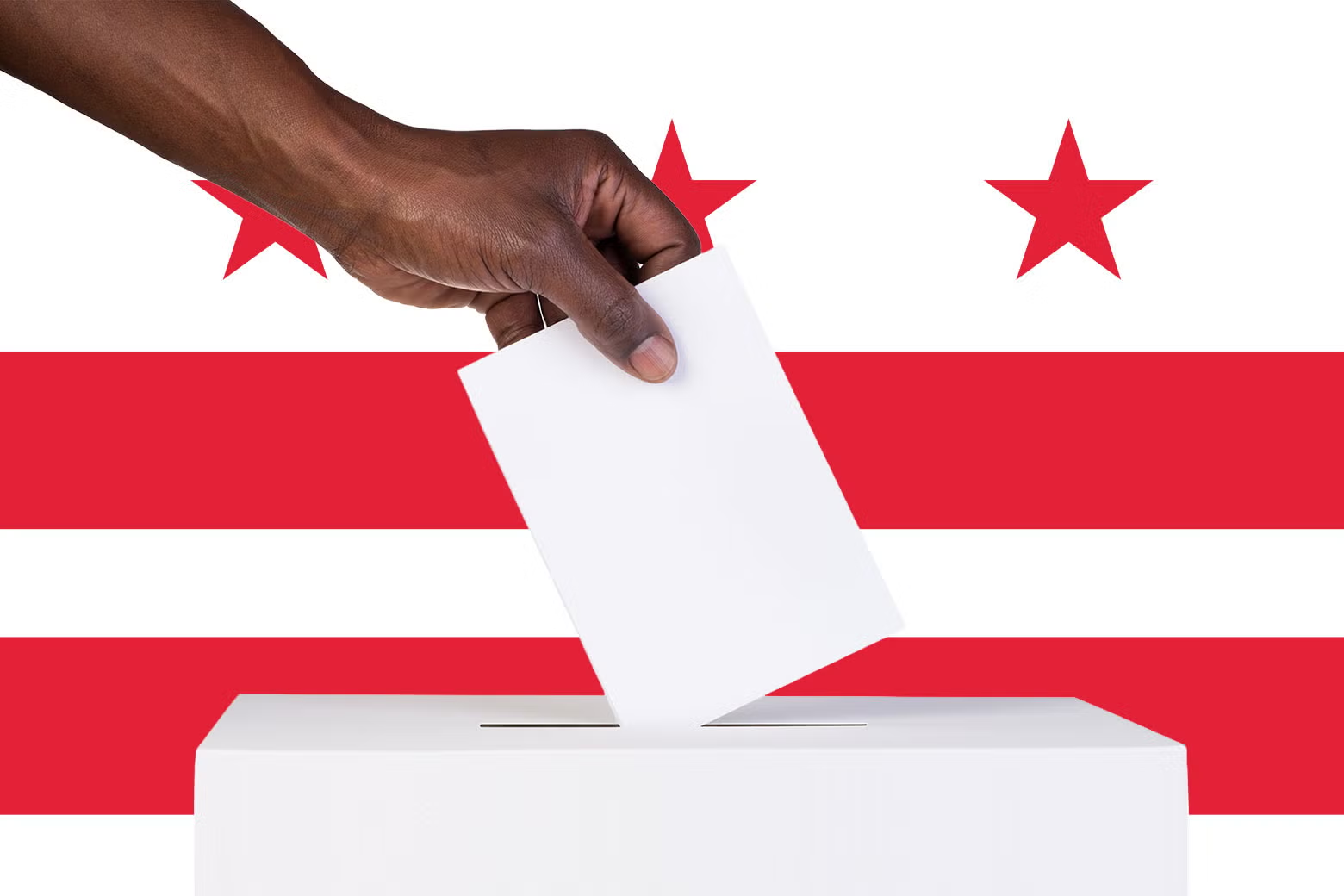
I am one of fewer than 25,000 people who share the distinction of having voted in the unsanctioned 2024 New Hampshire Democratic primary for a man whose name I had to Google before I could finish writing this sentence (former Rep. Dean Phillips). In that bitter January darkness of a Manchester elementary school parking lot, several dozen voters clustered in line beside me to get into the gym just as the polls opened.
Read more Two Conservatives Justices Just Took a Surprising Step to Save a Death Row Inmate’s Life. Why?
Then-President Joe Biden had demandedSouth Carolina jump New Hampshire into the first primary position, and the Democratic National Committee dutifully complied.But New Hampshire being New Hampshire, the state moved forward with its legally required first-in-the-nation primary election date anyway. So the party stripped New Hampshire of its awarded delegates, and Biden made a show of withholding his name from even appearing on the ballot, making Vermin Supreme perhaps the most famous candidate in the race. Phillips, a nondescript and mostly unknown Minnesota congressman, was the most serious protest vote option. As I waited in line before dawn, I wondered how many of my fellow voters were also there to cast their ballots against the DNC’s cloying affirmation of Biden’s doomed reelection campaign.
Uh, not very many, apparently. Thanks to a well-orchestrated write-in campaign, Biden still received more than 63 percent of the vote, then he secured 96.2 percent in the party-sanctioned first contest in South Carolina. The 2024 “Democratic presidential primaries” were effectively over by the evening of Feb. 3—but it turns out the party wasn’t done picking a nominee to run against Donald Trump, as some interesting things happened, you may recall, over the six to nine months that followed. Last primary season’s calendar debacle is central to how we got here. The decree that South Carolina go first in 2024 effectively guaranteed that Biden faced no real test until his shocking debate flameout. That disaster was a crucial ingredient for the dystopian stew in which we find America simmering today.
The DNC’s Rules and Bylaws Committee is in the thick of a drawn-out process to decide who is actually going to get primary election positions in 2028. It’s considering formal bids from 12 states, some familiar contenders like Iowa and New Hampshire, and others newcomers. (The legal semantics of Iowa’s holding caucuses has in the past allowed for New Hampshire to lawfully follow it in the primary calendar; in 2024, however, even though Iowa law technically sets its caucuses first, state Democrats complied with the DNC schedule by using later mail voting for the actual tally to assign delegates.) The ultimate DNC decision on a potential primary calendar will have to navigate a minefield of legal and political dog shit. The committee should debate, wrestle, have it out, all that. But it shouldn’t let South Carolina or any of those 12 states be the first presidential nominating contest. Instead, there is a minimally painful compromise option that is not currently under consideration in any Democratic circle I’m aware of but should be: Keep New Hampshire as the first-in-the-nation state to hold its Democratic primary election, but havethe District of Columbia vote first.
Why give in to New Hampshire? For one thing, the state will absolutely not budge. It has held its first-in-the-nation presidential primaries continually for over 100 years and has for over 50 years had a state law on the books requiring that these elections be held “7 days or more immediately preceding the date on which any other state shall hold a similar election.” Local fanaticism for this law and tradition cannot be overstated.
But New Hampshire shouldn’t be the first place to vote for the Democratic nominee, which is why this solution neatly addresses both problems (the state’s obstinance and its lack of representation of the demographics of the rest of the country). As D.C. is, famously and to its own chagrin, not a state, this would permit New Hampshire, under its own law, to position itself behind D.C. but before all other state primaries without running afoul of either its homespun voting rituals or its state election law.
There are a number of reasons why this D.C.–New Hampshire compromise would work. For one thing, DNC Chair Ken Martin has publicly prefaced that in setting out the primary calendar, Democrats must create a primary process that is rigorous, efficient, and fair. Essentially, what he’s trying to convey is that he wants primaries that will sharpen the candidate’s hand-to-hand politicking skills for the general election, won’t price out candidates from the competition by draining them of money too early, and allow any candidate who wants to run the ability to do so. Even ignoring the element of tradition, New Hampshire, with its small size, ease of access, and traditional obsession with democratic representation and retail politics, easily fits the mold for the earliest contest. So does D.C.
Vis-à-vis South Carolina, D.C. is a much better fit for the Democratic Party’s first primary election. Biden’s obvious but unofficial motive for pushing South Carolina specifically to the front in 2024 was to secure his own renomination, with the state’s Democrats having defibrillated his milquetoast initial exertions during the 2020 primary campaign. Publicly, though, Biden’s principal stated rationale for moving the state up was to increase racial diversity in the earliest voting states and reward Black voters for their significance in the Democratic Party coalition. It’s a worthy mission—and D.C.’s demographics similarly fit the goal of increasing the diversity of the first contests and positioning Black voices at the forefront of scrutinizing the party’s candidates.
With fewer than 1 million residents, D.C.’s small population will enhance direct voter contact and retail politics of the sort always championed by advocates of New Hampshire and Iowa. Even better, the District is only 68 square miles, allowing candidates to move from fundraiser to house party to speech in the park by mere Metro card—even on foot if one were inclined toward a charming and definitely not gimmicky photo op. Moreover, D.C.’s ease of accessibility for White House aspirants, given the line of work they’re already in, would be a plain cost efficiency for campaigns big and small. Of note, it’s a cheap, quick flight back and forth from Reagan airport to Manchester.
Narratively speaking, D.C. would offer Democrats useful conversations to refine their platform and talking points prior to the general election. The extreme contrast between enormous wealth in some sections of the city and entrenched and often racialized poverty in other neighborhoods would float economic inequality and racial disparity toward the top of the primary debates. How Democrats should address these challenges has been arguably the most prominent fault line within the party since Bernie Sanders and Hillary Clinton shared the stage. Further, white Democratic presidential candidates also have a long history of seeking to check a box on Black voter engagement with photo ops visiting the same Black churches in South Carolina before its primary. Perhaps a better way of showing Black Americans that the party doesn’t simply assume their votes are in the bag would be to listen to elementary school teachers in Anacostia or meet with entrepreneurs in Shaw.
Read more Does Anyone Want to Win the Midterms?
I know, I know—Americans don’t like Washington. So could D.C. going first inflate the right-wing talking point that the donkeys are the insiders’ party? Sure, lobbyists and other political manipulators get sent from all corners of the country to D.C. to serve various constituencies and interests—but hundreds of thousands of everyday Americans have lived there for decades and are perpetually overlooked. As a testing ground for Democratic candidates, D.C. lacks the suburban and rural voters of general election battlegrounds like Pennsylvania and Georgia, but it is quite similar along many demographic metrics to vital places like Philadelphia and Atlanta, where there will be an existential need for Democrats to energize, register, and turn out voters en masse. In D.C., Black residents account for nearly 50 percent of all registered voters. There have been significant turnout disparities between its wards, with the lowest turnout in recent elections in wards with the highest levels of housing instability and poverty. Forcing aspirants for the party nod to try to galvanize the kinds of voters they’ll need in record numbers in November is more important than bending to the chirping from the party in power about Democrats being insiders.
The party should welcome this conversation. Americans have a sour disposition toward D.C. because they hate Congress and its most visible partisans. I should hope that after 12 years of Donald Trump’s naked graft and venomous politics dominating our discourse, Democratic candidates might have some fun hammering the Matt Gaetz– and Kristi Noem–style dipshits, yes-men, and grifters who get sent to D.C. as the real bogeymen who are stifling the work of the actual civil servants who’ve been attacked and exiled by this chain saw–wielding, crypto-bro administration. Enough with incompetence reigning in Washington. And, not for nothing, D.C. voters have forever been disenfranchised by their lack of representation on Capitol Hill, while also providing the most reliable three electoral votes for a Democratic presidential nominee in the country—maybe they deserve a little of the Democrats’ love and attention? The party certainly has past sins to atone for: D.C. in fact passed a bill to jump the line in 2004 to draw attention to its lack of voting representation in Congress. The national Democratic Party found it undeserving and insisted that the vote be nonbinding; most of the major candidates, including eventual nominee John Kerry, withheld their names from the ballot.
Besides, D.C. could even offer the DNC a solution to what is otherwise sure to be a process full of hideous legal and political dilemmas. Per the announced process, Democrats will purportedly pick four, potentially even five, states as regional representatives to hold early primaries prior to Super Tuesday. The applicants include the “traditional” first four of recent years (New Hampshire, Iowa, South Carolina, and Nevada), as well as Michigan, Georgia, North Carolina, Tennessee, Virginia, Delaware, and New Mexico. Even if the New Hampshire legislature and governorship weren’t currently in Republican hands, they wouldn’t change state law on DNC orders. Similarly, Georgia, North Carolina, and Tennessee would require Republican-controlled legislatures to act to change their primary dates. Based on the past few years of interparty “dialogue,” the GOP is probably more inclined to ramp up its clicks and likes with noisy culture-war grousing about woke Democrats than to acquiesce to primary calendar changes. National Republicans will surely make as much hay as they can on this point, as they plan to stick to the traditional calendar. Many of the potential early schedule configurations under formal consideration will guarantee maximum pain in state legislatures and the national media, plus an unsanctioned primary or two.
On the contrary, while D.C. is currently scheduled for the first Tuesday in June, and did not formally apply to the party to go first, it would be a relatively easy lift to make that change. The D.C. City Council is effectively one-party rule. An act of the council advancing the primary date to the front of the calendar in accordance with a mandate from the national party would become law upon the expiration of a congressional review period.
There is one pesky concern—that congressional review period. To stop D.C. from moving its date, Congress would have to, within 30 days, pass a joint resolution disapproving of the council’s act and have it signed by the president to prevent the legislation from becoming law. Moving the sole primary date to the front, including for the seven or so Republican primary voters who live in the entire jurisdiction, could annoy the national GOP enough to take action against a council act if it is done before a likely incoming Democrat-controlled House is sworn in on Jan. 3, 2027. Nothing stirs the dear leader more than needless conflict and spectacle, so that would be something to think about.
But there are reasons why this might not come to pass. D.C. could either reconfigure the pertinent code sections to allow for the Democratic Party to move its primary up, or adjust the singular primary date for all parties. Giving the D.C. Republicans leeway to choose their own date would be the most painless option. They in truth have so few presidential primary voters that in 2024 they chose to move up the GOP nominating calendar themselves, by declining to use the official District primary day and instead simply holding their primary in one hotel over the course of three days, during which barely 2,000 people voted.
A calendar that begins with D.C. then New Hampshire offers a more level playing field for the breadth of potential good candidates who may emerge. It will also test the mettle of the front-runners. If Gavin Newsom, for example, is actually more than an apparent A.I.-generated Democratic candidate, he should be forced to prove it by meeting locals at house parties in Nashua and diners at U Street restaurants instead of on the podcast circuit and social media.
If the party’s goal is to have Democrats spend the better part of a year campaigning in a big battleground state, like Michigan, Georgia, or North Carolina, there’s no counterpoint favoring deep-blue D.C. or even purple New Hampshire. But by the battleground measurement, it obviously shouldn’t be South Carolina. Democrats have no chance of winning South Carolina in 2028. Zero. An inflatable Donald Trump Jr. could be the 2028 GOP nominee, running Cam Brady–style campaign ads, and Lindsey Graham would still whip up South Carolinians to dutifully present him with their nine electoral votes.
Ultimately, this is just one voter’s plea to the DNC Rules and Bylaws Committee as it crafts the 2028 presidential primary calendar—make it rigorous, efficient, and fair … and skip the self-flagellation of a major calendar overhaul. Keep the top spots small and retail and face-to-face. More diverse and respecting traditions. Minimize the specter of unsanctioned primaries and state lawmakers ranting about this issue to national media. Let the District of Columbia voters go first.
Read more The DOJ Just Admitted to Weaponizing a Prosecution Against Trump’s Foes