 By admin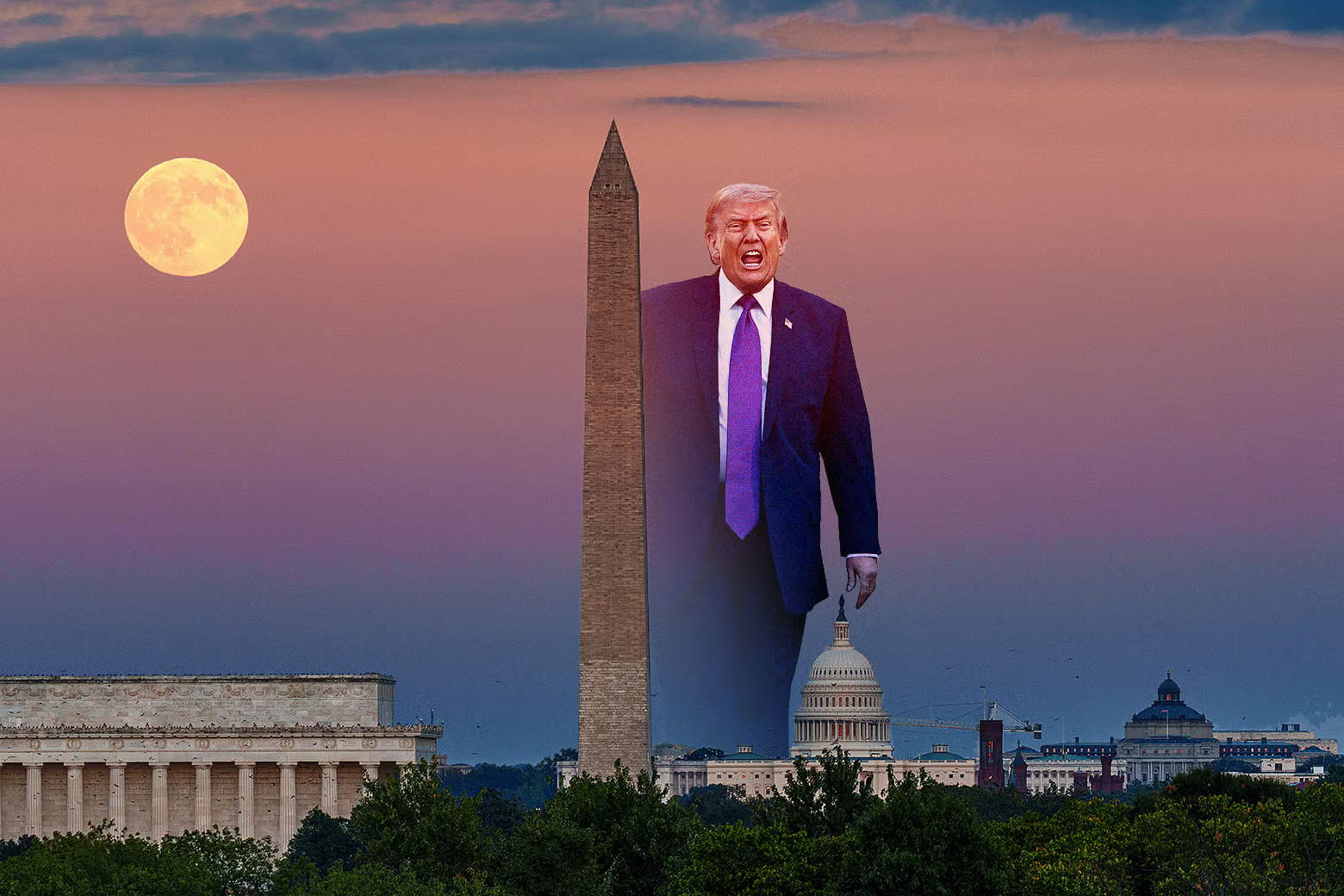
Under Donald Trump, the nation’s capital is getting a face-lift. The president has torn down the White House’s decades-old East Wing to make room for a massive ballroom that could end up costing taxpayers $1 billion or more. He ordered the Lincoln Memorial Reflecting Pool to be painted blue. He covered the Oval Office with golden tchotchkes, redid the Lincoln bathroom in marble, paved the Kennedy-era Rose Garden into a patio, and resurfaced a White House walkway with black granite sourced from Africa and carved in Italy (so much for America First). In some cases, the attempts to remake the city in Trump’s image have been literal; the neoclassical facades of the Justice Department and other federal buildings now feature giant banners of the president’s scowling visage.
Read more The Revolutionary Center: How to Revive Liberalism
He isn’t done either. Trump also wants to build a triumphal arch between the Lincoln Memorial and Arlington National Cemetery that would dwarf similar monuments in Paris and Rome. He has pledged to redevelop a swath of the National Mall into a “National Garden of American Heroes” that could reportedly feature dining facilities, an amphitheater, and hundreds of statues of famous Americans. On Thursday, his administration unveiled plans to transform one of the capital’s unassuming municipal golf courses into a luxe, 18-hole expanse that could someday host major tournaments.
The president’s vision of a revamped Washington has inspired a steady stream of opprobrium from political opponents, experts, and aesthetes. Many of them note that Trump’s design sensibilities would run roughshod over a capital city that was purposely engineered to embody democratic values. His proposed ballroom “represents another way this presidency has abandoned its imperative of projecting modesty, openness, and stability,” the architect and historian Neil Flanagan complained in the Atlantic this month. “It should reflect American values: hard work, humble beginnings, doing right by your neighbor,” the interior designer Annie Elliott told HuffPost. “The sterile white ballroom, with its 40-foot ceilings, gilded chandeliers, and sky-high windows, conveys none of that.” Trump’s arch, groused the New York Times, “would drastically change the sightlines between some of the country’s most symbolic memorials.” Writing in Air Mail, the Pulitzer-winning architecture critic Paul Goldberger called both designs “a desecration” of “the high aims of classical architecture.” Polls suggest that those critics’ reservations are widely shared. A Washington Post survey last month found public support for the ballroom running 2-to-1 against.
But if Washington is a city of national symbols, it’s hard to think of a more fitting monument to Trumpism than a tawdry ballroom, an oversized arch, and a terrace fit for Mar-a-Lago. To cast Trump’s overhauls as a perversion of the capital’s carefully calibrated architectural homages to democracy is to be living in the past. We’re talking, after all, about a man who rode a gilded escalator into the annals of American history, whose movement has been the dominant force in our politics for the past decade, and who, when asked last year whom his proposed triumphal arch was for, pointed at himself and said, “Me.” Plenty of previous presidents have left their mark on the city in ways that echoed their values and political vision. Why shouldn’t the vain, gauche man whom voters elected twice get to do the same, permanently etching himself and his political project onto the landscape? The nation’s capital was designed to mirror the character of the country. Trump’s renovations, tasteless though they may be, are a fulfillment of that tradition.
Trump is only the latest president to reshape Washington’s physical environs in line with his political goals. The city owes more than its name to the first commander in chief; George Washington encouraged the French developer Pierre Charles L’Enfant to design a capital that would symbolize the nation. L’Enfant gave Congress (the branch of government theoretically closest to the people) pride of place, with major streets radiating from it like spokes on a wheel. Later presidents made their own modifications to the cityscape. James Monroe and Andrew Jackson beefed up and refurbished the White House. Woodrow Wilson and Franklin Roosevelt erected millions of square feet of unsightly buildings on the National Mall to house an expanded federal bureaucracy during the world wars. (Richard Nixon tore them down decades later.) Lady Bird Johnson launched a series of beautification and urban renewal projects in Washington, a visual taste of the Great Society her husband hoped to bring about nationwide.
Before we go any further, please spare a thought for D.C.’s year-round residents, people with jobs and lives and families and dogs to walk, who are not only watching Trump garishly remake their hometown but also living through some of his most overt authoritarian impulses. America may have empowered the president to give the capital a case of Mar-a-Lago face, but the city’s inhabitants get only the slightest of say in federal matters.
But even if we limit the discussion to the most federalized and symbolic parts of the city, it’s worth addressing the objections to the idea that Trump is delivering the capital we deserve—or at least the one we voted for.
Yes, it’s true that most previous presidents had Congress’ go-ahead, public funding, and numerous design panels and historical-preservation committees’ sign-off before putting shovels in the ground. Many projects, like the Martin Luther King Jr. memorial and African American history museum, began as the deferred dreams of ordinary citizens. Most had at least some appreciation for the past. Harry Truman’s gut renovation of the crumbling executive mansion aimed to preserve the original feel of the White House’s public areas and living quarters. It also maintained the building’s relatively humble footprint, an explicit contrast with the palatial dwellings of European monarchs. Visitors often come away feeling that the White House and its spaces, including those they’ve seen on television, are smaller than they realized. Trump’s ballroom takes a wrecking ball to those pretensions to modesty.
The idea that the president has no legal authority to do what he’s doing has fueled court challenges to several of his pet projects. And on that basis, what he’s doing is incomparable to the many capital renewals of his predecessors. But in terms of echoing the state of our country today, what could be more apt than an administration that repeatedly undermines the rule of law, literally bulldozing a storied national landmark? It was inevitable that presidential fiat and impunity, which have metastasized across our political system under Trump, would eventually find expression in the capital’s terrain.
Read more Trump’s New Grift Is His Most Brazen … Ever?
Trump’s redone Oval Office, proposed arch, and hanging banners shamelessly recall the self-aggrandizement of tin-pot dictators past. His ballroom would overshadow the rest of the White House complex, jumbling the building’s symmetry but appropriately summing up Trump’s own vainglory and seat-of-the-pants governing philosophy. According to the initial design, which has since been tweaked, the ballroom boasted a colonnade that would have obscured guests’ view, a grand staircase that led nowhere, and a row of fake windows that hid bathroom stalls.
Trump’s D.C. makeover also captures one of his more cunning—and damaging—insights: that the institutions and procedures other presidents took for granted are in the hands of people who can be cajoled, intimidated, or replaced. To critics, Trump’s eagerness to steamroll process is a troubling sign of disregard for principles like deliberation, compromise, and rule of law. “Even if we are slow and we make mistakes and we fight, that process has meaning to us,” Carol Quillen of the National Trust for Historic Preservation told the Times.
But the president’s two terms have exposed the fragility of those institutions and norms. His willingness to stretch his authority, and the unwillingness of congressional Republicans to check him, is a signal feature of the Trump era that merits memorialization. Trump unilaterally dismantled the East Wing, and most of his party has embraced his argument that the ballroom is a national security imperative. He packed oversight commissions with appointees who would rubber-stamp his delusions of grandeur and did the same with the Kennedy Center, whose new board promptly renamed the performing arts venue for him. There’s even a possible corruption angle: To resurface the Reflecting Pool, Trump reportedly awarded a no-bid contract to a company he says worked on one of his golf clubs’ swimming pools. (The renovations, already over budget and behind schedule, reportedly won’t address the monument’s biggest problems: leaky pipes and algae blooms that turn its water cloudy and green.) To fund his ballroom, Trump initially solicited private donations that could open channels for powerful interests to curry favor with him. “It’s a metaphor for this administration,” California Gov. Gavin Newsom, a likely 2028 Democratic presidential candidate, told NBC News last year. “The recklessness to which he goes about things, the fact that he doesn’t believe in rules, he doesn’t believe they apply to him.” Precisely!
If completed, the ballroom would put on display how much Washington—both as a city and as a metonym for the federal government—has deviated from the founders’ intent. The hulking building would disrupt the line of sight that stretches down Pennsylvania Avenue from the White House to the Capitol building, a nod to the fact that Congress holds the purse strings and is meant to conduct oversight of the executive. “The ballroom is literally an imposition between two branches of our government,” the architect David Scott Parker, who’s on the board of the National Trust for Historic Preservation, fretted to the Times. But Washington no longer operates in line with that original layout. If Trump’s ballroom ends up a physical monument to a legislative branch that has handed over much of its power to the president, it would at least be conveying an honest truth. Other presidents have also sometimes behaved contrary to democratic ideals, and national memorials often present a more sanitized version of American history. Yet none of Trump’s predecessors were so bent on enshrining their shortcomings in mortar and marble.
Some opponents of Trump’s D.C. makeover have conceded these realities, to a point. Even a city as symbolically rich as Washington shouldn’t stay mired in the past, Goldberger, the architecture critic, acknowledges in Air Mail. “The capital is a living city, adding new layers of history as life goes forward.” Even architecture itself can be fungible. It wasn’t just the ancient Greeks and the American founders who favored classical forms; Roman emperors and the Nazis did too. But, Goldberger goes on, “neither Trump’s arch nor his redone reflecting pool nor his gaggle of statues is a meaningful new layer of history.”
That’s wrong. As even the president’s typical antagonists admit, Trump is the most politically consequential American of the 21st century. He has overturned long-standing assumptions about how the leader of the free world can and should comport himself, to the delight of his tens of millions of supporters. He has broken the cornerstone of American democracy, free and fair elections in which the loser cedes power peacefully, and won more votes after doing so than he did before. He has indulged U.S. adversaries and given NATO, Ukraine, and other allies reason to doubt American stewardship of the liberal international order. He has even tried to reshape how Americans understand their own history; the descriptions planned to accompany statues of King, Frederick Douglass, and Rosa Parks in Trump’s proposed Garden of American Heroes . The material excesses of Trump’s second term follow from a president unbound, determined to leave a mark on the vistas of Washington that matches the scar he has left on American society.
Of course, it’s still possible that Trump’s arch, Reflecting Pool paint job, and other proposed architectural changes won’t materialize, at least in full. Critics have sued to stop some of them; in March, a federal judge ordered the administration to halt ballroom construction, writing, “No statute comes close to giving the President the authority he claims to have.” More adverse rulings, or the delays that often accompany big renovations, could easily run out the clock on Trump’s presidency. Even if the projects do get finished, some Democrats are already talking about tearing them down if their party retakes power in 2028.
But picture, for a moment, the possibilities. A triumphal archway trumpeting nothing. A slapped-together ballroom the president promised others would pay for that instead costs taxpayers millions at a time of widespread economic discontent. A billionaire who once said he’d be too busy working for the country to golf putting on an upscale green he built in the heart of the capital. A revamped Rose Garden that buries the past and statues that diminish what the people they depict stood for. A Reflecting Pool void of any self-reflection. Sounds like Trump’s America to me.