 By admin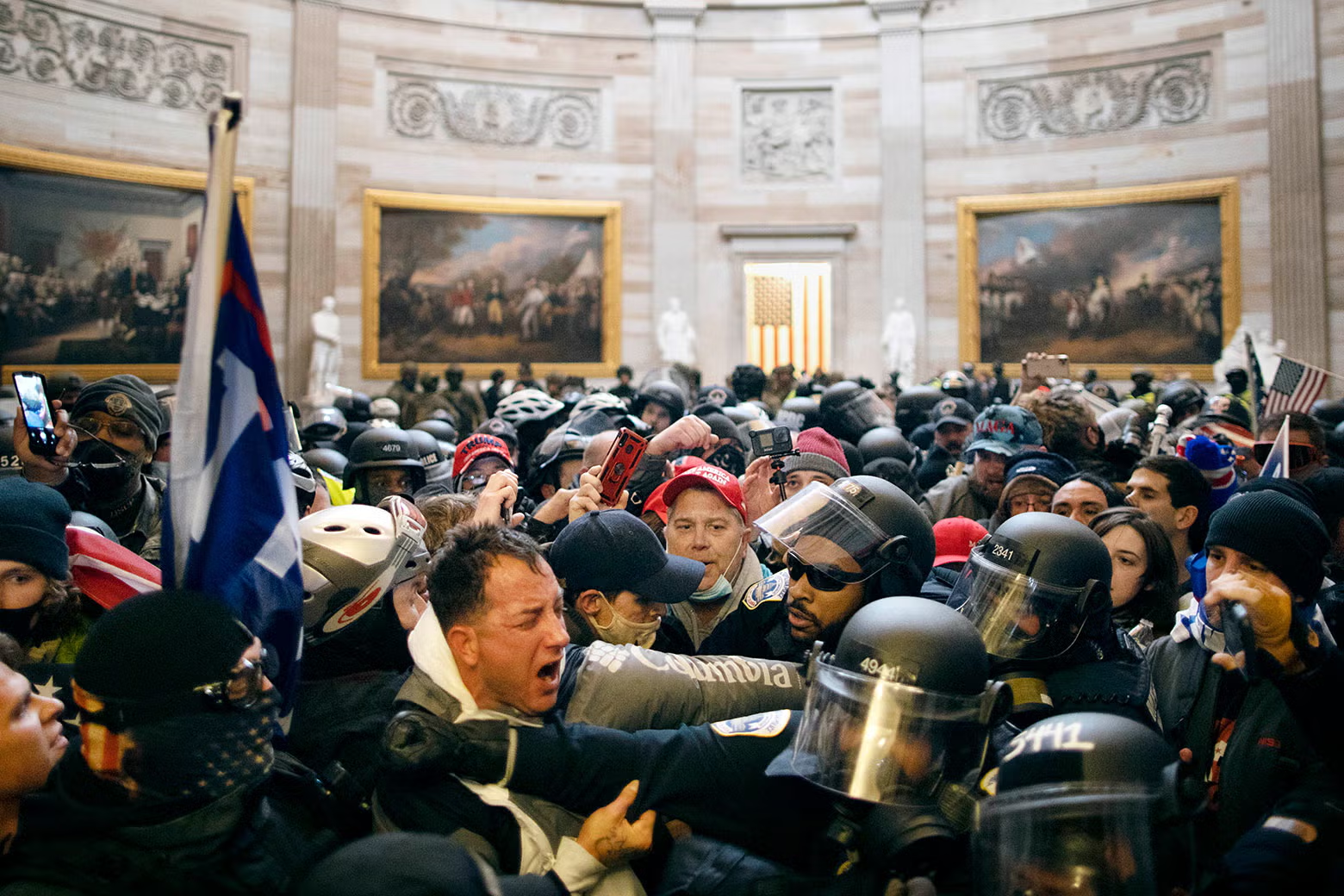
On Jan. 6, 2021, Larry Rendall Brock Jr. marched on the Capitol and became one of the riot’s most indelible figures. Many remember him as one of the “zip-tie guys”—he was photographed crossing the Senate floor in tactical gear, white flex-cuffs dangling from his fingertips. Before actually showing up in Washington, the retired Air Force lieutenant colonel had discussed, over Facebook, seizing members of Congress. He also floated applying the same interrogation techniques he once used against al-Qaida to “gain evidence on the coup” he thought the members were perpetrating.
Read more Trump’s First Big Vindictive Prosecution Just Went Up in Smoke
As Brock told us, the five years since have not been kind. He was convicted on six federal counts and served two years in prison. Even after his release, his combat-gear-clad image, zip ties in hand, became a visual he couldn’t outrun. “I gave the Left a beautiful optic for that day, and I never meant to do that,” he said. “Trust me, you have no idea how much I wish I had never picked them up, but I did.”
So, when Brock heard about the Justice Department’s new “Anti-Weaponization Fund”—a $1.776 billion program to compensate purported victims of a “weaponized” justice system, including prosecuted Capitol rioters—he felt something like relief. “I’m very thankful to President Trump for actually doing something about it,” he said, calling the fund “long overdue.”
Other Jan. 6 defendants we spoke with shared in Brock’s gratitude, maintaining that, far from being criminals, they are in fact the victims of overzealous prosecutions tied to the Capitol riot. Treniss Evans, a Texan who drank a shot of Fireball whiskey in the speaker of the House’s conference room, also praised Trump for the creation of the fund. Leo Kelly—a devout Christian Iowan who was seen ascending the Senate dais, leafing through sensitive documents, and praying in the chamber—described it as “a blessing.” Brian Mock, a Minnesota man filmed shoving an officer to the ground before later boasting that he “” out of him, believes the fund could finally allow him to retreat into a quieter life: “I think I’ve earned my peace.”
To many of these defendants, the fund is a long-awaited recognition of the “weaponized” justice they suffered. “It will mean everything to a lot of people,” Brock said. In some corners of the Jan. 6 community, the only question that remains is whether it will be enough to compensate for everything they claim to have lost.
Much of the country feels different. Since its announcement last week, the fund has faced mounting skepticism over its legal standing. Just last Wednesday, two police officers who defended the Capitol on Jan. 6 filed a federal lawsuit against the fund on the basis that it violates several federal statutes and even the 14th Amendment, which prohibits the use of public funds in aid of insurrection. A coalition of nonprofits and individuals, including a fired Jan. 6 prosecutor, followed suit—filing a similar against the fund in the Eastern District of Virginia. Republicans in Congress, too, have departed from the president on the “slush fund,” with members like Kentucky Sen. Mitch McConnell calling it “stupid” and “morally wrong.”
The hot-button initiative was established to settle President Donald Trump’s against the IRS over leaked tax returns, along with administrative claims stemming from the FBI’s 2022 search of Mar-a-Lago for classified documents and investigation into Russian collusion in his 2016 campaign. Drawn from the Treasury Department’s Judgment Fund—a permanent pool of taxpayer dollars typically used to settle government lawsuits—its mandate is to provide financial compensation and formal apologies to those who claim they were victims of DOJ-dubbed “lawfare.” The reserve seems set up to serve Trump allies who feel they were targeted by Biden-era actions, including the Jan. 6 prosecutions.
To the Jan. 6 rioters who violently breached the Capitol, a government check using Americans’ tax dollars isn’t outrageous, but overdue. While the defendants we spoke to acknowledged some discomfort using taxpayer dollars to finance this retribution, more striking was their unwavering belief that they deserved every cent. “It’s not really right to charge the taxpayers for it, but it wasn’t really right for the taxpayers to have their resources used against us,” Kelly said. Mock insisted that Capitol rioters were more deserving stewards of taxpayer money than the federal government because Jan. 6ers “are going to do way better things with those dollars than our government will ever do with them.”
Many defendants are already imagining what financial relief could mean for them. To Kelly, the “perfect resolution” would split the money among his church, his local school, and the Iowa Liberty Network—a PAC focused on electing conservatives and advancing causes like abortion restrictions, banning critical race theory, opposing vaccine mandates, and defending religious freedom. Brock said he would use some of the money to bankroll another attempt at running for state office, hoping to leverage political power “against corruption and fraud.” Mock, who reread The Lord of the Rings every year from fourth grade through ninth grade, has simpler dreams: “a hobbit hole out in the countryside, and as little as possible.”
Every defendant we spoke to argued for compensation for attorneys’ fees.Kelly said his costs alone ran well north of $100,000. Beyond that, many think they are entitled to further financial restitution. And it carries a hefty price tag—particularly given that most led middle- to upper-middle-class lives before their sentencing. The money, in their view, not only has to make up for mounting legal fees, but lost income, tainted reputations, fractured families, and years spent behind bars.
Mock, who previously owned a landscaping company, said he lost his house and “a good six-figure job” while serving jail time—estimating he has lost $1.2 million in salary alone. He said he plans to pursue an eight-figure claim against the government. Evans said that “a six-figure settlement, to most January 6 defendants, is a slap-in-the-face insult.” His once multimillion-dollar company collapsed after its association with Jan. 6, and he was subsequently fired. He will apply to the fund pursuing over $1 million in damages.
If the fund’s taxpayer-backed $1.776 billion cache were to be divided evenly between just Jan. 6ers, each would receive around $1.125 million. To Brock—who lost not just his salary but his pilot’s license and, thus, the ability to practice his profession—a “paltry million” is “not enough.” Mock said it is “the absolute least they can give.”
“When you look at the overall weaponization, there’s so many parts to it,” Mock said.
Defendants told us about the toll they felt their prosecutions took on their families. “I had my son essentially taken away by a hostile judge who claimed it was an ‘insurrection,’ ” Brock said. He plans to use the fund money to hire an attorney to fight for custody, but that’s just the practical remedy. “How do you measure taking away a father’s right to see his child for five years?” he said. Evans described a similar loss: “I had my home raided, and my family put at gunpoint for what ended up being a misdemeanor, because they asserted some ridiculous charge.”
Read more Trump’s Floundering in Iran Is Great News for China and Russia
For Mock, pretrial detention—which he likened to Soviet forced-labor prisons—is the foundation of his perceived injustice. “Those of us who were in the gulag, who were held pretrial in ‘21 and ‘22, faced a weaponization unlike any group of people in modern history,” he said. Both he and Brock reported extended solitary confinement stints—four months for Mock, seven for Brock.
Long before the fund surfaced, Jan. 6ers spent years pursuing recourse on their own—even from their prison cells. After being encouraged to settle in 2021, Mock fired his Berkeley-educated lawyer and filed a handwritten pro se motion to dismiss all of his 11 counts from his D.C. jail, using—according to him—nothing but a “pen, a piece of paper, and a pocket Constitution.”
The later denial of his motion did not cool his grievances, but calcified them. Although he was released in January of 2025, Mock is still chasing vindication against a supposedly unjust legal system that convicted him of kicking a police officer. “Many ‘assaults’ were not assaults. I was found guilty of a thought crime,” he told us. And he has been resolved to pursue every legal and administrative avenue, vowing to “exhaust every internal remedy available” until, in his view, justice is served.
Indeed, for many Jan. 6ers, monetary relief is not all they are after. Even a multimillion-dollar payout pool cannot compensate for what they see as a fundamentally unfair adjudicative process. “There’s a lot more than just financial restitution,” Brock said. “I mean, my First, Second, Fourth, Fifth, Sixth, and Eighth Amendment rights were violated by my own government that I fought for, so what price do you put on that?”
Since last winter, the Trump White House has cast Jan. 6 prosecutions as not merely illegitimate, but illegal. The DOJ created a “Weaponization Working Group” thanks to an executive order aimed at examining alleged Biden-era prosecutorial overreach, including that of Jan. 6. Evans, who said he began working with the weaponization task force in June 2025, pushed for sweeping investigations into the prosecutors behind Jan. 6 cases. He even suggested criminally charging them outright. “Should they not be accountable?” he said. Legally, the proposition borders on fantasy: Prosecutors are broadly shielded from civil and criminal liability, and the proposal to prosecute prosecutors over charging decisions would radically cut against modern legal doctrine. Evans wasn’t interested. “I don’t want to hear shit like ‘absolute immunity.’ … It’s immunity from a mistake. … There is no protected class of any kind when it comes to the law.” But so far, the Weaponization Working Group has produced one report, on exclusively anti-Christian bias. Mock, who claims to have met with the group’s leader, Ed Martin, found this disappointing: “The American people expect equal justice, not selective follow-through.”
Mock arrived at Martin’s desk with ambitions that would similarly break from legal tradition, seeking the impeachment of the entire D.C. bench. Just 15 federal judges have ever been impeached in U.S. history—and only for “high Crimes and Misdemeanors,” not simply because litigants opposed their rulings. That history renders the prospect of impeaching an entire judicial bloc both legally unfounded and politically extraordinary. Even Mock acknowledged the objective as “unprecedented,” saying it “would’ve taken some big balls to pull off.” He had previously filed an impeachment statement against the federal judge who convicted him, a complaint against the inspector general, and an SF-95 tort claim—highly unusual approaches that have all been rendered futile, at least thus far. He told us he also met with several representatives and even routed materials about perceived weaponization through Secretary of Defense Pete Hegseth.
Other Jan. 6ers have tried much of the same. Brock ran for state office, promising election integrity and judicial accountability, and lost. Evans told us about hand-delivering 535 spiral-bound copies of a self-drafted weaponization report to every member of Congress. At first, Texas Rep. Chip Roy indicated he’d bring articles of impeachment against the federal judge who’d convicted Evans, but Roy backed out, according to Evans, because Republicans “just didn’t have the votes.” (We reached out to Roy’s office for comment but did not hear back by press time.) Evans says he is still in touch with a few members as founder of Condemned USA, an advocacy group for the Jan. 6 community. He continues to lobby congressional officials and their D.C. staff members, but his broader aims have yet to materialize.
Meanwhile, Evans has tried other approaches, namely the courts. As a self-described paralegal, he’s assisted Peter Ticktin—a south Florida attorney for Donald Trump who represents high-profile Jan. 6 defendants (including Enrique Tarrio and Stewart Rhodes)—on more than 400 civil claims against the Justice Department. The government has yet to settle a single one.
And the fund’s announcement has only accelerated their efforts to challenge alleged DOJ “weaponization.” Just within the past week, Evans filed a lawsuit against the Justice Department in federal court. Ticktin separately continues to build out legal theories about the purported targeting of Jan. 6 rioters. One central framework, he told us, will argue that D.C. Metropolitan Police “set up” Capitol rioters, using crowd-control tactics to provoke violent confrontation. “We’re going after police for excessive force,” he said. “Jan. 6 was actually planned in advance. It wasn’t a spontaneous thing where a whole bunch of protesters decided to storm the Capitol.” Many defendants embrace similar narratives. “It wasn’t an attack. There was a protest. Police created the part that really drove it out of hand,” said Evans. “My intent was clear: to simply demonstrate and sing the national anthem.”
For many defendants, the alleged orchestration of Jan. 6 did not end at the Capitol that day—it extends into the government’s public retelling of the riot. Mock thinks Congress’ Jan. 6 committee “literally doctored evidence” with “Hollywood theatrics and flat-out lying.” He also said that those involved “should be in prison,” and that “every single J6er out there would trade any dollar amount” to fully expose the committee’s actions.
Ultimately, Trump’s $1.776 billion olive branch to the Jan. 6 community may do little to temper their broader campaign for retribution, especially in light of recent GOP discussions about who qualifies as a victim of “weaponization.” Alabama Sen. Tommy Tuberville said Attorney General Todd Blanche privately assured Republican senators that rioters who assaulted police would be excluded from the fund—although Blanche declined to say so in public testimony this past Tuesday. The distinction is telling for certain Jan. 6 defendants. “If we aren’t all included in this fund, then it is clear that Blanche, the DOJ, Senate, FBI, etc., are still complicit in the weaponization against us, and this whole thing is an attempt to sweep their culpability under the rug,” Mock said.
And even the prospect of compensation hasn’t softened broader plans for civil litigation. When asked whether any of the more than 400 Capitol rioters would forgo their lawsuits against the DOJ upon the fund’s announcement, Ticktin shared that the claimants at his law group are “going forward with all of it.” Among them is Brock, now a client of Ticktin, who still insists “there’s been zero accountability” for the prosecutors, judges, and FBI agents that he believes coordinated a campaign of legal retaliation against him.For Brock, a government payout is nice, but what he really wants is a reckoning. “Someone has to make this right,” he said.
Read more The Best Place for a College Student to Truly Learn