 By admin
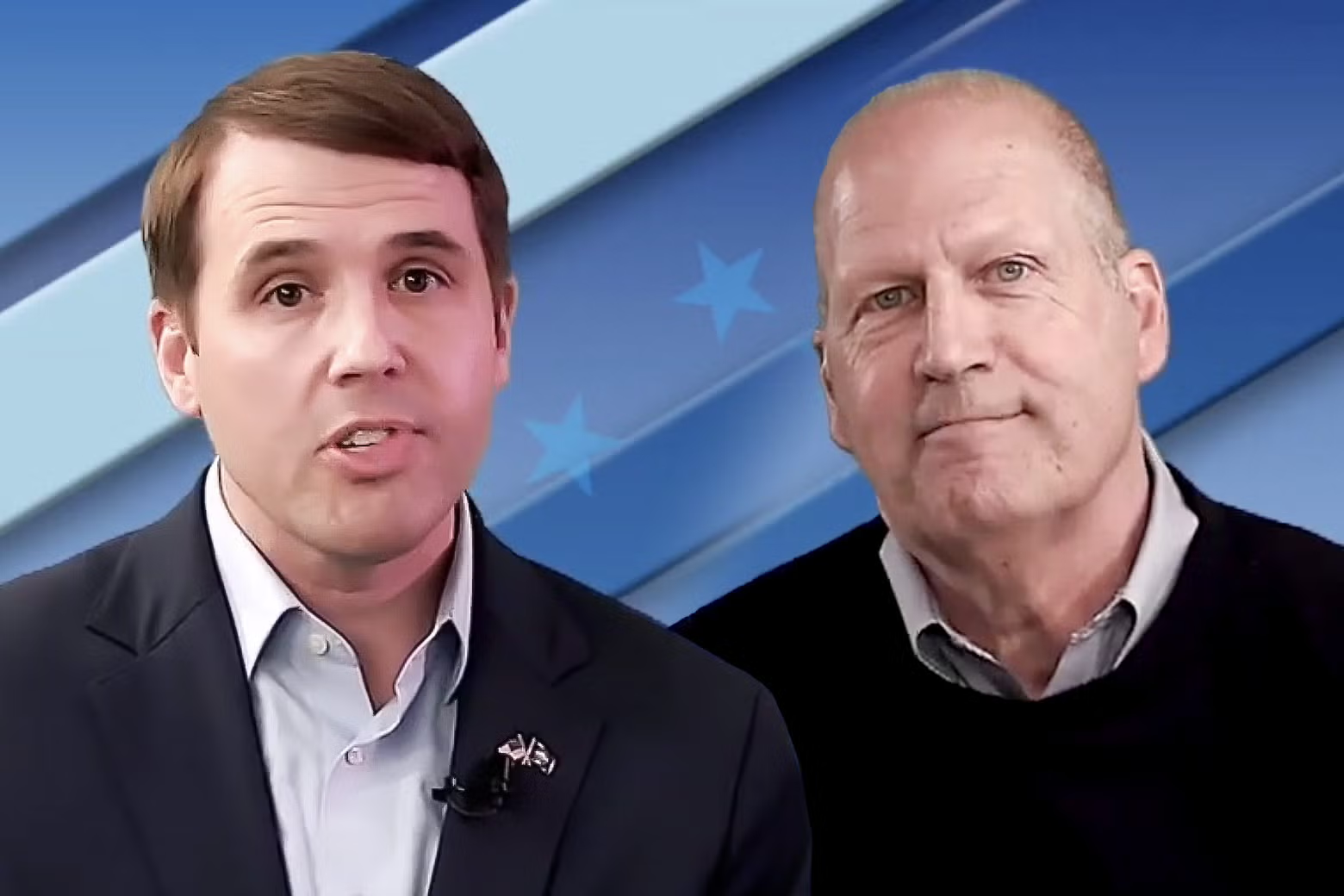
Less than half an hour into the first debate between the two candidates for New Hampshire’s open Senate seat, the moderator put his foot in his mouth. “Do you think that’s important, Chris Sununu?” George Epstein, of the Conway Daily Sun, tried to ask one candidate, before immediately course-correcting: “Excuse me—Chris Sununu is definitely the wrong name to use.”
Read more Why There’s a Real Risk of a Replay of the 2020 Election Come Tuesday
It was a mistake that said more about the race than any of the candidates’ answers. Yes, John Sununu, Republican, is running against Chris Pappas, Democrat. But Epstein’s error wasn’t an unfortunate mashup of the two candidates’ names: It was a reference to John’s younger—and significantly more popular—brother, Chris Sununu, also the state’s most recent former governor. (John Sununu has served on New Hampshire’s behalf in both the U.S. House and Senate, but he’d been out of office—and out of politics—for almost 20 years, until he joined the race this year.) If you’ve read anything about the New Hampshire Senate race, you might have heard that this is the one where the Republican is trying to ride his brother’s coattails to flipping a seat. This is reflected in his campaign’s perhaps oversimplified yard signs, the majority of which carry only two words “Sununu, Senator,” prompting plenty of residents to wonder if he’s deliberately skipping listing his first name.
Video from Slate
Otherwise, on paper, the New Hampshire Senate race has been a bit of a sleeper, despite the fact that it’s a competitive contest in an every-seat-counts struggle for control of Congress’ upper chamber. There are plenty of reasons for that: The September primaries were extremely boring compared to other Senate primaries that demanded national headlines. And unlike other primaries that seemed to point toward where the Democratic Party might be heading in 2028, Pappas’ win hardly felt like a bellwether. He did face a challenger from the left, but Karishma Manzur never put up numbers that made her a real threat, and Pappas beat her handily. Sununu did the same with his further-right challenger, Scott Brown, the former senator who had previously (and briefly) represented Massachusetts. That brought Pappas and Sununu to face off against one another in a Senate race that feels almost like it could be happening back in 2012, with classic establishment candidates from each party promising Granite Staters that they’re the ones who will have New Hampshire’s back in Washington.
By many measures, it should be Pappas’ race. New Hampshire may be purple, but it’s reliably voted Democrat for president every year since 2000, and the delegation it sends to D.C. has been blue over the past several cycles too. Despite a bit of panic earlier this fall (“New Hampshire Democrats Sound an Alarm: We’re Losing” blared a New York Times headline in September), Pappas has .
But I have become particularly interested in New Hampshire’s Senate race, in large part because I live here—I moved a couple of weeks after Trump retook the presidency, soon enough that my town hall was still displaying the 2024 vote count, when 800 residents went for Kamala Harris and 792 went for Donald Trump. And I have come to think of this race not as a sleeper, but as the flip side of the coin to whatever happens with Abdul El-Sayed’s bid for Michigan’s seat or James Talarico’s impressive attempt to flip Texas. This is a race of establishment candidates in a moment when both the Republican establishment and the Democratic establishment are beleaguered.
I wanted to find out what the establishment version of either political party even looks like these days, and whether the most boring Democrat in a midterms year of stars might have something to teach the rest of his party. I also needed to understand whether anyone actually votes a split ticket in our wildly polarized times. Given my own progressive tendencies, I came away surprised by how much close observation of the contest changed my mind.
It’s not that this race feels like it’s happening specifically in 2012, it’s just that it has a retro feeling about it, particularly thanks to the candidates themselves. Jason Barabas, a government professor and director of the Rockefeller Center for Public Policy at Dartmouth College, put it succinctly: “You have the first open Senate race since 2010, but you have two incumbents squaring off.” Chris Pappas served in the House of Representatives for four terms before the Dems nominated him for Senate this year, and Sununu, a former congressman and senator, comes from the state’s biggest political dynasty. (It’s not just John Sununu’s brother Chris—the boys’ father, also John, also served as governor of the state, and as chief of staff for George H. W. Bush, with a memorable legacy.) “If his name wasn’t Sununu, I don’t think he’d be in the position he’s in,” Nicholas Germana, a government professor at Keene State University, told me.
Germana knows what he’s talking about not only because he studies government (primarily German politics, not American ones), but because, like so many New Hampshirites, he serves in the state government himself. New Hampshire’s House of Representatives has 400 members (though apparently no one sits in seat No. 13), making it the second biggest legislative body in the country, just after the U.S. House, and one of the largest governing bodies in the world. This is particularly silly when you consider the small size of the state—with under 1.5 million residents, it’s split into just two congressional districts. But it’s also a huge source of pride and a cause of political engagement here. While reporting this story, multiple state reps reminded me that New Hampshire was the first state to declare independence from England (six months before the country did), and even if the state is losing its first-in-the-nation primary status (Iowa was always a caucus), being demoted from second to third (South Carolina and Nevada are moving up for Democrats) in this upcoming cycle, New Hampshire will still take its task extremely seriously.
Is it people’s political involvement that has given the state its purple nature, with a push and pull back and forth between the parties? Not really. Independents outnumber registered Republicans and Democrats. For years now, the state government has been red—and currently, it’s a united Republican governorship, Senate, and House—while the state votes blue for president and sends a full blue delegation to D.C. Which means that people are splitting their tickets: red for the state, blue for the country.
“That’s something we talk about all the time—marvel at, frankly—is how much ticket splitting there is,” Germana told me. That’s partly because you have a much higher likelihood of actually knowing your House representative, which might get you to vote across party lines. But it’s also because there’s some cultural state pride in “balancing things out,” even in these times. New Hampshire had one of the highest rates of ticket splitters in the 2022 midterms, Barabas told me, and this year, 13 percent of voters have already declared a preference for splitting their ticket. (The likely way this will lean is to send Pappas to Washington while the current governor, Kelly Ayotte, stays in power.)
But the times are making it harder and harder to do that. These midterms are seeing an active effort from Democrats across the state as they respond to some of the more extreme moves made by the united Republican state government. “Republicans in the state had been able to maintain a brand identity that is different than the national Republican Party—rooted in that traditional view of what a Yankee Republican used to be,” Germana told me. But as the Republican agenda has lurched right, that distance has evaporated. In recent sessions, the GOP here has passed culture-war legislation like banning trans athletes from sports. They’ve also taken more aggressive steps to throttle public schools, including voting in a school voucher program that has activated plenty of independent voters. These days, there’s “no daylight between the Republican brand in the state and the Republican Party nationally,” Germana told me, though it’s worth keeping in mind that Germana is not just an observer—he’s technically a member of the opposition party.
All of this makes Sununu’s bid to flip a Senate seat a tough effort, and that’s before you take into account his weaknesses as a candidate. While Sununu says he’s not at all trying to fool anyone into thinking he’s Chris, multiple people told me they only realized which brother was running when the primary came around in September. (Their reaction was not positive—Chris had a lot of cross-party appeal thanks to being “a phenomenal retail politician,” Germana said, which John lacks.) John Sununu’s been out of politics since he lost to Jeanne Shaheen in 2008, and it’s Shaheen he’s looking to replace now. While his absence from politics affords him a certain distance from Trump, when he lost his Senate seat, Sununu resorted to a classic move for the establishment and politicians of both parties: He went into lobbying, something the Pappas campaign has made hay of in both ads and debates.
John Sununu was a Never-Trump Republican who supported John Kasich in 2016 and Nikki Haley in 2024. And yet, he finds himself in a difficult position this race, as D.C. Republicans personally recruited him to run, after failing to get his brother to do so. It feels a bit like he’s trying to run this race as if he could be New Hampshire’s very own Susan Collins, a Republican, sure, but a reasonable one who would hold his party to account. The problem is, Donald Trump endorsed him during his primary race, and here, like everywhere, Trump’s popularity is plummeting. Recent polling found that the number of Granite Staters who approve of the president was the lowest ever—just 19 percent said they approved of Trump in September of this year (compared to the 41 percent who approved of Trump in 2018, during his first in-office midterms). People are mad about tariffs and the Iran war just like they are everywhere—but New Hampshirites get to be extra mad because we share a border with Canada and are heading into winter, where fuel costs will matter more.
Read more Is Iowa a Swing State Again?
All in all, Collins and Sununu seem to be the last individuals trying to claim that it’s possible to be something of a New England Republican—conservative on fiscal issues while being socially liberal—as Trump’s presence and his overwhelming grip on the Republican Party make the viability of that brand more and more difficult. But even Collins is struggling with this message this cycle, and Sununu is not campaigning in the relentless way she is in neighboring Maine. “Sununu is running a low-key campaign with almost no public rallies, few appearances from Republican surrogates, and limited engagement with national media,” the Dispatch reported recently, and he dropped out of what was supposed to be the final debate. I myself tried to engage with his campaign in multiple ways—attempting to RSVP to a meet-and-greet I was told was closed to the press, emailing the campaign, and even eventually texting his campaign spokesman—all to no avail. The main action seems to be in the form of the millions of dollars pouring into the state, where the GOP does have a clear advantage. (In early October, Republicans had spent $39 million compared to Dems’ $23 million, though both campaigns said they have about $14 million on hand for the final few weeks.) The latest ad features Sununu trying to distance himself from Trump, repeating his line that he’s “never met the man.”
Pappas is doing the exact opposite of Sununu. He’s been crisscrossing the state (well, driving up and down—you can’t really drive across in New Hampshire) with bigwig Democrats who are happy to add a stop here in anticipation of 2028. Raphael Warnock, Pete Buttigieg, and Gavin Newsom all came through, and late this month, Pappas was joined by Kamala Harris herself. Which is part of what has gotten Pappas into trouble with members of the left flank of his party: Donald Trump may be toxic, but the Democrats are also dealing with their own intra-party feud. Manzur, his primary challenger, took aim at Pappas’ establishment connections and big money—her signs said “Powered by People, Not Billionaires.” And like Abdul El-Sayed, she tried to make her weak fundraising (in the low hundreds of thousands, not millions) an asset rather than a liability. It didn’t work—Pappas beat her by a ratio of just about 2-to-1—but it doesn’t mean her messaging didn’t land somewhere. I spoke with a group of students at Colby-Sawyer College in New London who were all required by a class to attend a political event on campus, and when I asked what they thought of Pappas, they all groaned and told me he was a “corporate Dem”—basically as bad as Sununu, who they didn’t want to vote for either, mind you. Several were still deciding whether they’d bother to change their state registration to vote here this fall (one knew she wouldn’t because she was “excited to vote against Susan Collins”).
College students will be college students, but they weren’t the only ones I heard lamenting that Pappas might not have what it takes. An that found Pappas has the edge also showed that both candidates have underwater favorability ratings. And I have to admit, for a long time, I felt the same way. On primary day, I was personally conflicted about who I’d vote for. (I’m a registered Democrat.) Ultimately, I watched about 30 minutes of the debate between Pappas and Manzur, and decided that Manzur wouldn’t have a chance of making it out of our purple state. I pulled the ballot for Pappas, but really it was a vote for pragmatism, driven by concerns over the ultimate balance of power in the Senate.
Since then, though, I’ve been following him much more closely, and I’ve come to feel differently about my pragmatism vote. That’s largely thanks to the actual campaign that Pappas has knit together—one that has closed the initial gap he faced and looks solid going into November. At one stop I watched him tour a small manufacturing plant, nothing bright or flashy, but Pappas was the picture of politeness, gamely asking questions about how they’d gotten a competitive edge in the niche grips they made. The visit demonstrated what a layup Dems are getting this time around: Tariffs causing this small business problems—check. The war in Iran increasing expenses—check. Healthcare premiums going up—check. Pappas, whose family has long owned the Puritan, an event and conference space with a restaurant that claims to have invented chicken fingers, was able to engage in the minutiae of their business, from a place of true empathy. An on-floor engineer remarked that they sell their scrap metal, and the price has skyrocketed—something they take as a sure indication that the economy is going down the tubes. “Just like when peanut butter sales go up,” the chicken-finger heir nodded solemnly.
At that stop, I spoke with an employee who told me she’s never been into politics herself, but that she’s estranged from both her parents on account of Trump. She stopped talking with her mother the day Roe v. Wade was overturned, she said—she couldn’t take it anymore, and she wants to set an example for her son about how people should behave.
Her story was specific, but the distaste for Trump was second only to “affordability” on the trail, and luckily for Democrats this cycle, the two are intertwined now. You can’t go to a campaign event in New Hampshire without running into at least a few state reps (or candidates for state rep), and many of these people told me that they’re hearing from a lot of independents who are fed up with Trump and prices and are voting blue, and even a few registered Republicans here and there. Many offered praise for Pappas, who is skilled at listening to all sides of an issue and takes his representation of a mixed district seriously, they said—he’s made it easy for right-leaning folks to switch over. “He’s a guy who knows how to win a purple district,” Germana had told me, and he’s calibrated his public persona and strategy around that.
One thing that’s stood out to me is the way Pappas seems to actually decenter himself in these settings, which you don’t need me to tell you is unusual for a politician. If elected, he will be the first openly gay senator in American history. This is not something he ever brings up himself, which, sure, maybe is a nod to the fact that identity politics is truly dead, but I think is more of a representation of his style as a legislator. Also: You’d think the man whose family claims they invented chicken fingers, of all things—what is more American and universally beloved than a chicken finger—would toot that at least a little bit on the campaign trail. But it’s all pretty straight “as a family business owner, I understand the struggle” type stuff. (On a recent visit to the Puritan Backroom, I was struck by two things: how quintessentially New Hampshire it was, which I’ve realized is my code for “caters to Trump voters,” and how delightfully large their Puritan Backroom–branded sauces are—Pappas should be running on his record of ranch portion sizes.) He’s a politician who has done things methodically, which in this day and age means mainly that he paid his dues in both the New Hampshire House and the U.S. House, along with a stint on the state’s executive council, before he went for a bigger office. In his mid-40s, he seems young for the Senate, but that’s just because he has a boyish look and our standards for how old lawmakers should reasonably be are broken. He has a stick-to-the-message-ness that can make him seem rehearsed—or can be interpreted as discipline from someone who is taking his race dead seriously.
At a canvass kickoff event on Oct. 17, the one where Gavin Newsom joined the New Hampshire delegates running for office, I heard more practical praise for Pappas. A state House rep who described herself as far more progressive than he is explained why she voted for him in the primary over Manzur: Pappas pledged to endorse his opponent if he was bested, and Manzur did not. This was not the moment for such games, the rep had concluded. There was a couple who had come up from Massachusetts to canvass who constituted the first real Chris Pappas fans I met in the wild (“I’ve always liked him,” the woman told me, with an almost mothering quality). OK, fine, it wasn’t really the wild—these were people who were giving up their Saturday to knock on doors for Democrats, and would most likely end up at a “No Kings” rally later in the afternoon.
Just two days before, the Pappas campaign had announced a “Country Before Party” steering committee of more than 50 Republicans and independents who were endorsing Pappas for Senate. The big coup on that list was Don Bolduc, the Republican who has been defeated for that exact Senate seat in the previous cycle. “I think that one was kind of surprising, to tell you the truth, and that can be quite powerful,” Barabas, the Dartmouth professor, told me. At the canvass launch, Pappas attributed Bolduc’s endorsement to his military experience, and his recognition of the nightmare the military is currently facing, led by Pete Hegseth into the Iran war. It set Pappas up perfectly for his line that “everyone is welcome on this team: progressives, moderates, independents, Republicans.” It was this plain appeal that made me start to realize what feels good—almost calming—about Chris Pappas’ campaign. There was something fundamentally decent going on here—a representative who truly seemed to understand that the job of an elected official is to represent all of his constituents, not just the ones who agree with him.
One of the most memorable pieces of political journalism I’ve read this midterms cycle was a New York Times Magazine feature from Robert Draper that reported out, via interviews with legislators in both national houses, why Congress is so broken. It turned the entire idea of the midterms on its head for me: “On Nov. 3, American voters will decide which party controls the House and the Senate for the remainder of Trump’s presidency. In theory, at least, the outcome of their decision should be enormously consequential.” In practice, though, Draper is not sure how much any of it really matters, as he goes on to outline exactly how much power the legislative branch has ceded during the mind-bending times of President Donald Trump. There are many reasons for that, including Trump’s astonishing willingness to break norms (see: setting tariffs, something Congress is supposed to have control over). But Trump is also the avatar for how our broader politics have broken over the past decade-plus. Members from both parties explained that the quality of those who choose to join the government has declined, by which they mean that they’re all narcissists now. “What you see now are too many people who come in viewing Congress as their green screen,” David Joyce, a Republican from Ohio, told Draper. “And they’re going to make a name for themselves and don’t give a damn about anything else.”
I’m not trying to suggest that the old Congress was all sunshine and daisies. Bogged down by our resolutely two-party system, we Americans can end up fetishizing Washington bipartisanship (that is ultimately out of step with what most regular people want—there’s a reason both sides are turning on the establishment this cycle). But even compromise is getting a bad name these days. Work too hard to actually get things done, and you might end up primaried by an inexperienced challenger like Manzur who may have plenty of good ideas, but no ability to even make it to D.C. to try them. It’s not that Congress should be populated by only normies, but it’s good to have a solid bloc in the mix. They aren’t exciting, but they’re a decent bulwark against the kind of “exciting” we’ve been living through, with brief interruptions, for a decade now. In the absence of a Congress that passes legislation, we have a Congress full of grandstanders.
Forgive me for my Pollyannaishness, but as I’ve tried to figure out what is happening in my own state, why this tight race isn’t getting as much attention as I think it should, I came to a pretty simple conclusion. Chris Pappas is running to legislate. In 2026, that’s pretty boring. But I found myself convinced by his pitch—that he is actually going to Washington to attempt to solve our problems, even if it means reaching across the aisle or compromising in favor of getting something, anything, done. He won’t do it with a lot of fanfare, and he certainly won’t do it in a tight black V-neck. But he’ll try. Let’s just hope it’s still possible.
Read more MAGA Wants to Do a Jan. 6 on Brazil’s Behalf

Get the best of news and politics
Sign up for Slate’s evening newsletter.