 By admin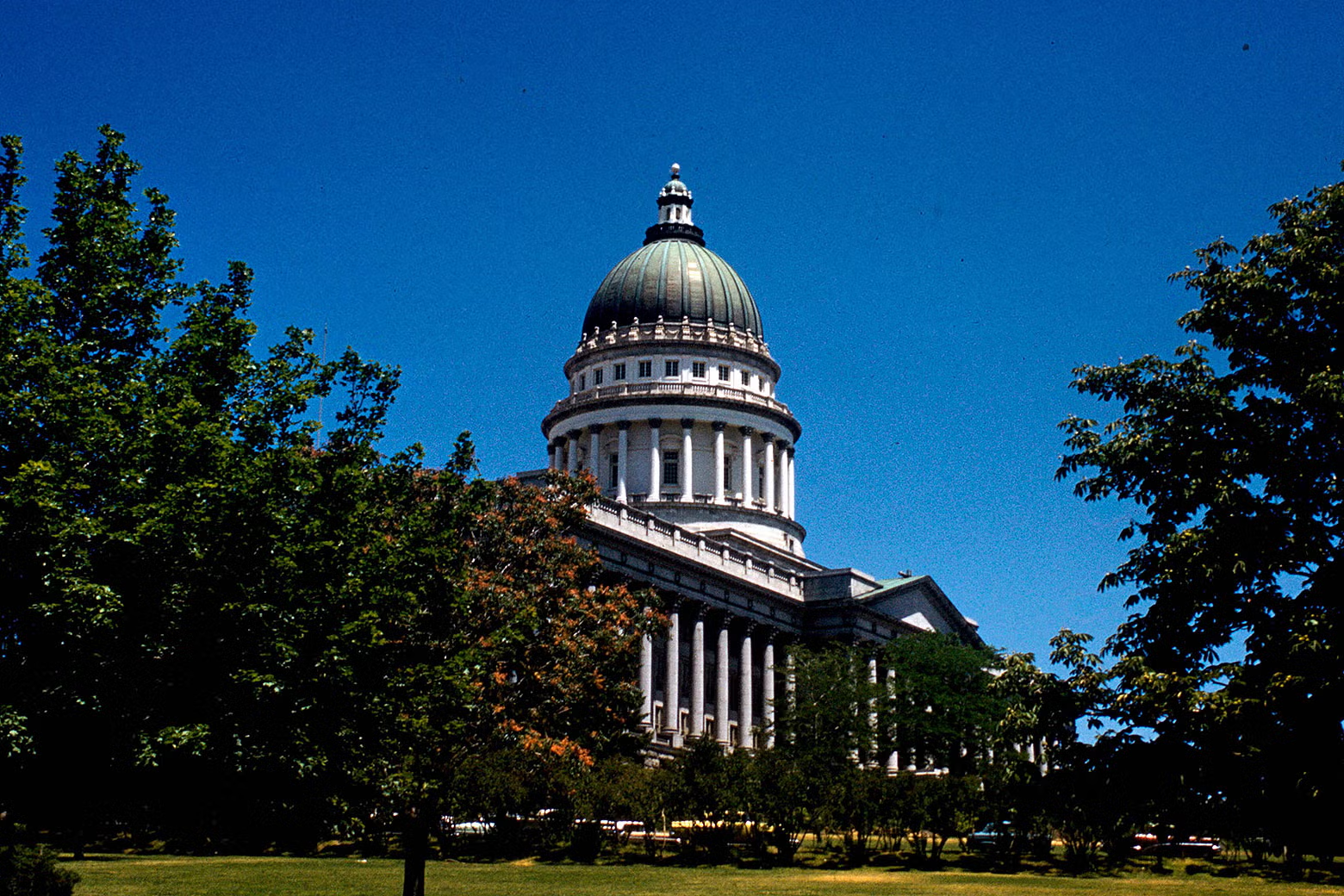
A case before the Utah Supreme Court will determine whether judicial panels created under a new law to hear constitutional challenges will be allowed to decide much of the state’s high-profile litigation. The law establishing the panels, enacted just a few months after a Utah judge struck down the state’s gerrymandered congressional map, effectively gives litigants veto power over the assigned judge, a tool usable at any point in constitutional litigation.
When litigants file a transfer notice pursuant to the law, their case is moved from the assigned trial judge to a three-judge panel randomly selected from across Utah’s judicial districts. State officials quickly invoked the law in the congressional map case, as well as in pending cases over abortion access and environmental rights. The court will hear oral arguments over the law’s constitutionality in October.
Video from Slate
Utah legislators are not alone in relocating constitutional review after a major defeat. In recent years, at least seven states have enacted laws altering venue rules, transferring jurisdiction, or creating new judgeships, judicial districts, or courts for constitutional challenges to state law. Several other states considered similar provisions last legislative session. While proponents point to politically neutral justifications for such laws, including having greater geographic diversity among the judges deciding cases with statewide impact, the timing of these efforts tells a different story: Most were enacted in response to legal setbacks for the state in litigation over abortion, public education, or voting rights—and state officials invoked the new laws in those very cases shortly thereafter.
As these laws proliferate, so too has litigation over their validity. Courts have generally invalidated these laws when they intrude on core judicial powers, are inconsistent with explicit provisions in state constitutions, or encourage procedural gamesmanship among litigants. However, where nothing in the state constitution expressly prohibits such laws and the laws neither violate separation of powers nor impede the administration of the judiciary, courts have been willing to uphold them. Multiple lawsuits are still pending.
Kentucky was among the first states to enact a law altering venue rules to reroute constitutional litigation away from judges who had previously issued major decisions against the state. After a multiyear effort to remove constitutional challenges from the dockets of circuit court judges in the state’s capital whom some state officials deemed to be too liberal, the Legislature in 2023 passed a bill allowing any party to file a notice in constitutional challenges that obligated the Kentucky Supreme Court clerk to transfer the case to a randomly selected circuit court. In subsequent litigation over the law, the Kentucky Supreme Court found that the law violated separation of powers under the state constitution because it circumvented the Kentucky Supreme Court’s constitutional authority to establish the state’s judicial recusal processes and control its clerk, and that the law divested circuit courts of their inherent power over transfers and recusals.
Last year, Arkansas and Montana enacted similar laws. As in Kentucky, prior to these laws most constitutional challenges were heard by judges presiding in the capital, whom some legislators criticized as activists. The Arkansas law transferred original jurisdiction for facial constitutional challenges from trial courts to the Arkansas Court of Appeals in an apparent effort to bypass trial judges elected by voters in Little Rock. A few weeks later, amid a legislative session that saw dozens of bills aimed at “reining in” Montana courts, Montana enacted a law requiring that constitutional challenges be filed in the district represented by the sponsor of the challenged law rather than the state capital. Given Montana’s many single-judge districts, the law enables legislators to handpick the trial judge tasked with determining whether a law complies with the Montana Constitution.
Earlier this year, the Arkansas Supreme Court found the law transferring jurisdiction violated a provision of the Arkansas Constitution that preserves the original jurisdiction of the state’s circuit courts. Meanwhile, Montana’s invocation of its law in the state’s long-running climate case has drawn a legal challenge. In June, the district court denied the state’s motion to transfer and declined to address the plaintiffs’ constitutional claims. The Montana Supreme Court is likely to weigh in in the coming months.
But when new laws governing venue in constitutional cases do not raise procedural gamesmanship objections or intrude on core judicial powers, courts have generally been willing to allow them to go forward. For example, in response to conservative Illinois litigants filing lawsuits challenging gun regulations, bail policy, and COVID-19 policies in more conservative judicial districts downstate, Illinois enacted a law in 2023 that requires that constitutional challenges be filed in either Cook County, where Chicago is located, or Sangamon County, which includes the state capital. Last year, the Illinois Supreme Court upheld the law against a due process challenge, ruling that it did not violate the due process rights of litigants outside Cook and Sangamon counties.
While the laws above divert constitutional litigation by altering venue rules, other states have taken approaches similar to Utah’s, with laws creating new panels, districts, or courts to hear such cases.
Read more We Found the Most Galling Argument of the Upcoming Supreme Court Term
Prior to 2021, constitutional challenges to Tennessee laws had to be filed in Davidson County, home to the state capital, Nashville. Things began to change after 2019 when Tennessee courts struck down the then-governor’s signature education policy for violating Tennessee’s home rule provision. The next legislative session, the state enacted a law requiring that constitutional challenges be heard by a three-judge panel composed of one judge from each of Tennessee’s three judicial divisions.
In 2023, Texas enacted a law requiring that appeals of constitutional challenges be rerouted from Austin-based appellate judges to a newly created statewide appellate district composed of three judges initially selected by the governor, then subsequently elected statewide in partisan elections. At the time of the law’s passage, lawsuits challenging the constitutionality of Texas law typically had to be filed in the state capital, meaning that the appellate judges reviewing decisions in these cases were geographically based around Austin. In the early 2020s, those judges upheld high-profile injunctions against executive orders concerning COVID-19 and mask mandates. By 2022, Democrats had flipped every Austin-based appellate judgeship. In 2024, the Texas Supreme Court the law, determining that the creation of a statewide appellate court with exclusive jurisdiction over constitutional appeals was a permissible exercise of the state’s authority to “divide” Texas into Court of Appeals districts and to restrict and regulate its jurisdiction.
Earlier this year, litigation challenging Utah’s new panel system prompted the state to pass an amended version that automatically creates a standalone constitutional court with newly appointed judges that will hear all constitutional challenges if the original panel law is struck down. The litigants that the panel system exceeds the Legislature’s authority to pass judicial legislation, which is constitutionally limited to amending rules of procedure. They also argue that the constitutional court’s exclusive jurisdiction is inconsistent with Utah’s constitutional requirement that its district courts function as courts of general jurisdiction, capable of hearing virtually all types of cases.
Finally, North Carolina legislators have created temporary judgeships to install new judges and empower them to decide facial constitutional challenges and all redistricting cases.
In 2014, North Carolina passed a law requiring that certain constitutional challenges be heard by a three-judge panel appointed by the chief justice. As in Tennessee, the law was prompted by a ruling striking down a major education bill issued by a judge sitting in the state capital. In 2021, a panel convened pursuant to the law found that a voter-ID law was unlawfully passed with discriminatory intent.
In subsequent legislative sessions, the Legislature passed two bills granting itself the authority to appoint 12 special superior court judges to serve eight-year terms and authorized those judges to sit on the panels hearing constitutional challenges, which special superior court judges previously could not do. The appointments also broke from past practice in other respects: In the 29 years prior, the Legislature created only 17 such judgeships, the governor appointed the judges to fill those positions, and the judges served only five-year terms.
As new laws altering the venues and judges hearing constitutional cases proliferate, state courts will be tasked with setting limits on the legislature’s authority to use indirect mechanisms to influence constitutional litigation. Sometimes, state constitutions will have clear language in conflict with these laws. For instance, last year the Oklahoma Supreme Court struck down a law that authorized the governor to appoint business court judges within Oklahoma’s district court system because the Oklahoma Constitution requires that district judges be elected. But sometimes state constitutions will not have clear prohibitions on the challenged law, and courts will have to decide whether separation-of-powers principles or provisions guaranteeing litigants due process or access to courts prevent legislative meddling of this sort.
Read more John Roberts’ New Role Model Demonstrates Everything Wrong With the Supreme Court
Get the best of Jurisprudence.
Sign up for Slate’s legal newsletter.